

by Contributed Content on December 8, 2025
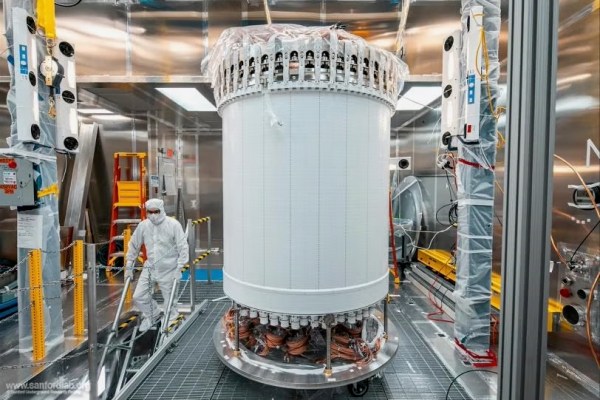
There’s more to the universe than meets the eye, according to information released by SLAC in Menlo Park today. Dark matter, the invisible substance that accounts for 85 percent of the mass in the universe, is hiding all around us — and figuring out exactly what it is remains one of the biggest questions about how our world works.
The newest results from LUX-ZEPLIN (LZ) extend the experiment’s search for low-mass dark matter and set world-leading limits on one of the prime dark matter candidates: weakly interacting massive particles, or WIMPs. They also mark the first time LZ has picked up signals from neutrinos from the sun, a milestone in sensitivity.
Key takeaways:
The LZ collaboration expanded their search for low-mass WIMPs (weakly interacting massive particles) using the world’s most sensitive dark matter detector, narrowing down what dark matter particles might look like.
Precise calibration and an improved understanding of their detector let LZ scientists observe a neutrino signal from the sun that can mimic dark matter interactions, marking the detector’s first glimpse of the “neutrino fog.”
LZ found the strongest evidence of boron-8 solar neutrinos interacting with xenon atoms through a rare process called “CEvNS,” building on hints from other experiments.
LZ is an international collaboration of 250 scientists and engineers from 37 institutions. The experiment is managed by the Department of Energy’s Lawrence Berkeley National Laboratory (Berkeley Lab) and operates nearly one mile below ground at the Sanford Underground Research Facility (SURF) in South Dakota.
Researchers at the Department of Energy’s SLAC National Accelerator Laboratory in Menlo Park play an instrumental role in operating the LZ experiment and analyzing the data collected to look for evidence of dark matter interactions. SLAC carried out a broad range of early hardware development, detector construction, detector and background modeling, online and offline system development, and xenon purification for the project. Today, SLAC is leading pre-project development for the United States’ scope of the international next-generation experiment, known as XLZD.
“It feels very rewarding to see this new result, knowing how many SLAC personnel contributed to the construction and commissioning of LZ, maintaining detector operations, ensuring continuous data flow and co-leading this very analysis,” said Tomasz Biesiadzinski, SLAC associate staff scientist and LZ detector operations manager. “I look forward to seeing what LZ delivers next.”
Photo of The LUX-ZEPLIN main detector in a surface lab before installation underground. Credit:Matthew Kapust/Sanford Underground Research Facility