
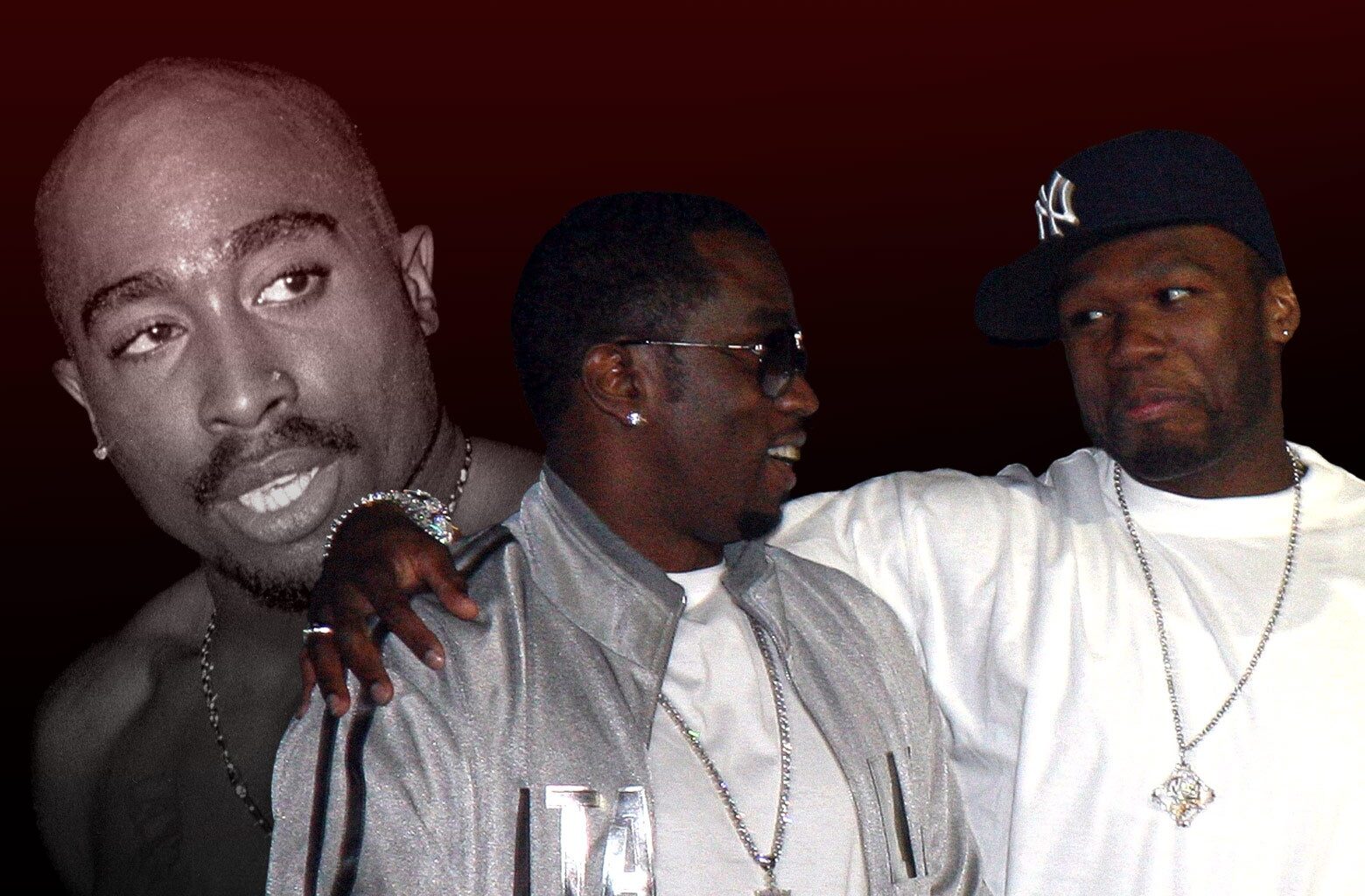
It has been two months since Sean “Diddy” Combs was sentenced to four years in prison as a result of his landmark federal racketeering case. The hip-hop mogul was cleared of the more serious charges of racketeering and sex trafficking, and only found guilty of the lesser charge of transportation to engage in prostitution—a more lenient verdict than some expected, all things considered. But that didn’t stop one of Combs’ longtime rivals, rapper 50 Cent, from going ahead with his previously announced plans to executive produce a documentary chronicling Combs’ alleged misdeeds. Last week, that docuseries—Sean Combs: The Reckoning—arrived on Netflix, where it rocketed to the No. 1 television slot on the platform.
The series aims to cover a lot of ground in four hourlong episodes, going over the recent sexual assault allegations against the entrepreneur (which are still mounting in filed civil suits that currently tally over 70) as well as various prominent questions of his past, like, What, if any, is his alleged involvement in the murder of beloved rapper Tupac? Netflix has certainly promised a number of bombshells in the docuseries detailing Combs’ rise to prominence in the industry—but whether the streaming platform delivers on those promises is another matter. Here’s a breakdown of what to know from Sean Combs: The Reckoning.
Since this release is timed after Diddy’s case, I imagine it’s mostly focused on the allegations of sexual assault and domestic violence?
No, actually. The first two episodes are about Combs’ rise to fame and power as a music industry leader, chronicling his upbringing, how he got into the industry, the creation of his label, Bad Boy Entertainment, and, of course, the infamous East Coast–West Coast/Tupac vs. Biggie feud of the ’90s. The last two episodes focus more on his noted rumored history of abuse, whether that’s the alleged financial exploitation of his former business partners and signed artists or the proclaimed professional and sexual exploitation of his protégés, starlets, and romantic partners.
The most shocking parts of the documentary are actually the earlier segments, which detail stories about his rise as a major record executive and the coastal hip-hop feud, and which include never-before-seen pretrial footage of Combs.
Wait, what?! What “pretrial footage”?
Apparently, Combs hired a videographer to follow him while he was in New York City and chronicle the time leading up to his eventual arrest, which happened in Manhattan on Sept. 16, 2024. The docuseries opens up with footage of Combs in NYC days before his eventual arrest, on the phone with his lawyer, Marc Agnifilo. In the video, Combs is explaining to Agnifilo that, due to Combs’ tanking public perception, he needs someone who has a successful track record in propaganda to help his image, aware that the public is full of “possible jurors.” “We have to find somebody that will work with us,” he says. “It could be somebody that has dealt in the dirtiest of dirtiest dirty business of media and propaganda.”
Other footage from this time period is peppered throughout the docuseries, showing Combs agreeing to take photos with people coming up to him on the street (who happen to all be men). In another clip, Combs remarks that he needs hand sanitizer and a bath after coming into contact with so many people, saying “That’s what I have to do … It’s like 150 hugs, you feel me? We gotta be realistic about what’s going on out here, it’s time to cleanse.” In another snippet, Combs asks if they should hire an editor to splice together clips of Dawn Richard—a former member of his groups Danity Kane and Diddy–Dirty Money, who has filed a civil suit against him alleging crimes of sexual assault, battery, harsh working conditions, and inadequate pay—where she “speaks positively about her relationship with Diddy.”
Combs having a videographer follow him around right before his arrest while he’s making plays for his upcoming legal battle sure is … presumptuous.
And now it’s also a legal matter, as Combs’ lawyers have sent Netflix a cease and desist regarding the footage. A spokesperson for Combs has stated that the footage was “never authorized for release,” adding: “As Netflix and CEO Ted Sarandos know, Mr. Combs has been amassing footage since he was 19 to tell his own story, in his own way. It is fundamentally unfair, and illegal, for Netflix to misappropriate that work.”
Netflix has released their own statement in response, maintaining that “the footage of Combs leading up to his indictment and arrest were legally obtained. This is not a hit piece or an act of retribution.” The docuseries’ director, Alexandria Stapleton, has said of the footage: “It came to us, we obtained the footage legally and have the necessary rights. We moved heaven and earth to keep the filmmaker’s identity confidential.” (As for how this may have come to be, a former publicist of Diddy’s claimed that the mogul never signed a contract with the videographer behind the footage, nor paid them, resulting in such an outcome.)
Netflix also addressed claims by Combs’ team that having 50 Cent, whose real name is Curtis Jackson, involved in the docuseries is unfair and prejudiced, given Jackson’s yearslong public dislike of Combs. To this, Netflix clarified that “Curtis Jackson is an executive producer but does not have creative control. No one was paid to participate.”
Oh, wow. I’m seeing a lot of headlines and social media posts about Diddy’s supposed involvement in the Tupac murder, which comes up in the earlier episodes of the doc. Does the series actually prove that Diddy had a hand in Tupac’s murder?
Not necessarily—but it does shed new, eye-opening light on the situation. The docuseries plays audio of the proffer interview that Duane “Keefe D” Davis, who is currently awaiting trial for the 1996 murder of the famous West Coast rapper, had with law enforcement in 2008. A proffer is a legal arrangement wherein a person is allowed to provide information to law enforcement with the understanding that anything self-incriminating said in the proffer cannot be used against them. It’s not full immunity, but a particular legal arrangement often made for leniency, like a lighter sentence or reduced charge. In Sean Combs: The Reckoning, the audio of Davis’ proffer finds the man telling a story, in great detail, about how Combs allegedly arranged for the murder of Tupac for $1 million.
Is it unequivocal proof that he actually did? Well, no. If accepted, first of all, this interview would be testimony, and testimony alone does not inherently prove guilt or innocence or win cases. But does this audio provide a more detailed peek into one of culture’s largest mysteries? While the information itself isn’t necessarily new to the public, the audio just may be, and it does flesh out the whole sordid affair. (It’s worth noting, however, that, per the documentary, Davis is now saying that the proffer was made under duress.)
What I found more surprising, though, are the allegations from Kirk Burrowes, a co-founder of Diddy’s record label Bad Boy Entertainment. Burrowes—who filed a breach of contract suit against Combs in 2006 and a legal complaint against Combs for sexual abuse, coercion, and violence in 2025—claims in the documentary that Combs is also indirectly to blame for the 1997 murder of Biggie Smalls. According to Burrowes, Biggie—who was in L.A. when he was killed—was supposed to fly to Europe on the day of his murder. Burrowes alleges that Biggie was uncomfortable being on the West Coast after Tupac’s death had ratcheted up the coastal-feud tensions, but Combs forced him to stay because he liked gloating and wanted to party on the West Coast. Because of this choice, Burrowes claims that Combs “ushered Biggie to his death.”
What else does the doc have to say about the earlier days of Combs’ prominence?
It chronicles his relationship with his mother, his earlier romances (which, many interviewees note, were colored by abuse), and testimonies pertaining to his psyche and thought process as he climbed the ranks within the industry. The docuseries does a convincing job of drawing a connected trail of Combs’ history of being involved in legally fraught or reputation-ruining situations, even while somehow making it out unscathed (and uncuffed). For example, the earlier episodes go over Combs’ connection to the fatal City College charity basketball game of 1991, a 1999 club shooting that Combs was present for, and more.
Does the doc drop any big bombs about his recent legal matters or latest assault allegations?
Not really. The docuseries does provide talking-head interviews from people who were in Combs’ orbit over the years, including some who formerly worked for him, like Capricorn Clark, who testified in the federal trial—or people who are mentioned in the lawsuits, like Aubrey O’Day and Kalenna Harper, two former musicians who worked with him as part of the groups Danity Kane and Diddy–Dirty Money, respectively. Mostly, Sean Combs: The Reckoning works through allegations against Combs that have already been made public in recent lawsuit filings. But, even though we might have been aware of these stories, they have never been told on camera by the people they most concern.
Take, for example, a truly heartbreaking response from O’Day, who reads a section of an affidavit from an unnamed woman that details a sexual assault against O’Day, by Combs and another man, while the singer was intoxicated. O’Day says that she doesn’t remember the incident, adding, “Does this mean I was raped? Is that what this means? I don’t even know if I was raped and I don’t want to know.” O’Day goes on to express her frustration, saying, “You realize the burden that that puts on my soul for the past year, which is, if I expose one person who’s got a civil lawsuit, that gives Diddy and his legal team credit to take down everybody else as potential liars.” Even figures who eventually said they didn’t see any improper activity on their part, like Harper—who is mostly involved because of the allegations against Diddy filed by her former bandmate, Dawn Richard—still detail in the docuseries the way Combs might have treated them unfairly financially, or hounded them for support when the lawsuits first started pouring in. We also get testimonies from Lil Rod, a producer who worked with Combs on his latest album and filed a lawsuit against him alleging many of the same infractions as the others, as well as footage the producer collected of his time working with Combs.

Dana Stevens
It’s the Movie That Could Finally Get Adam Sandler His Oscar Nomination. It Left Me Teary.
Read More
Pertaining to Combs’ legal matters, the most revealing things the series includes are talking heads from two jurors of the federal case, who come on to explain how they came to their verdict. However, they’re not presenting any information that hasn’t already been extensively reported on from the trial—just their opinions on how it all went down.
OK, one last question that’s been gnawing at me. What the hell does any of this have to do with 50 Cent?
Combs and the half-dollar rapper have a long-standing beef. Though they were never friends, per se, Jackson and Combs worked together professionally a number of times. However, this relationship started to erode in the early 2000s with a number of small slights. For example, on the 2002 remix of a Biggie song, Jackson raps, “There’s no place like home, New York! New York!/ I run this city, I don’t dance around like Diddy.” Then, the two allegedly clashed over another artist, Mase, in 2005. According to Jackson, he was aiming to sign Mase, a Bad Boy artist, to his label, G-Unit, but the deal fell through because of what Jackson believed were “unreasonable” terms from Combs. Then, everything came crashing down when Jackson released a diss track in 2006, “The Bomb,” in which Jackson insinuates that Combs knew who was involved in Biggie’s murder. Over the years, Jackson has continued to incessantly troll Combs. They’ve also gone head-to-head in other ways, like both having brand deals with different vodka brands.
Netflix’s Hit Diddy Documentary Makes Some Outrageous Insinuations. Here’s What You Need to Know.
The 10 Best TV Shows of 2025
In 2023, after a handful of the earlier civil suits against Combs were filed, Jackson announced that his production company, G-Unit Film & Television, would be releasing a documentary about Combs and the alleged assaults. He added that proceeds of the docuseries would go to victims of sexual violence. (It is unclear how much Jackson may have profited off of this Netflix docuseries and if any money was donated to relevant causes or organizations.) When the news broke that federal agents were raiding Combs’ properties, Jackson took to X to quip: “Now it’s not Diddy do it, it’s Diddy done.”
While Jackson has drawn some criticism for what some perceive as more concern for getting one over on Combs than about Combs’ alleged victims, Jackson told ABC News’ Good Morning America: “If I didn’t say anything, you would interpret it as that hip-hop is fine with his behaviors. There’s no one else being vocal.”
This documentary certainly won’t be helping resolve their feud. According to another recent X post from Jackson, Combs sent the rapper flowers, presumably from prison. Was this bouquet a threat, as Jackson’s fans are fretting, or just a friendly floral arrangement? Knowing the history of the two entertainers’ beef, it’s far more likely to be the former.
Get the best of movies, TV, books, music, and more.