
Qihang LiuDepartment of Physics, Southern University of Science and Technology, Shenzhen, China
July 7, 2025• Physics 18, 127
A new symmetry-breaking scenario provides a comprehensive description of magnetic behavior associated with the anomalous Hall effect.
Q. Liu/ SUSTech; APS/Carin Cain
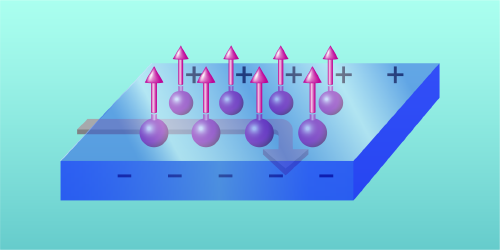
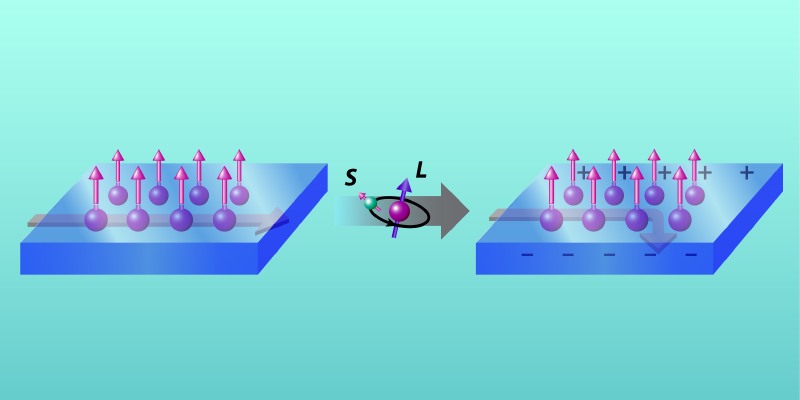
Figure 1: In a ferromagnetic metal where electron spins (S) do not interact with orbital motion (L), electrons flow without transverse deflection (left). The anomalous Hall effect emerges only when spin–orbit coupling—even if weak—is introduced (right). This reveals a new perspective: The anomalous Hall effect originates fundamentally from spin–group symmetry breaking driven by spin–orbit coupling.
Q. Liu/ SUSTech; APS/Carin Cain
Figure 1: In a ferromagnetic metal where electron spins (S) do not interact with orbital motion (L), electrons flow without transverse deflection (left). The anomalous Hall effect emerges only when spin–orbit coupling—even if weak—is introduced (right). This reveals a new perspective: The anomalous Hall effect originates fundamentally from spin–group symmetry breaking driven by spin–orbit coupling.×
In 1879 Edwin Hall discovered that a flat conductor carrying current, when placed in a magnetic field, will develop a transverse voltage caused by the deflection of charge carriers. Two years later he discovered that the same effect arises in ferromagnets even without an applied magnetic field. Dubbed the anomalous Hall effect (AHE), that phenomenon, alongside the ordinary Hall effect, not only catalyzed the rise of semiconductor physics and solid-state electronics but also laid the groundwork for a revolutionary convergence of topology and condensed-matter physics a century after Hall’s discoveries. Recent experiments, however, have uncovered behavior that cannot be explained with current theories for the AHE. Now Zheng Liu of the University of Science and Technology of China and his colleagues have proposed a new interpretation of the AHE based on a new type of symmetry-breaking scenario triggered by spin–orbit coupling (SOC)—that is, the coupling of an electron’s spin to its orbital motion [1]. By treating SOC as a perturbation and expanding it in a series, they provide a comprehensive description of the AHE that solves some of the limitations of current theoretical approaches.
The conventional understanding of the AHE has centered on the time-reversal symmetry breaking caused by magnetization. When spins are aligned, reversing time flips the direction of the Hall voltage. Consequently, the Hall resistivity was naturally expressed through a linear dependence on magnetization in which the Hall current is deflected in a plane perpendicular to the magnetization direction.
However, recent AHE studies have revealed that this traditional picture is insufficient. For instance, the AHE can persist even when the plane of Hall deflection is parallel to the magnetization, and the Hall resistivity often shows complex nonlinear behavior [2]. Also, some antiferromagnets with zero net magnetization have been found to exhibit a significant AHE, a behavior that the conventional theory cannot explain [3]. These findings raise a fundamental question: What could provide a complete and accurate understanding of the AHE in terms of magnetic ordering? From a theorist’s point of view, the large energy scale associated with magnetization (typically on the order of electron volts) makes higher-order effects challenging to accommodate within perturbation-based frameworks. These limitations challenge the time-reversal-breaking paradigm and create an opportunity for a new theoretical foundation.
The groundwork for a deeper understanding of the AHE emerged when physicists began considering the role of SOC in charge carriers. These studies progressively incorporated the pivotal concept of the Berry phase, revealing that the AHE in collinear magnets, such as ferromagnets and antiferromagnets, stems from both magnetic moments and, crucially, from SOC effects [4]. More importantly, SOC is typically much weaker than magnetic exchange, which makes it more amenable to perturbative approaches. In their recent work, Liu and colleagues propose a new perspective. Instead of viewing the AHE solely as a consequence of time-reversal symmetry breaking by magnetization, they reinterpreted it as a phenomenon driven by symmetry breaking due to SOC.
What symmetry does SOC break in a magnetic system? To answer, one must consider the symmetry of the magnetic system without SOC. While magnetic group theory has been the standard for describing magnetic materials, deeper investigations revealed that a more comprehensive space or symmetry group is needed to fully characterize their geometry and physics—namely, the spin group [5]. The group arises from the intrinsic nature of local magnetic moments. Beyond simple flipping, spins possess the vector property of rotation. Consequently, symmetries in spin space can exist independently of lattice symmetries when SOC is negligible [6]. A key example is the paramagnetic-to-ferromagnetic phase transition, which corresponds to the breaking of spin-rotation symmetry. Although the concept of spin groups emerged more than half a century ago, its mathematical theory has been fully developed only recently, enabling the classification of magnetic structures and the understanding of their physical properties [7].
In collinear and coplanar magnetic structures without SOC, time-reversal symmetry is broken. But a combined symmetry—time reversal followed by a 180° spin rotation (an effective time reversal within the spin group)—can forbid phenomena like orbital magnetization and the AHE. The incorporation of spin-group operations reveals that the anisotropy of the AHE with respect to the magnetic structure originates precisely from spin-group symmetry breaking. Liu and his collaborators leveraged the specific structure of spin groups in collinear ferromagnets to analyze the AHE in detail, formulating a more complete multipolar expansion law to replace the traditional linear empirical formula.
The dipolar part of this new law successfully explains the in-plane AHE observed in low-symmetry materials, where a charge current induces a transverse Hall voltage parallel to the magnetization direction. Furthermore, the nonlinear characteristics inherent in the higher-order multipolar terms predict that the in-plane AHE can be widespread in magnets. Significantly, recent experiments have directly observed the in-plane AHE in common ferromagnets like iron and nickel [8], providing strong experimental validation for the theory.
Symmetry and its breaking are core themes in physics. The spin group, representing the SOC-free Hamiltonian, offers a powerful new lens to study various SOC effects and to disentangle the contributions to material properties of magnetic exchange interactions and SOC. The work of Liu and his collaborators provides a comprehensive understanding of the venerable AHE phenomenon: the fundamental scheme of symmetry-breaking transitions not from a space group to a magnetic group but from a spin group to a magnetic group. In the future, the theory will also be applicable to the nonlinear Hall effect, the spin Hall effect, and other transport phenomena.
Over the past decade, researchers have gradually discovered that many spin-related phenomena can be induced by local magnetic moments without requiring SOC. A prominent example is offered by the recently discovered altermagnets, where collinear magnetic order combined with specific crystal fields induces spin splitting—a phenomenon also described within the spin-group framework [9]. Beyond spin splitting, magnetic order itself can generate quantum geometric effects that manifest in various linear and nonlinear transport phenomena [10].
Although Liu and his collaborators primarily discuss ferromagnetic materials, a similar understanding of the AHE can be directly extended to altermagnets, noncollinear magnets, and so on. A broad pathway has now been laid for exploring emergent quantum phenomena in magnetic materials through the lens of spin-group symmetry.
ReferencesZ. Liu et al., “Multipolar anisotropy in anomalous Hall effect from spin-group symmetry breaking,” Phys. Rev. X 15, 031006 (2025).J. Zhou et al., “Heterodimensional superlattice with in-plane anomalous Hall effect,” Nature 609, 46 (2022).S. Nakatsuji et al., “Large anomalous Hall effect in a non-collinear antiferromagnet at room temperature,” Nature 527, 212 (2015).D. Xiao et al., “Berry phase effects on electronic properties,” Rev. Mod. Phys. 82, 1959 (2010); N. Nagaosa et al., “Anomalous Hall effect,” 82, 1539 (2010).W. Brinkman and R. J. Elliott, “Space group theory for spin waves,” J. Appl. Phys. 37, 1457 (1966); D. B. Litvin, “Spin point groups,” Acta Crystallogr., Sect. A 33, 279 (1977).P. Liu et al., “Spin-group symmetry in magnetic materials with negligible spin-orbit coupling,” Phys. Rev. X 12, 021016 (2022).X. Chen et al., “Enumeration and representation theory of spin space groups,” Phys. Rev. X 14, 031038 (2024); Y. Jiang et al., “Enumeration of spin-space groups: Toward a complete description of symmetries of magnetic orders,” 14, 031039 (2024); Z. Xiao et al., “Spin space groups: Full classification and applications,” 14, 031037 (2024); X. Chen et al., “Unconventional magnons in collinear magnets dictated by spin space groups,” Nature 640, 349 (2025).W. Peng et al., “Observation of the in-plane anomalous Hall effect induced by octupole in magnetization space,” arXiv:2402.15741.L. Šmejkal et al., “Beyond conventional ferromagnetism and antiferromagnetism: A phase with nonrelativistic spin and crystal rotation symmetry,” Phys. Rev. X 12, 031042 (2022).H. Zhu et al., “Magnetic geometry induced quantum geometry and nonlinear transports,” Nat. Commun. 16, 4882 (2025).About the Author
Qihang Liu is a professor of physics at Southern University of Science and Technology in China. He obtained his bachelor’s degree and PhD from Peking University. After graduation, he worked as a postdoctoral researcher at Northwestern University in Illinois and as a research associate at the University of Colorado Boulder. He is engaged in computational condensed-matter physics, with a recent focus on new theories and effects of symmetry in quantum materials within the fields of spintronics and topological physics.
Subject AreasRelated Articles
 More Articles