
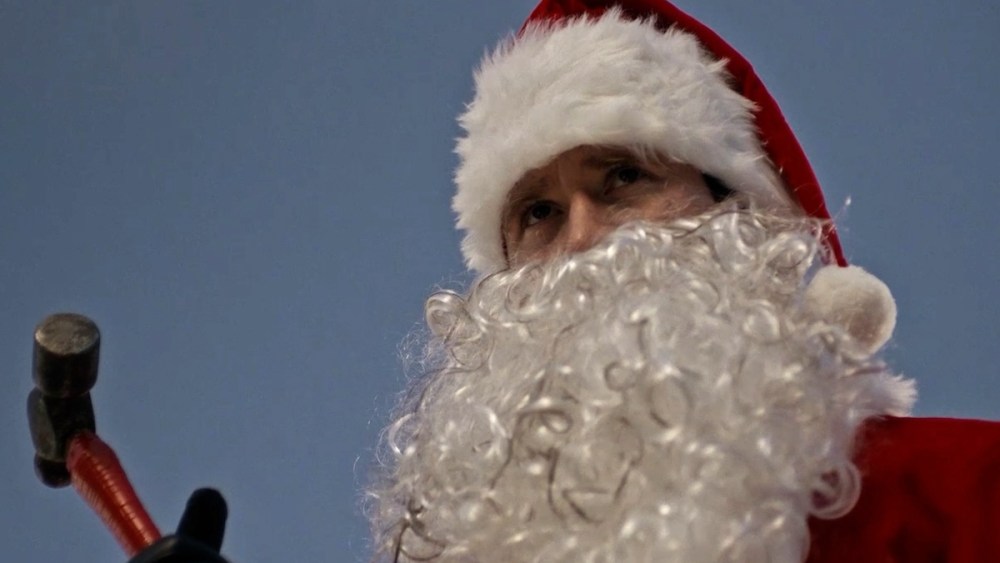
The ranks of Christmas-themed horror movies swell further every year, digested with relish by genre fans and cheerfully ignored by everyone else. But in 1984, a menace to Yuletide morality yea more dire than Starbucks holiday cups stirred vociferous objections. Charles E. Sellier Jr.’s low-budget “Silent Night, Deadly Night” opened the same day as “A Nightmare on Elm Street,” initially outgrossing that now-classic. TV ads were decried for frightening innocent children; Siskel & Ebert demonstrated rare unity in condemning the whole enterprise; there were public protests. The backlash was such that soon it was withdrawn from theatrical release — though that didn’t curb eventual popularity on home formats.
Such was this somewhat amateurish psycho chiller’s impact that it sustained four mostly direct-to-video sequels over the next seven years, including one directed by cult auteur Monte Hellman and another starring Mickey Rooney. An official 2012 remake, “Silent Night,” had almost no connection to the original beyond a Santa-suited killer. Now we have a new reboot titled “Silent Night, Deadly Night” again. Hewing closer to the 1984 template, it’s an improvement on that film — not a particular high bar to reach — though a somewhat mixed bag overall.
Billy Chapman is again introduced as a child (Logan Sawyer) visiting his senile grandpa in a rest home. This proves upsetting, though not nearly so much as the ride home, when Billy’s parents are shot to death by a random Santa-costumed assailant who tailgates them. Years later, Billy is a disturbed young man (Rohan Campbell) who hears the voice of an “imaginary friend” and sees dead people … some of whom he’s just killed, as per the voice’s instructions. He’s a transient loner drifting from town to town, one step ahead of police, steered by that inner guide (Mark Acheson). “Charlie” holds him to their annual task of filling an Advent calendar with bloody thumbprints after each murder in the 24 days leading up to Christmas.
This particular Dec. 20th finds Billy fleeing the site of one slaughter, landing in Hackett, Minn. There, he gets a job at Ida’s Trinket Tree, a festive knick-knack store whose namesake founder is deceased. It’s now run by her amiable widower Dean Sims (David Laurence Brown) and his daughter Pamela (Ruby Modine). Billy is attracted to Pam, though she is volatile. Her outward temper flares as easily as his inner one, which often compels him to stalk and terminate supposed “bad people.”
The first unfortunate local he now chooses for that fate is an older customer (Tom Young) who incites jealousy by seeming to flirt with Pamela, though he otherwise doesn’t seem “bad” at all. Never mind: Out comes Billy’s ax. Later our hero dislikes a loud woman at a hockey rink, then greatly expands his kill count upon discovering she’s an actual Nazi — tracked down among others of that ilk at a “3rd Annual ‘I’m Dreaming of a White Power Christmas’ Party.” It’s a busy night for that ax.
Though Nelson departs from the original film’s storyline after the prologue, this “Silent Night, Deadly Night” works well enough to a point. It sports an uptick in craftsmanship, and a welcome absence of the 1984 edition’s dumb sexploitation, in which women inevitably found themselves running while topless. Also not missed are the crass laughs of the slicker 2012 film, which had an unpleasantly cynical, snide edge. Campbell’s protagonist isn’t so different from his misfit in “Halloween Ends”; fortunately, Billy does belong at the center of this story (in that abysmal franchise-snuffer, his character felt like an ill-advised distraction from the ones we really wanted to see, i.e. Jamie Lee Curtis’ heroine and maniac Michael Myers).
But this latest incarnation of a series that’s now spanned five decades gets a bit lost in the end, piling on too many ideas it hasn’t developed. There’s the basic one of Billy extinguishing lives to fulfill his pact with “Charlie,” whom we initially assume is a schizophrenic delusion. Then we realize “Charlie” knows things (like how to get to victims’ houses) that Billy couldn’t, and eventually it appears there is some kind of occult spirit-transference going on. Wholly separate is the issue of kids going missing in the region, taken by a “snatcher” whose lair Billy and Pamela uncover at the darkly lit climax. This is immediately preceded by a flashback-cluttered confession of prior wrongdoings between them, something so shoehorned-in it seems to exist just to provide more body-count violence for the trailer.
When we find out who the “snatcher” perp is, it hardly registers. Likewise, “Charlie’s” original identity is murky at best. Adding to the pileup of bad guys is Pamela’s ex-boyfriend Max (David Tomlinson), a cop who skulks around suggesting more menace than he gets to deliver. How many serial killers is too many for a plot to bear? Nelson’s screenplay might have had fun with that excess. Instead, it comes off as confused miscalculation, as if he had ideas for several “Silent” installments, then belatedly decided to cram them all into one awkward package.
Still, it’s all pacey and colorful enough, with sufficient gore to please genre fans after a couple of relatively restrained early deaths. (Each demise is preceded by a crimson onscreen chapter title, as in “Kill Foster Mom.”) The Manitoba-shot production has nice widescreen photography by Nick Junkersfeld, resourceful design contributions and an effective score by the collaborative trio Blitz//Berlin. In a welcome shift from the de rigueur inclusion of clips from the original “Night of the Living Dead” or “Carnival of Souls,” this horror exercise instead features another public-domain fave: 1964 camp classic “Santa Claus Conquers the Martians,” glimpsed on a TV screen in one sequence.