

If you’ve been near Madison’s lakes in the last week or so, chances are, you’ve heard an loud screeching noise coming from the water. The culprit: hundreds of swans.
Each November and December, two swan species pass through Madison during their fall migration from the Alaskan and Canadian Arctic to Chesapeake Bay and the mid-Atlantic Coast. The length of their stay on Lake Mendota and Lake Monona depends on weather conditions and can range from days to weeks, according to Stanley Temple, the Beers-Bascom Professor Emeritus in Conservation at the University of Wisconsin-Madison.

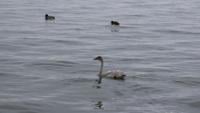
A swan glides on Lake Mendota by Tenney Park.
Photo by Lily Spanbauer
As they travel, the swans make distinct vocalizations to defend territory, signal threats or communicate with family members, according to Sumner Matteson, a Madison-based avian ecologist. The two types of swans, trumpeter and tundra, each make distinct calls. Tundra swans, the more common of the two, have a high-pitched whistling call. Trumpeter swans, which were recently reintroduced to the Midwest through a recovery program, have a distinct trumpet-like call (hence the name).
To catch a glimpse of the swan swarm, Temple recommends Tenney Park or the Lakeshore Nature Preserve.

The Lakeshore Nature Preserve is one of the best places to catch a glimpse of the migrating swans.
Photo by Lily Spanbauer
More than witnessing the absurdity of hundreds of loud swans in Madison’s lakes, Matteson says that seeing the birds can serve as an important reminder.
“They [the swans] are an integral part of our natural heritage and a constant reminder to conserve our precious natural resources that contribute to the amazing biodiversity we are blessed to experience,” Matteson says.
Lily Spanbauer is an editorial intern at Madison Magazine.
COPYRIGHT 2025 BY MADISON MAGAZINE. ALL RIGHTS RESERVED. THIS MATERIAL MAY NOT BE PUBLISHED, BROADCAST, REWRITTEN OR REDISTRIBUTED.