
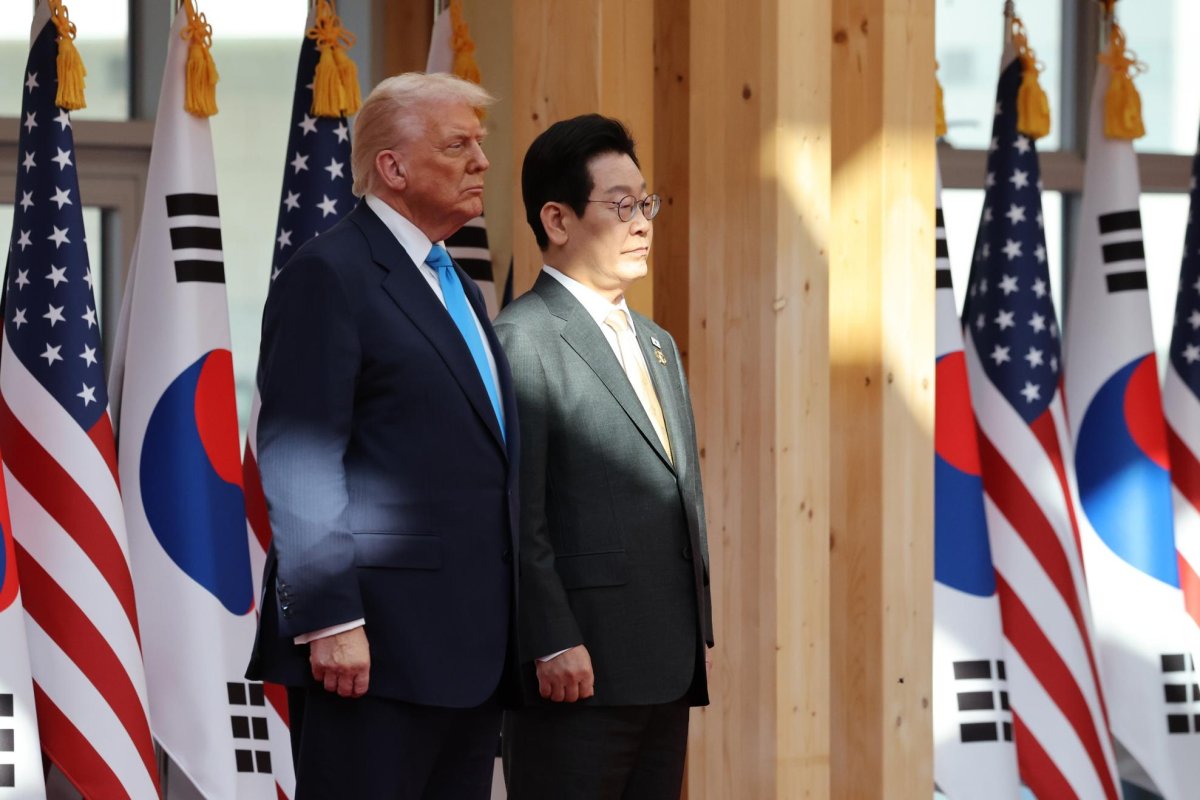
Washington has reaffirmed its commitment to providing extended deterrence to South Korea, officials said Friday. This Oct. 29 file photo shows U.S. President Donald Trump and South Korean President Lee Jae Myung at the APEC summit in Gyeongju. File Photo by Yonhap
The United States has reaffirmed its commitment to providing extended deterrence to South Korea during its first meeting of a key nuclear deterrence body with the South under U.S. President Donald Trump‘s second term, officials said Friday.
The allies held the fifth meeting of the Nuclear Consultative Group (NCG) in Washington on Thursday, according to Seoul’s defense ministry.
This week’s meeting was led by Kim Hong-cheol, the deputy minister for national defense policy, and Robert Soofer, acting deputy assistant secretary of defense in charge of nuclear deterrence, chemical and biological policy.
According to a joint press statement, Soofer reiterated the U.S. commitment to provide extended deterrence to South Korea, utilizing the full range of U.S. defense capabilities, including nuclear.
Kim stressed that South Korea will assume the “leading role” in the conventional defense of the Korean Peninsula.
The allies also “reviewed the progress on NCG workstreams and recognized the NCG as an enduring bilateral consultative body to strengthen the U.S.-ROK Alliance and enhance extended deterrence,” the statement showed. ROK is the acronym of South Korea’s official name, the Republic of Korea.
This week’s NCG meeting marked the first such talks since January and also the first under Trump’s second term.
The NCG was established as the outcome of a summit between former President Yoon Suk Yeol and former U.S. President Joe Biden in April 2023. The nuclear deterrence body was created in an effort to strengthen the credibility of the U.S. extended deterrence commitment to using the full range of its military capabilities, including nuclear, to defend South Korea.
As the NCG session had not been held for almost a year under Trump’s second term, speculation had arisen that the U.S. may review whether to maintain the NCG scheme or its commitment to extended deterrence to South Korea.
The joint statement, meanwhile, said both sides assessed NCG activities, including “conventional-nuclear integration” table-top exercises, help enhance the alliance’s cooperative decision-making for potential nuclear contingencies on the Korean Peninsula.
The allies also approved future plans and activities for the sixth NCG meeting to be held in the first half of 2026, it said.
Copyright (c) Yonhap News Agency exhibits its content from being redistributed or reprinted without consent, and forbids the content from being learned and used by artificial intelligence systems.