

This is a part of an occasional series looking at aspects of Colorado’s faltering economy.
As part of her job, Eve Lieberman talks to businesses across Colorado every day.
“One of the top challenges that they are facing right now is the uncertainty with regards to tariffs,” she said.
She’s executive director of the Colorado Office of Economic Development and International Trade. The state estimated that Colorado businesses have had tariff rates increase seven-fold, from 3 percent in 2024 to 21 percent 2025. And it’s having an impact.
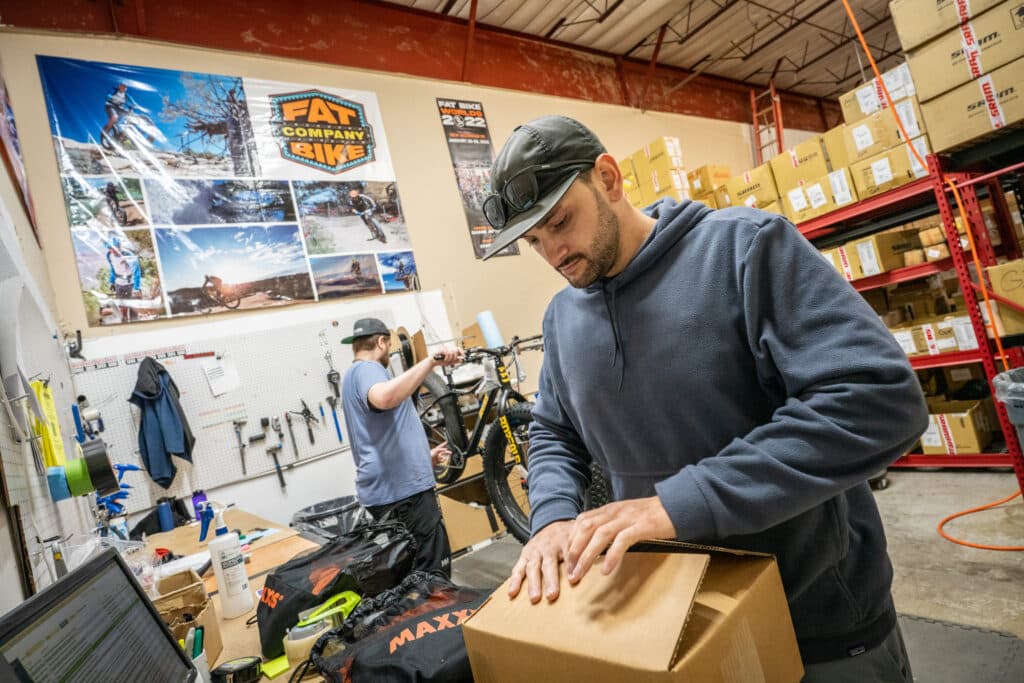 Hart Van Denburg/CPR NewsDavid Miller packs components to ship as Dakota Mossbrook assembles a bike at Borealis in Colorado Springs, April 15, 2025. Tariffs on components from China have put a big strain on Borealis.
“They are considering whether to raise prices, do they absorb those costs? Do they pass it on to consumers? What does that do in terms of their business model? Do they have to let go of certain employees? Do they have to reduce salaries?” she said.
Democratic Gov. Jared Polis was more blunt. “The very people building Colorado’s economy are paying more because of [President Donald Trump’s] misguided trade war.”
This is just one example of how federal policies made 2,000 miles away can impact local businesses and individuals and reverberate across the state economy. There are a lot of other federal policies and decisions — from taxes and regulations to federal job layoffs or cuts to social programs — that can help or hurt economic growth in Colorado.
The outlook for the state economy next year is pretty flat. The annual Colorado Business Economic Outlook for 2026 from the University of Colorado Boulder’s Leeds School of Business expects slow growth, including slow job growth.
“That is unusual for Colorado to have that slow of growth outside of a period when we are entering or exiting a recession,” said Brian Lewandowski, executive director of the Business Research Division at the school.
While state and local policies also factor in, there has been an unusual level of impact coming from federal policies.
There’s been a lot of focus on tariffs, but federal layoffs have impacted workers in the state, the government shutdown, the cuts in federal food aid like SNAP means less people buying food in the local grocery store, less government spending overall going to universities, labs, even agriculture and a drop in international tourism due to the Trump administration, just to name some.
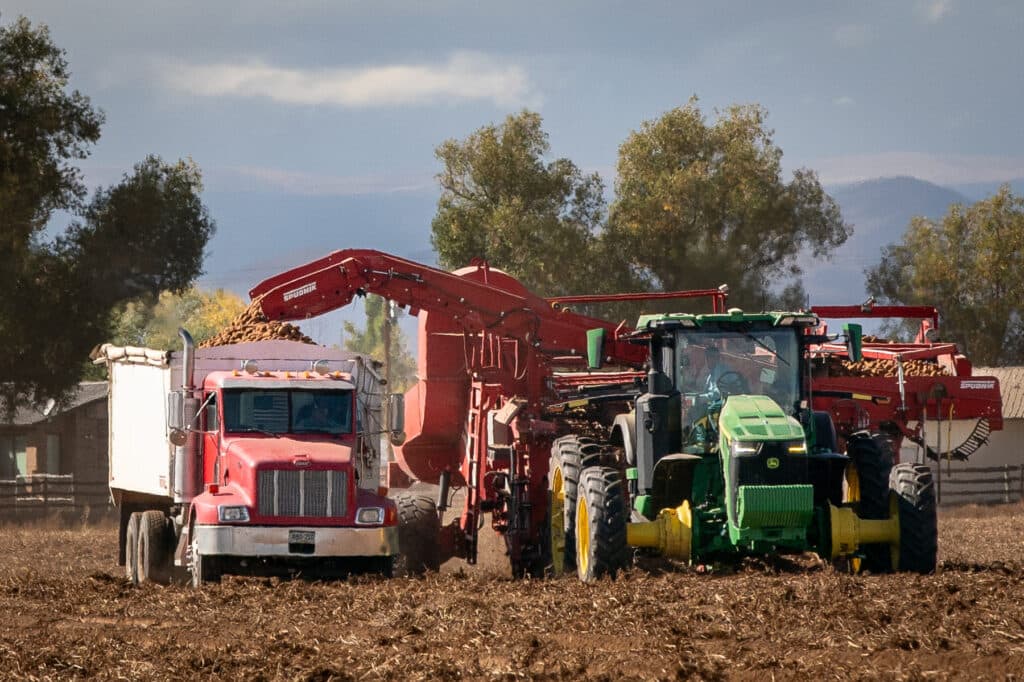 Hart Van Denburg/CPR NewsPotato harvest time on a farm between Monte Vista and Alamos in the San Luis Valley, Sept. 29, 2025. The valley is said to be the second-largest producer of potatoes in the United States.
But it’s not all doom and gloom. Lewandowski is hopeful the tax policies could help next year.
“It’ll lead to perhaps some more investment and some more income for households in Colorado. So, while we sort of view some of the policies as having a drag on the Colorado economy in the near term, I think there are some upsides that we are acknowledging as well,” he said.
And that’s something the White House is hoping people keep in mind. It’s not just one policy, but the totality of policies.
“The vast majority of businesses are better off under all of these policies jointly than they would have been otherwise had all of these policies not come into place,” Pierre Yared, acting chair of the Council of Economic Advisers for the Trump Administration, told CPR News.
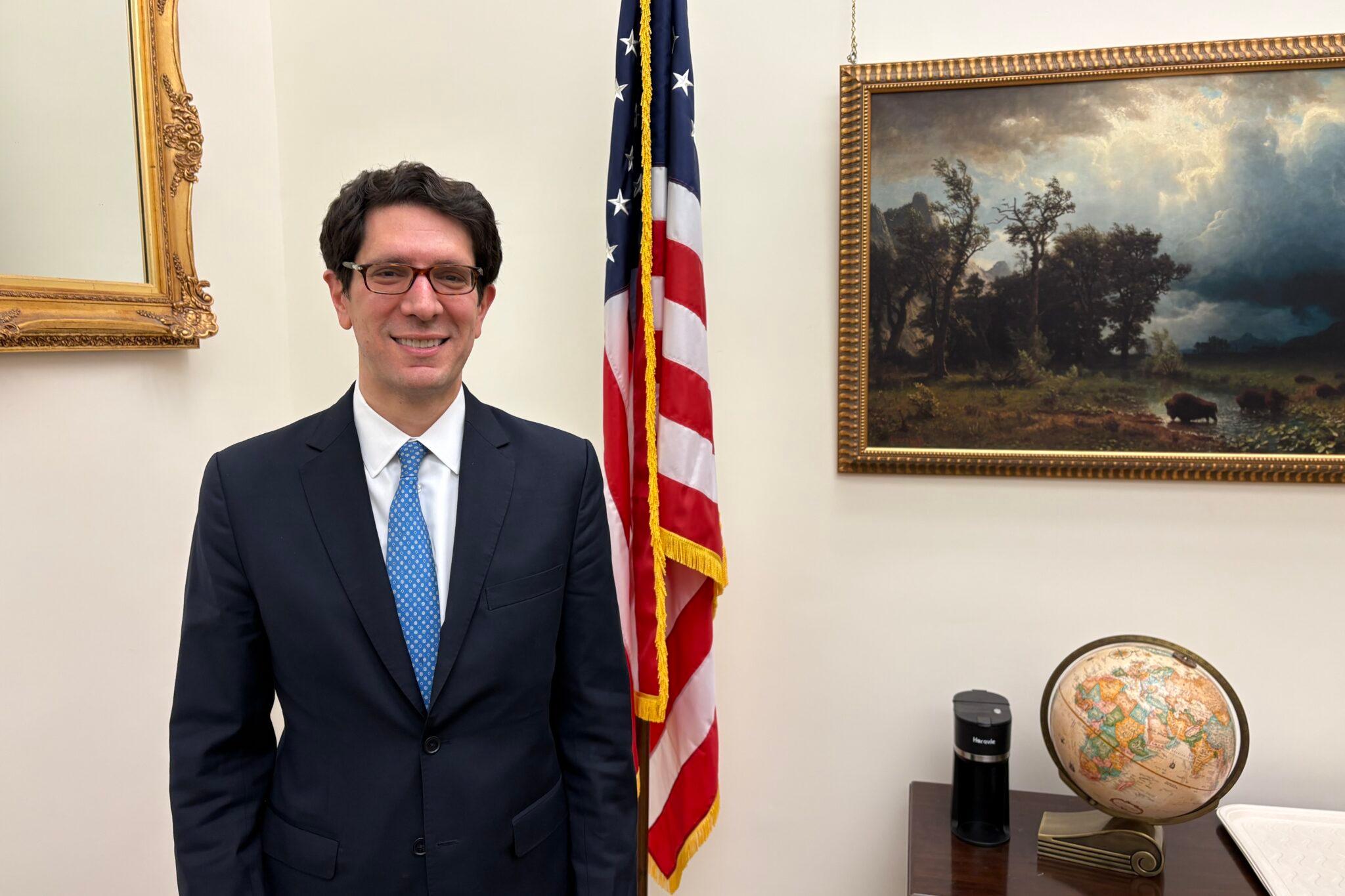 Caitlyn Kim/CPR NewsPierre Yared, acting director of the Council of Economic Advisers, is bullish that Trump’s economic policy will bolster the economy.
Yared is bullish about the U.S. economy. He said there are three main legs to Trump’s economic stool.
The first is the One Big Beautiful Bill (which many Republican members of Congress now call the Working Families Tax Cut), which Republicans believe will help put more money in people’s pockets. Think non tax on tips or not tax on overtime. Yared said 26 percent of Coloradans would benefit from the overtime tax break, while 4 percent of Colorado workers will benefit from the no tax on tips. (Both of these tax breaks are temporary and last through 2028.)
The second leg is focused on deregulation, which Yared said, “also reduces the costs of businesses, of making things. So that also makes it easier, that helps businesses flourish.”
And the last leg is tariffs. Yared argues it can protect businesses from unfair trading practices from other countries and provide incentives to look domestically for suppliers.
It’s all these together that Yared said, “is leading to an extreme optimism business, optimism, a lot of investment in the country. Some of that is being reflected in Colorado.”
 Kevin J. Beaty/CPR News
But that optimism isn’t necessarily translating down to the people.
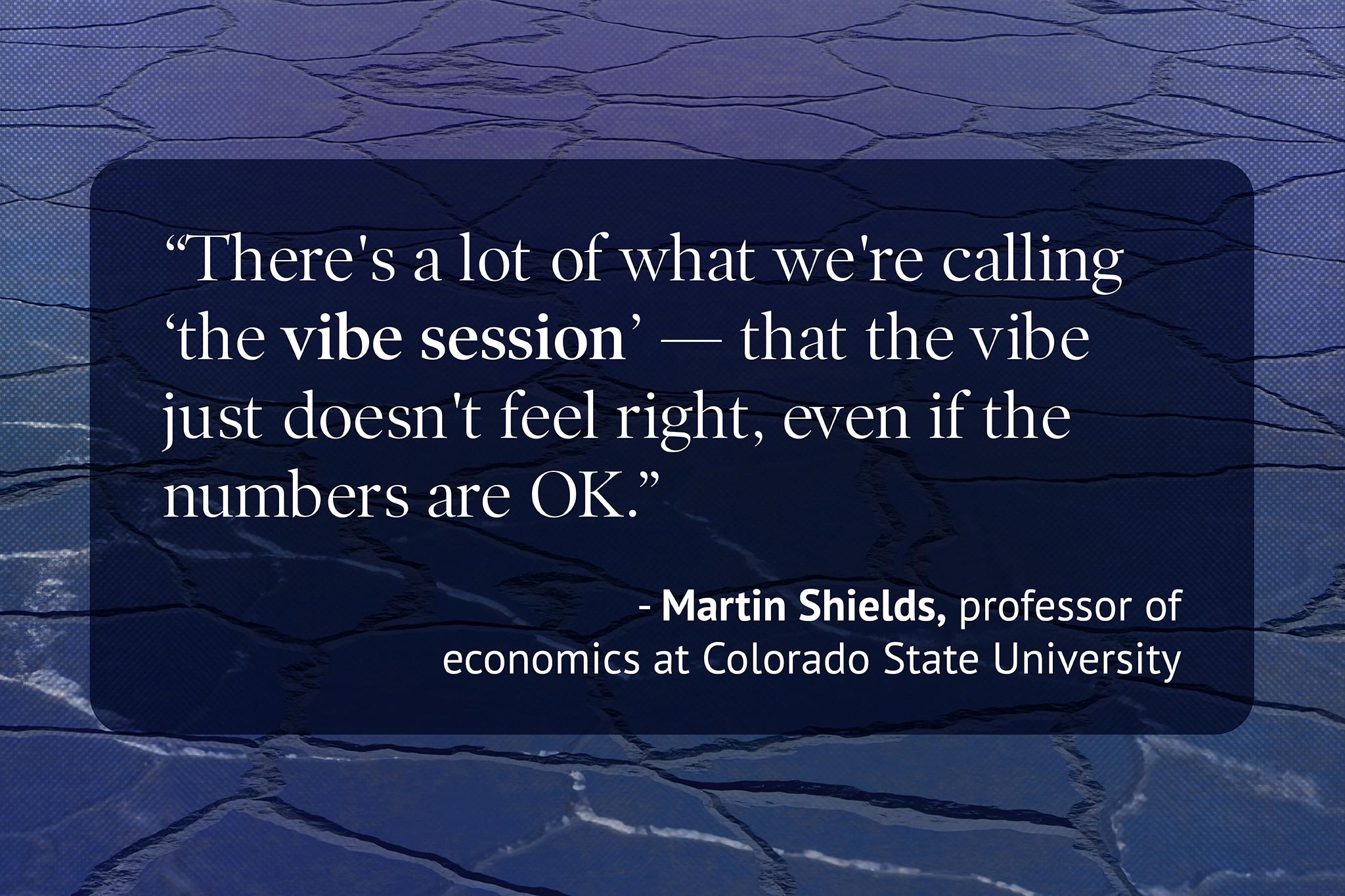
“I think that people are feeling the squeeze these days,” said Martin Shields, professor of Economics at Colorado State University. “There’s a lot of what we’re calling ‘the vibe session’ — that the vibe just doesn’t feel right, even if the numbers are OK. But in that context, there’s a lot of uncertainty and a lot of anxiety.”
That uncertainty and anxiety is reflected in recent polling, too. Last month, a Fox News poll found that 76 percent of respondents viewed economic conditions as either “not so good” or “poor.” The Colorado Polling Institute found that 46 percent think Colorado’s economy will get worse next year, with 43 percent saying it will stay about the same. Only 12 percent think it will get better.
Whenever there’s a change in administration or change in power in Washington, there will be a shift in policy priorities, leading to some uncertainty.
But Trump’s second administration has been going full force in reversing what it can from the Biden administration. For example, the clean energy economy. The Biden administration supported policies in this area, and the Trump administration reversed or stopped many of them.
“All these companies, like General Motors and Chrysler and Ford, are building out this new EV infrastructure investing billions of dollars in battery technology and research and development,” Shields said. “And now all of a sudden that’s all pulled out from under them..that’s a lot of money that was thrown away for no good reason.”
He noted some of the companies will go ahead, but “it certainly changes how businesses plan and sometimes makes previous investments irrelevant.”
“Just to go from one extreme to the other, that’s pretty chaotic at times,” Shields said.
A report from the think tank Energy Innovation said doing away with solar and wind tax credits in the One Big Beautiful Bill will cost the state $7 billion in economic activity and more than 9,500 jobs will be lost.
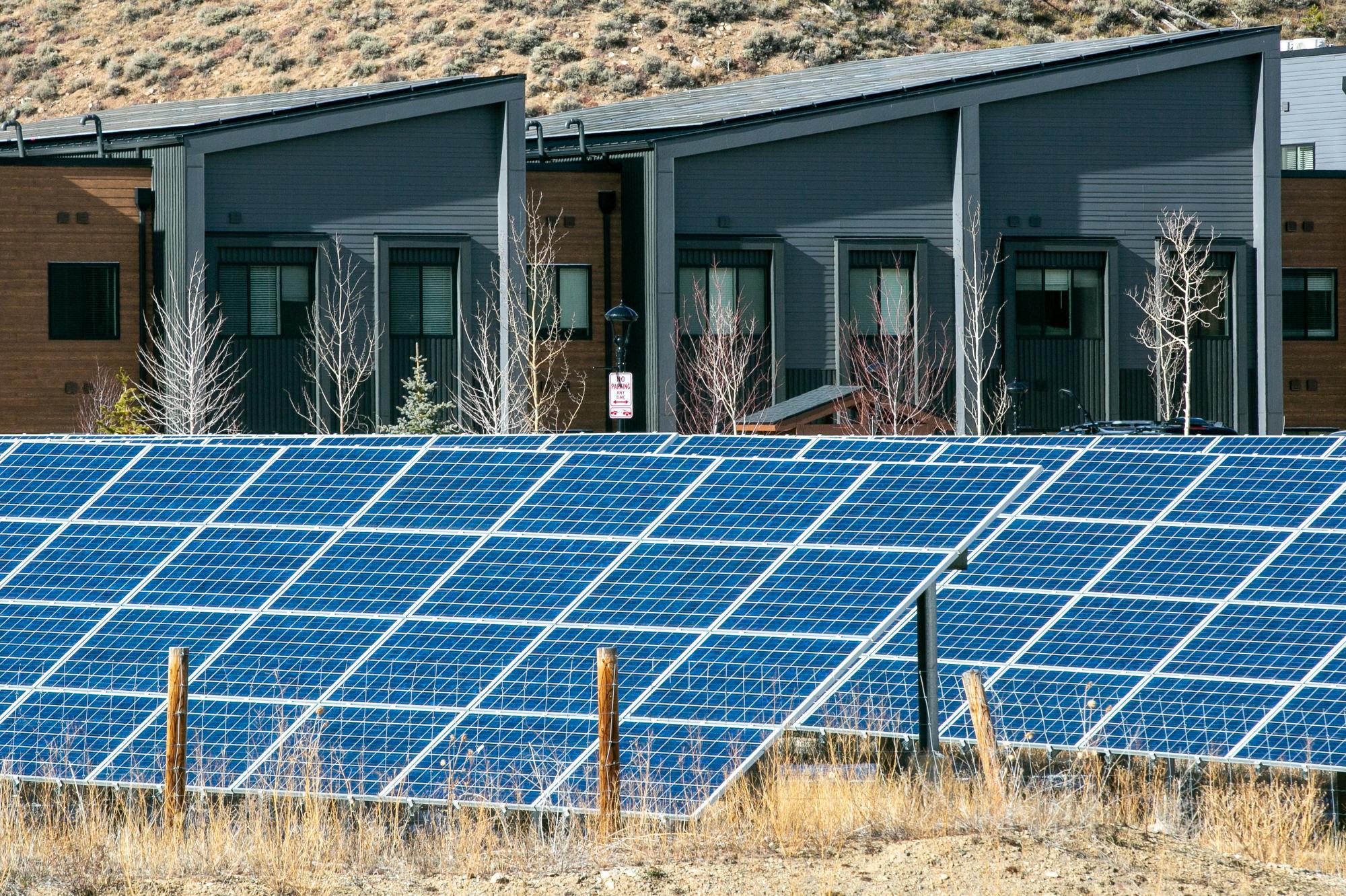 Hart Van Denburg/CPR NewsSolar energy panels in front, and on the roofs, of recently built homes in the Vista Verde neighborhood near Breckenridge, Nov. 28, 2025.
“The No. 1 thing that businesses and households want is certainty,” said Richard Wobbekind, senior economist at the Leeds School of Business at CU Boulder. “I think it’s an extremely important role for government.”
He said that when the government creates so much uncertainty, it can upset the macro economy. He’s not against change, like shrinking the size of government.
“You need to do them in a way that is well thought out, and in my opinion, phased in over time and doesn’t create disruptions that lead to the uncertainty equivalent…So to me, it’s a very important role to make the environment as certain as possible.”
And with no agreement on extending a subsidy for people who buy health insurance on the marketplace, there’s more uncertainty heading into next year for people around health care.
Democratic Sen. Michael Bennet agrees. He sits on the Senate Finance committee, which focuses on tax and trade policies, as well as entitlement programs like Social Security and Medicaid.
For him Trump’s tariff policies are illustrative “of something that you can’t plan for, you can’t make good decisions about.”
“If you’re a farmer or a rancher or a small business owner in Colorado, you deserve to know why the president makes the decisions he makes. And you deserve to be able to predict, at least with some degree of confidence, what the next six months is going to bring,” Bennet said. “And what I found is so different about President Trump’s approach is that hour to hour, nobody can predict what he’s going to do.”
Bennet also said this is not an Democratic or a Republican problem or an issue, nor an issue of federal versus state policies.
“We have to bring the American Dream back to America and to Colorado. And it’s going to take Republicans and Democrats working together. And it’s going to have to last beyond just one majority in the Congress or one governor’s term in office,” he said.

Colorado’s economy is flashing warning signs. Job growth has slowed to a trickle. Layoffs are inching up. The housing market is in a slump. Both the state and its biggest population center are struggling to plug massive budget holes. On top of all that, the longest government shutdown in history was weighing on the economy.
The big question, though, is whether all the bleak data points to something more serious: recession. And the answer is complicated.
Colorado Public Radio takes a look at what those warning signs might mean through the new series Silent Recession. Read more stories in the series here.