
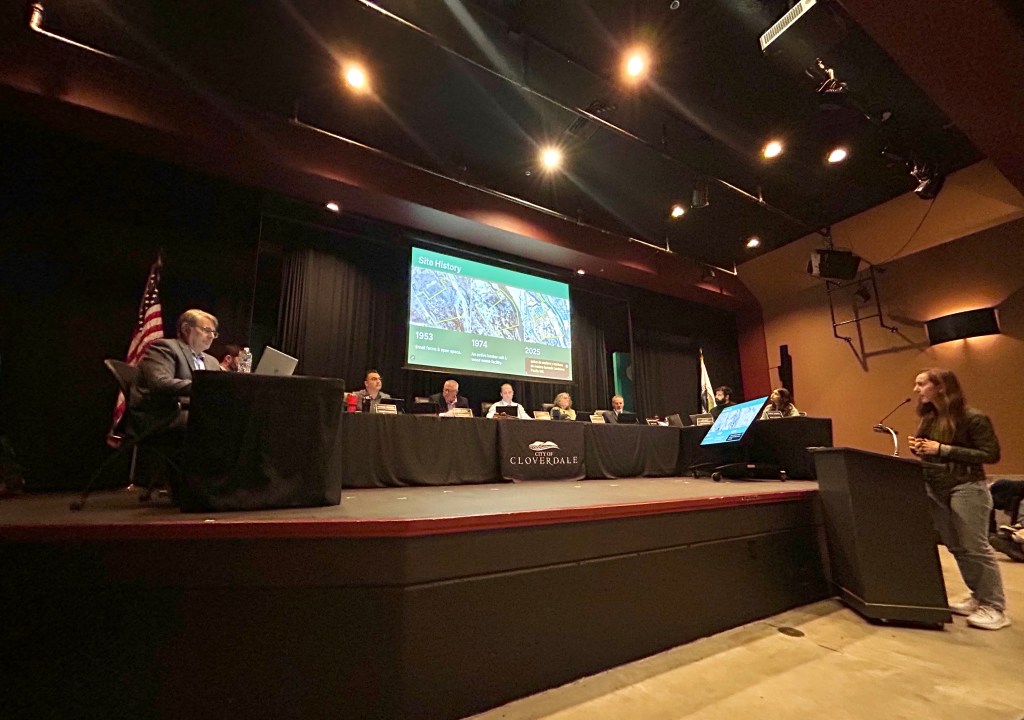
Despite deep doubts aired by residents who packed Wednesday’s meeting, the Cloverdale City Council accepted a Bay Area developer’s assessment of the water needs tied to its large housing and resort project, proposed for a shuttered lumbermill and wood waste site at the south end of town.
The 4-1 decision in favor of a consultant’s study tied to the Esmeralda Land Company project featured Councilmember Marjorie Morgenstern as the lone no vote.
Morgenstern, like many residents on hand Wednesday, said she was concerned there were “too many variables” that prevented her from knowing whether the city would have enough water in the future for the residents it currently has.
“We don’t know what’s coming down the pike. There could be droughts. There could be an earthquake. The unknown variables concern me,” Morgenstern said.
The development is proposed for the 266-acre Asti Road property once slated to be the Alexander Valley Resort, put forward by San Francisco-based Laulima Development. That project fell through in 2017 and the site went back on the market.
The project proposed by Esmeralda Land Co. could see Cloverdale grow by an additional 1,500 people at buildout, according to conservative estimates by the developer’s water consultant, based on the expectation that a share of those scooping up the mix of 605 apartments, townhomes and single-family houses would not be full-time residents.
In addition to the homes and at least two hotels, the plan calls for two restaurants, a racquet club, two indoor pavilions, an outdoor amphitheater, retail space, light industrial facilities, a K-6 private school and a standalone office building. It would also have more than 1.8 million square feet of landscaped area, including a dog park, community garden and playground.
“We are really excited to give it a new life and build a new neighborhood for Cloverdale,” Esmeralda founder and managing partner Devon Zuegel said.
Esmeralda Land Co. is an offshoot of the now two-year-old Edge Esmeralda, a month-long luxury retreat and pop-up village dedicated to promoting sustainable and technology-supported ways of working and living.
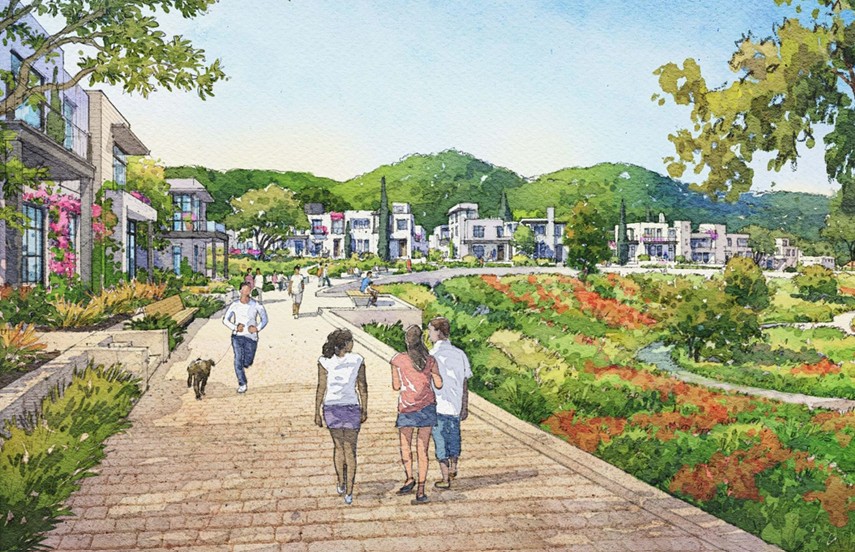
A rendering of the promenade at Esmeralda, a proposed development on 266 acres in the south end of Cloverdale (Esmeralda Land Company).
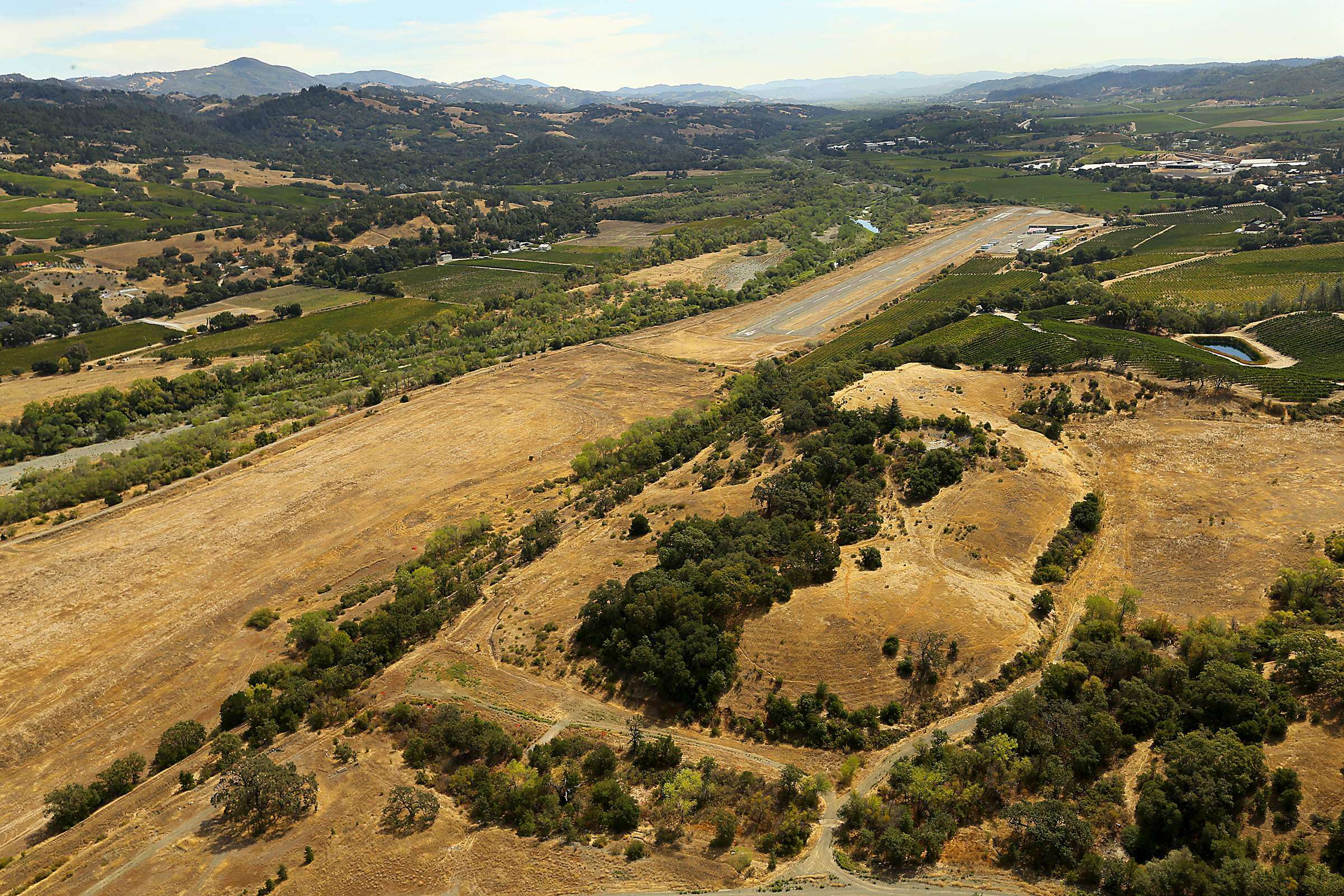
Part of the site of the proposed 266-acre Esmeralda development in the southeast part of Cloverdale lies near the city’s airport, pictured above and to the right. (John Burgess / The Press Democrat, file)
Christopher Chung/The Press Democrat
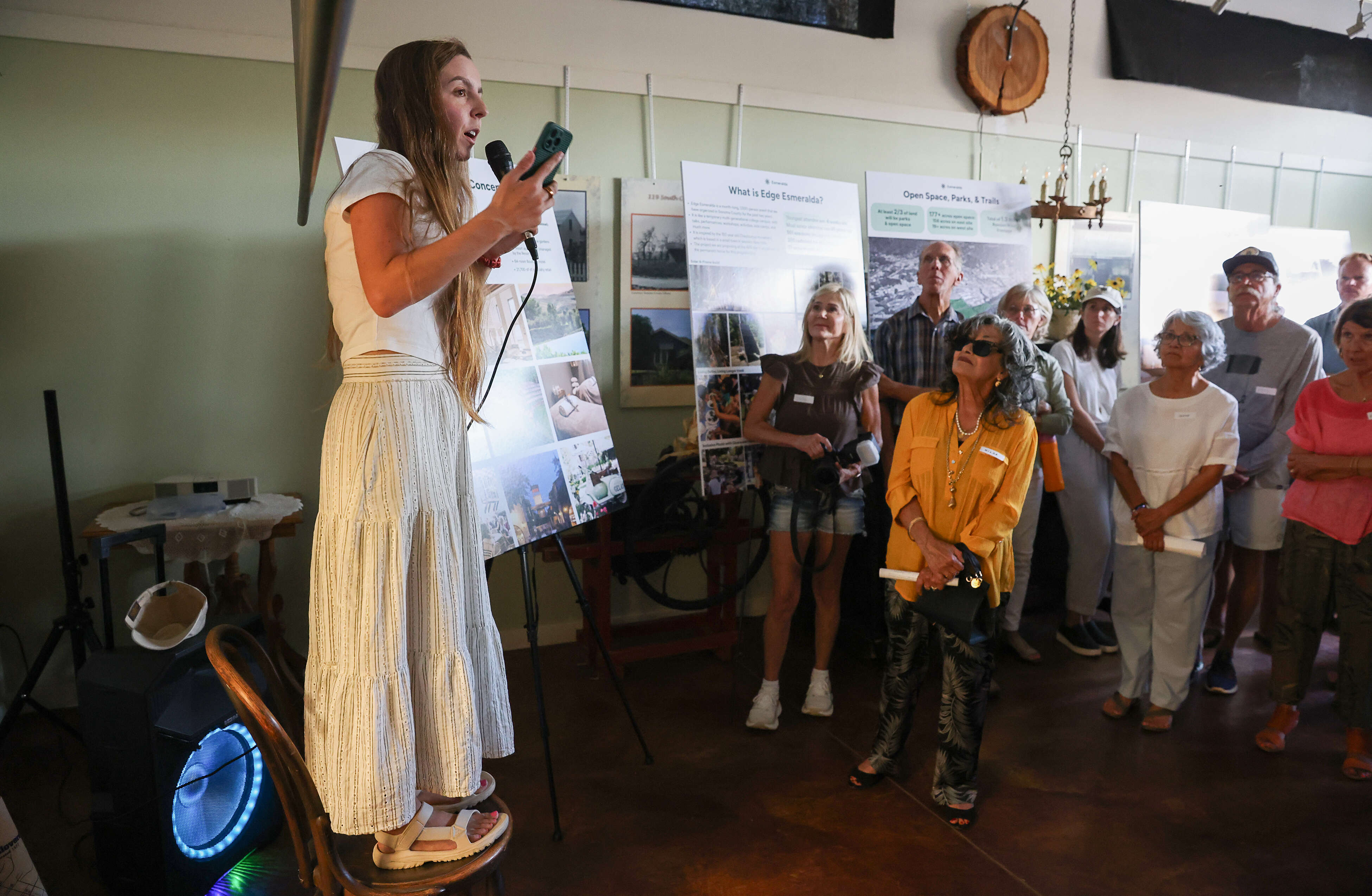
Esmeralda development leader Devon Zuegel speaks during an informational open house in Cloverdale on Thursday, July 24, 2025. (Christopher Chung/The Press Democrat)
Christopher Chung/The Press Democrat
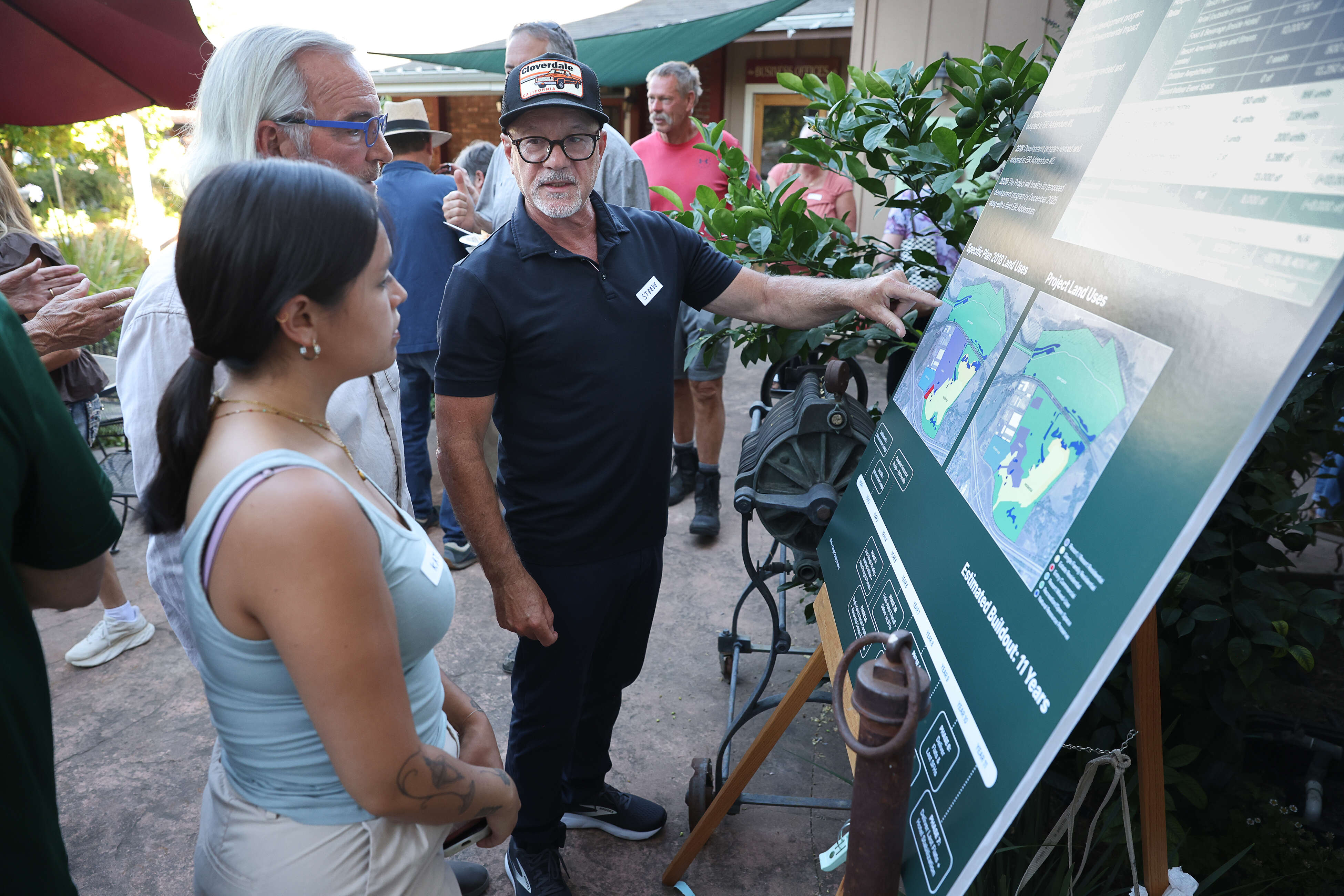
Steve Kawa, right, looks over an informational display for the Esmeralda development with Cee Brown and Kat Henkle-Kawa during an open house in Cloverdale on Thursday, July 24, 2025. (Christopher Chung/The Press Democrat)
Christopher Chung/The Press Democrat
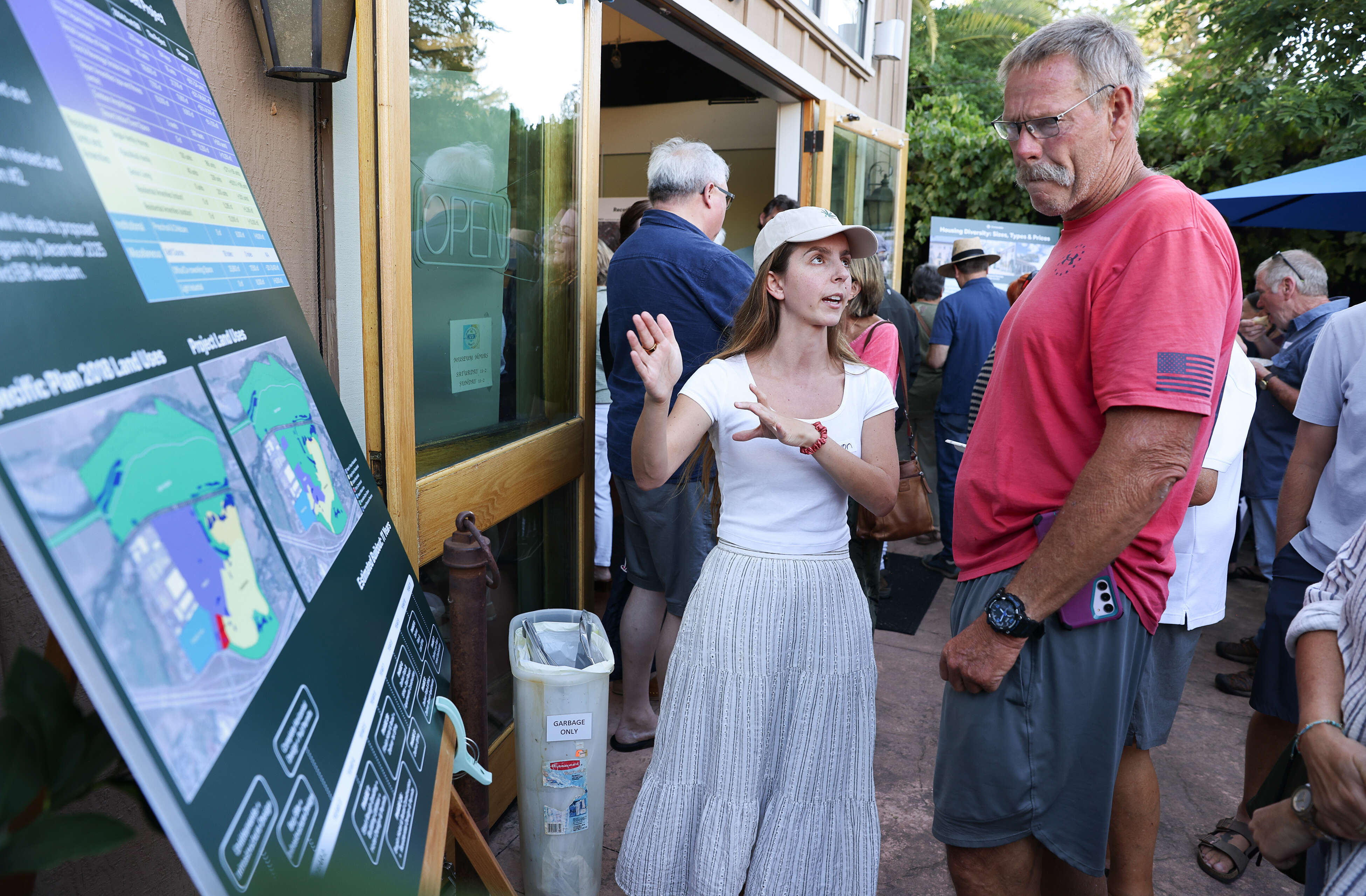
Esmeralda development leader Devon Zuegel, left, discusses plans with Rick Blackmon during an open house in Cloverdale on Thursday, July 24, 2025. (Christopher Chung/The Press Democrat)
Show Caption
1 of 5
A rendering of the promenade at Esmeralda, a proposed development on 266 acres in the south end of Cloverdale (Esmeralda Land Company).
The project, proposed July 2024, is expected to go before the planning commission and city council starting next spring. There, it will require approval of its design and site plans, building permits and a development agreement with the city. Esmeralda Land Co. is relying on environmental studies for the site completed in 2004 for the past resort project and last updated in 2018.
Wednesday’s hearing focused on a key city determination needed to move forward: answering whether Cloverdale has sufficient water supplies to serve the project.
Esmeralda’s hired consultant, EKI Environment & Water, determined it does. The firm estimated the project would need at least 76 million gallons annually, or 233 acre feet — equating to a 20% increase in Cloverdale’s current annual average usage over the past 20 years. (An acre-foot is equivalent to the amount of water needed to flood most of a football field one foot deep, and can supply the needs of three water-efficient households for a year.)
Cloverdale’s state water rights allow it to pump a maximum of 910 million gallons, or 2,792 acre feet, from its wells fed by subsurface Russian River flows — its main source of water. The current annual citywide usage is 383 million gallons, or 1,175 acre feet annually, while the most the city has used over the past 20 years was 569 million gallons, or 1,746 acre feet, in 2013.
By 2035, the targeted completion date for the Esmeralda project, the developer’s consultants expected citywide water demand to hit 639 million gallons, or 1,961 acre feet. By 2045, demand would be 676 million gallons, or 2,074 acre feet, according to the consultant’s projections.
Those projections account for adding over the next 20 years about 5,500 people, including the Esmeralda residents — a roughly 60% increase in the city’s population.
To offset some of the water use, the developers are proposing to build two 500,000-gallon water tanks that could be used in case of an emergency. Project representatives have also told the city they would like to move forward as customers of a future municipal recycled water project. Using non-potable water for irrigation could reduce the development’s potable water footprint from 76 million gallons to 49 million gallons, according to Brad Arnold, water resources engineer and planner with EKI Environment & Water.
Still, the prospect of future droughts weighed heavy on the minds of many of those in the audience concerned about water scarcity.
Over the past decade, California has experienced a pair of yearslong droughts that severely strained water supplies in Sonoma County, and especially along the upper Russian River, where Cloverdale and Healdsburg rely on wells fed by river flows sustained in the dry season by the smaller of the watershed’s two main reservoirs, Lake Mendocino.
The Esmeralda water study shows Cloverdale could struggle to meet future demands during a dry year, when supplies are not expected to exceed 600 million gallons, or 1,841 acre feet.
In the depths of the last prolonged drought in 2021, the state curtailed water use linked to the Russian River, with per-person usage in the affected region limited to 55 gallons a day.
“What would have happened if we had an Esmeralda?” Cloverdale resident Betty Landry asked. “I know my lawn died. We wouldn’t get to shower for a month? We couldn’t water anything? That’s the thing. I can’t imagine it being much worse than it was.”
Arnold appeared to downplay the severity of that last drought, one of the worst in a generation, which brought Gov. Gavin Newsom to the dry bed of Lake Mendocino in April 2021 to proclaim what would become a statewide emergency. By that point, two-year rainfall totals in Santa Rosa were about half the historic average, and even lower in Ukiah, just west of Lake Mendocino, which sat at 44% of its capacity going into the driest part of the year. Lake Sonoma, the region’s largest reservoir, was at only 62%.
Arnold, however, called that period less a “physical drought” than a “regulatory drought.” An Esmeralda-sized development, he contended, answering Landry, “certainly would not hurt the situation.”
Mayor Todd Lands said he was “between a rock and a hard place” in approving the water study.
“They say there’s enough water,” he said. “And I’m not smart enough to go against” the assessment.
Amie Windsor is the Community Journalism Team Lead with The Press Democrat. She can be reached at amie.windsor@pressdemocrat.com or 707-521-5218.