
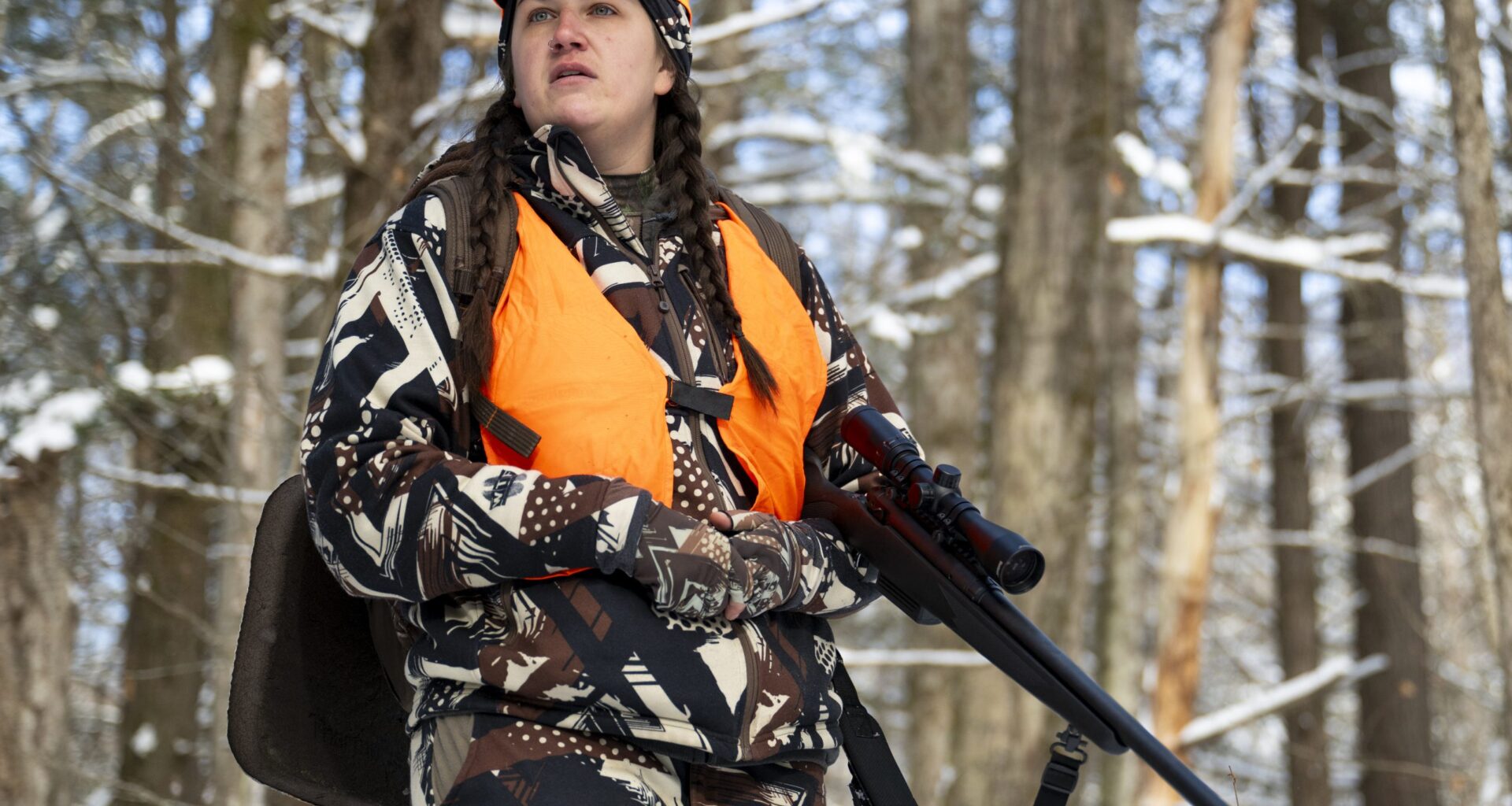
During shotgun season, deer hunters are given the green light to begin their hunt a half hour before sunrise, which during this time of year averages about 7:10 a.m. This means for those looking to be out as early as possible, like hunter Sheryl Magdycz, obstacle number one is getting out of bed at about 4 a.m. while she hears frigid winds pounding against the walls of her bedroom.
The Worthington resident has been an avid hunter her whole life, but got back into it fully over the past five years, and now she lends her hunting expertise by volunteering with several nonprofits, including the state’s Becoming an Outdoors-Woman (BOW) program and the American Daughters of Conservation.
“I like to be in the stand a half hour before I can legally shoot, because if I’m walking in and I bump into a deer, I don’t want them to see me,” she said. “Because if they see you, you’re screwed.”
By hunting, she and most of her fellow sportsmen and women say they are doing their part to preserve local ecosystems.
Shotgun season in Massachusetts begins the first Monday after Thanksgiving and lasts nearly two weeks. This year, the season opened on Dec. 1 and is set to close on Saturday, Dec. 13, with hunting allowed between 30 minutes before sunrise and 30 minutes after sunset.
Hunters like Magdycz, as well as wildlife experts from the state, say that hunting is an important way to help keep the deer population in check while also engaging in something timeless, peaceful and for many, even humane.
Martin Feehan, deer and moose biologist at MassWildlife, said the aim for this shotgun season is to harvest 5,000 or 6,000 deer in the state. Broken down, this means 12 to 18 deer per square mile.
He underscored the importance of hunting deer to protect the ecology of forests, since an over abundance of deer can mean overbrowsing, or eating vegetation, especially young trees, shrubs and forest understory plants. Overbrowsing by white tail deer in Massachusetts is a serious issue since it can lead to stunted forest regeneration, loss of native plants and increased invasive species.
“Hunting is incredibly important … too high a population impacts everything from the forest floor to the canopy,” said Feehan.
Safety first
Before she said anything else as she prepared to head out one day last week with a Gazette reporter and photographer in tow, Magdycz gave a public safety announcement. Everyone walking trails and in public wooded areas during shotgun season should avoid wearing brown and black and other neutral colors, and throw on some orange, yellow or red so hunters don’t mistakenly aim at a person, she said.
“There’s a lot of public land in the area, and people walk their dogs and they wear brown or black,” said Magdycz. “And as hunters, yes, we are responsible for knowing our target and what’s behind it, but it’s just scary, and I want to create awareness and have people know that you can’t be too safe.”
Before she headed out last week, Magdycz threw on an orange safety bib to stand out, explaining that at least 500 square inches of orange must be worn by hunters during shotgun and the primitive firearm hunting seasons.
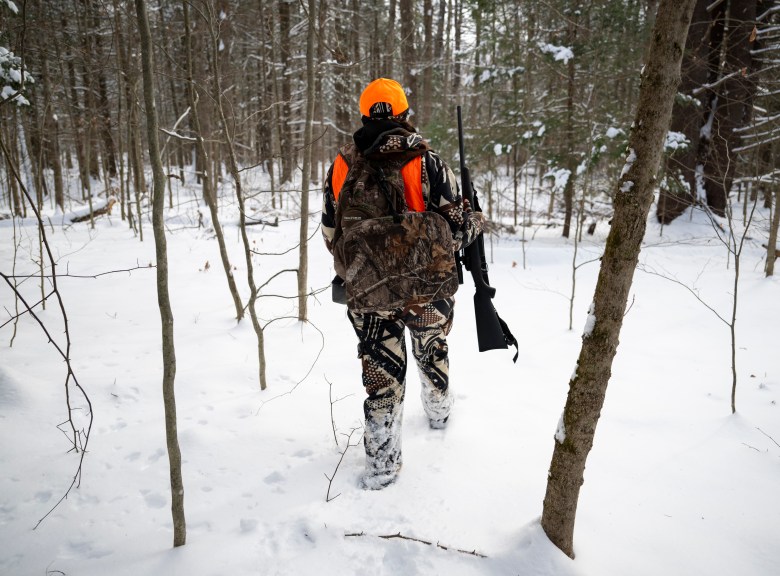 Sheryl Magdycz walks toward the Hiram H. Fox Wildlife Management Area while deer hunting, Thursday, Dec. 4, 2025, in Worthington. DANIEL JACOBI II / Staff Photo
While the human eye can distinguish the bright colors, deer cannot, she said.
“They can’t see our orange. They have different color patterns,” she said. “They see blue in high shades and greens and stuff.”
The design of Magdycz’s hunting gear may look more like modernist art or a style choice as opposed to traditional camouflage prints. Truth is it’s specifically designed to remain invisible from deer.
Called Whitetail Forensics, the print was designed with the eyesight of a deer in mind by a father and son in Pennsylvania.
“What deer see when they look at traditional camo pattern is a blob,” she said. “This is actually made to break up your silhouette. It’s actually quite crazy how much it works. The doe that I shot was at 8 yards, and she looked at me a few times but she never saw me. I had a deer at 30 yards in Vermont a couple weeks ago. Deer never saw me.”
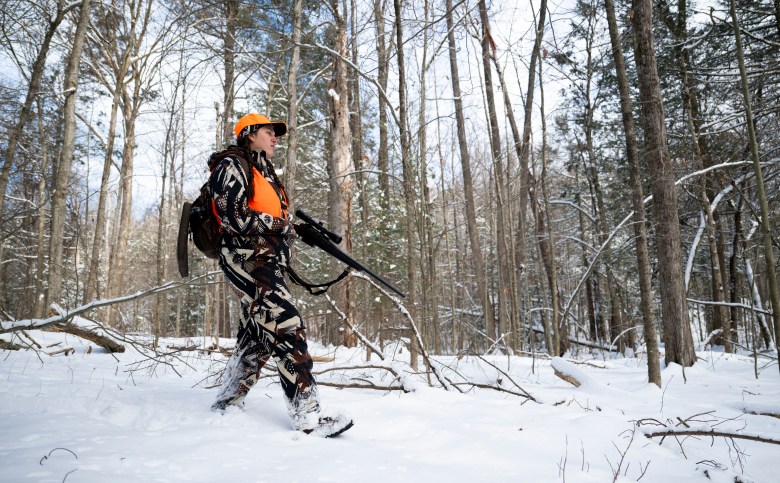 Sheryl Magdycz searches for tracks while deer hunting at the Hiram H. Fox Wildlife Management Area, Thursday, Dec. 4, 2025, in Worthington. DANIEL JACOBI II / Staff Photo
Alpaca socks, boots, several layers of clothing — all are essential. In her backpack is a cushion to sit on and a tree stand to get a spot in a tree, which is typically used more during bow season. She has a rattling device that can simulate the sound antlers make when deer butt heads.
She also has zip ties and safety pins to tag a deer’s ear after it has been caught. Also in her backpack is a knife to dress the dear and plastic bags to harvest the heart. Tucked in her arm last week was a Savage 220 Bolt Action 20 Gauge Shotgun with copper-tipped bullets.
Once she is out in the forest, silence is an essential tool to successfully hunting down a deer.
“Their nose and their smell is their biggest defense. Their hearing is OK, their eyesight is OK, but their nose is definitely their biggest defense,” she said, adding that it is best for the hunter to position themselves so the wind is blowing in their face so the hunter’s scent can’t reach the deer.
Magdycz also explained that deer are good at tracking human patterns. “They remember,” she said. “You can pattern the deer, but deer will pattern humans too.”
When aiming the shotgun, the goal is to hit what is essentially the shoulder of the deer’s front leg, which allows for a double lung shot — the most instant and lethal way to take out a deer.
“I’ve always been taught to aim for your exit — aim for what you want your weapon to pass through, ideally the double lung shot, because that is the most effective, quick, most lethal and most humane kill. You will kill them,” she said.
She said for any amateur looking to get into the hobby, step one would be to get a hunting safety certificate in Massachusetts and complete a basic hunter education course to get a hunting license. She also said pheasants are a good species to hunt for beginners, and shotguns are typically easier to use than bows.
“A lot of people, if they want to start, they will start with gun hunting because it’s perceived to be a little bit easier in the sense that the weapon reaches further and it’s more powerful,” she said. “Like I was bow hunting since I was 16 or 17 and I didn’t harvest a deer until 2023.”
At the weigh station
A shot deer is called a harvest, and each harvested deer needs to be checked in at a weigh station by a hunter within 48 hours of making the kill. MassWildlife Outdoor Education Specialist Jack Bonafini was overseeing the data being collected at the agency’s Connecticut Valley District Office in Belchertown last Saturday, Dec. 13.
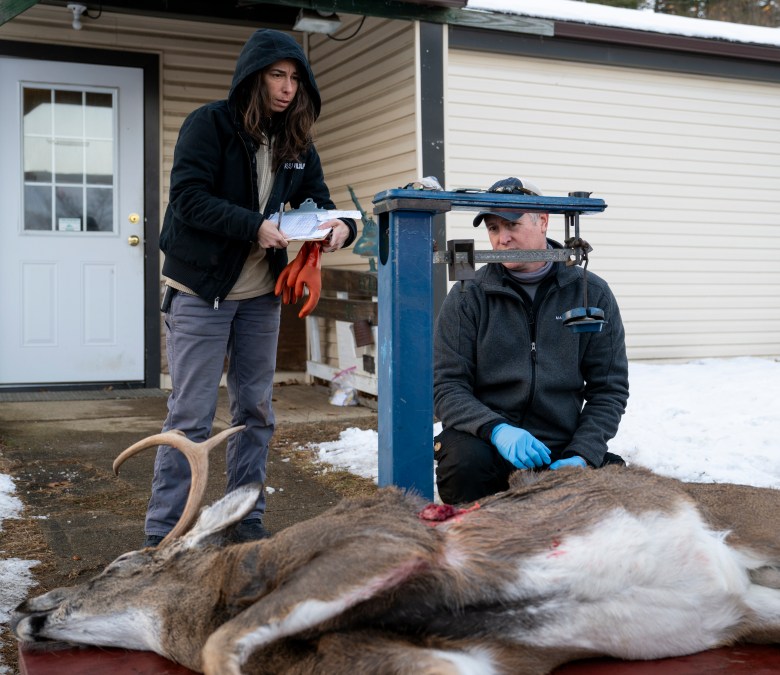 MassWildlife Technician Shasta Slade, left, and District Manager Joseph Rogers weigh a buck at the MassWildlife Connecticut Valley District office, Saturday, Dec. 6, 2025, in Belchertown. The buck would weigh in at 212 pounds. DANIEL JACOBI II / Staff Photo
“We get the weight. We’ll age the deer and we’ll give them their confirmation number for their tag … that’s essentially what we do for biological data,” he said, adding that their ages are determined by measuring how worn down the deer’s teeth are.
Students from the University of Massachusetts Amherst were also on site that day collecting samples for a Lyme disease study.
The Massachusetts Division of Fisheries and Wildlife and the Laboratory of Medical Zoology at UMass Amherst has been sampling ticks retrieved from deer since 2023, and since then, 600 white-tailed deer have had their blood samples taken and 4,000 ticks have been collected.
“We take ticks from the deer, and we’re studying Lyme disease and how deer serum is basically immune to that disease,” said Martha Leo, a junior at UMass. “We’re studying the actual bacteria itself, the deer themselves, in the hopes of trying to find some answer for Lyme disease or a vaccine.”
Bonafini and the students were both inspecting a doe caught in Granby that morning by hunter Rebecca Potter. The doe weighed in at 142 pounds, and she said it was her third catch in five years of hunting. In Belchertown, she and her father removed the deer from the bed of their pickup truck, placed it on the scale and went back home with it.
Magdycz said that hunters often get a bad rap for being inhumane. While she said like any group of people there may be a “few bad apples in the bunch,” she says hunters have tremendous respect for what they hunt.
“Hunters get a bad rap for feeding on animals,” she said. “But in my experience, hunters are the biggest animal lovers that I know. Like we all have pets — and I mean, I break my car for squirrels. I’m not just out to kill, I’m putting food on my table.”
She says her father taught her a valuable lesson about never wasting by telling her when she was young that if she shot anything off the birdfeeder in the backyard she had to eat it. And this is the manifesto that guides how she approaches hunting to this day.
It is typical to hear that venison meat tastes either tough or gamey, she said, adding that if that’s the case the meat probably hadn’t been prepared correctly.
Magdycz personally butchers and processes the deer that she catches, and said venison is able to be used as a substitute for any dish, including steaks, sausages and patties, and tacos and meatballs — even for dishes like venison Bolognese. She personally wants to do a roasted neck and try extracting bone broth after she harvests her next deer.
“We really try to minimize waste because you work so hard to get a shot or even see a deer,” she said. “I mean there was one season I saw one deer, and all I saw was its butt all week.”