
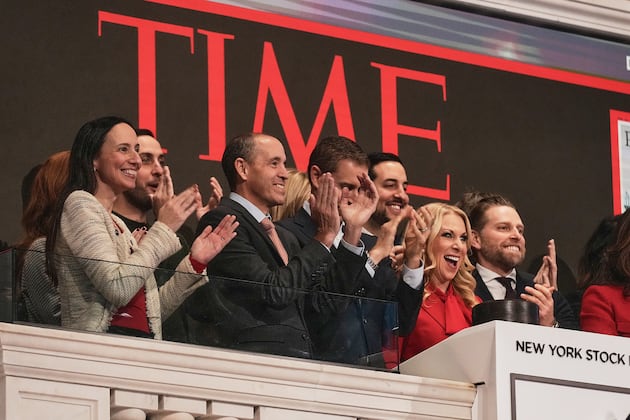
A year ago, Time magazine named Donald Trump its Person of the Year for the second time, generating howls of outrage from Democrats and solid sales of the latest edition with Trump on the cover. (He was also selected in 2016.)
This year, it’s hard to imagine who is going to buy up all the issues. Certainly not Elon Musk’s mother — Maye Musk hasn’t even tweeted about it, despite her son being in the official Person of the Year painting, a reimagining of a famous photograph from 1932.
That’s because in choosing “The Architects of AI” as the most influential people of 2024, Time found a way to unify America, pleasing no one at all, except the handful of people featured on the cover. The mehs are deafening, as are the “you’ve got to be kidding me’s.”
“Is that all you’ve got?” the whole internet, if not the whole country, seems to be asking.
In picking the people who have given us Diaper Diplomacy and videos of cats playing instruments on the porch after bedtime — the only AI that many Americans encounter, other than the bot that takes their order at the Wendy’s drive-through — Time editors ducked hard choices. They could have chosen Benjamin Netanyahu, Pope Leo or Charlie Kirk, the latter a long shot yet an option enthusiastically promoted by his fans.
Elon Musk could have been a contender for the advances in Neuralink that are improving the lives of people who have been paralyzed.
Trump was also reportedly considered again.
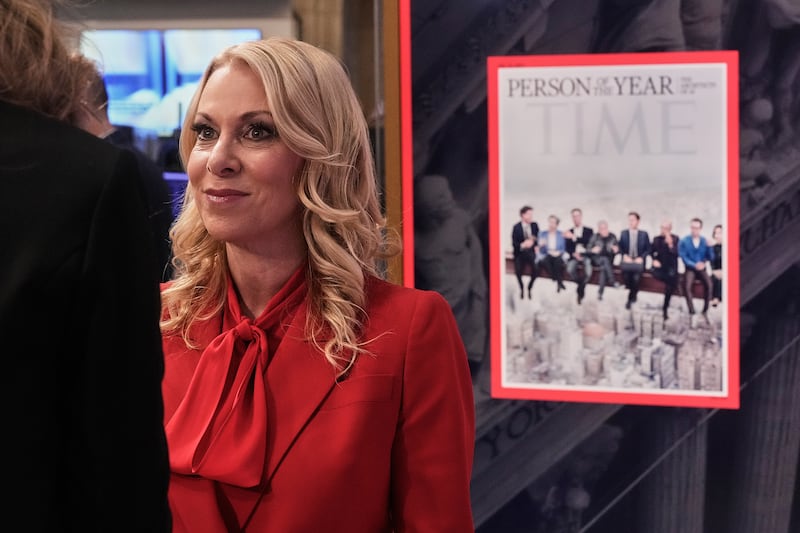 Time CEO Jessica Sibley is interviewed on the floor of the New York Stock Exchange, adjacent to Time’s “Person of the Year” cover, Thursday, Dec. 11, 2025. | Richard Drew, Associated Press
So why this group of people and why now? It’s not that Time is afraid of controversy. The magazine has courted controversy in the past, selecting Adolf Hitler and Joseph Stalin, to name a few. (The criteria is who has the most impact on the world, for better or for worse.)
Time editors say many predictable things in their argument for the selection, all of which come down to: AI is upending the world as we know it.
“These new tools can feel like magic. In the past few weeks alone, we’ve learned that AI could facilitate communication with whales, solve an unsolved 30-year-old math problem, and outperform traditional hurricane-prediction models. These systems are improving at a blistering pace, taking seconds to perform work that once took people hours,” Time writers explain.
The article quotes Jensen Huang of Nvidia, saying of his industry, “This is the single most impactful technology of our time.”
Huang is probably right. And yet the same week of the announcement, CNN noted that AI stock prices were falling. There has been much speculation of late about an AI bubble. Those who aren’t saying we’ve been oversold on AI are saying it’s going to kill us. (“If Anyone Builds It, Everyone Dies” should be Book Title of the Year.)
In a wry piece for The Atlantic, Charlie Warzel evokes another questionable Time choice from years past: the one in which the magazine in 2006 selected you, as in all of us.
The “architects of AI” also include all of us, Warzel contends, since artificial intelligence derives its intelligence from what we’ve all put out there on the internet. Odds are decent, he says, “that morsels from your life have been used to train chatbots.” He’s not wrong.
Time’s “Person of the Year” seemed to be a bigger deal when it wasn’t accompanied by myriad other accolades, which now include Time’s Athlete of the Year, Entertainer of the Year, CEO of the Year, and even a Kid of the Year, the latter a Texas teen who works to protect seniors from digital crime.
A smart and compassionate 17-year-old isn’t a “kid” in my book, and the title “Kid of the Year” seems a bit insulting, as does the selection of the “architects of AI” to the rest of us. But it could have been worse, and may yet be.
There is talk in scholarly circles about whether AI should be granted legal personhood. The Person of the Year in a coming dystopia could be … AI itself.