
The Athletic has live coverage of the Army-Navy game and the 2025 Heisman Trophy ceremony.
SOUTH BEND, Ind. — Jeremiyah Love hesitated, hardly his default setting.
Sitting in a tiny interview room next to Stanford Stadium last month, the running back wondered if his final game at Notre Dame — even if he didn’t know it at the time — was also the end of his Heisman Trophy campaign. After taking a knee to the ribs in the first quarter, Love finished with just 66 yards in a late-night blowout of the Cardinal. For a long-shot candidate, it felt like a finale, even if Heisman voting didn’t open for another week.
Did Love think this dream may have ended with no one watching?
“Yeah … I mean, not really. I wasn’t really focused on it,” Love said. “I came into this game making sure we ended the season how we wanted to. I didn’t come into it trying to do anything individually. I just wanted the best thing for my team.”
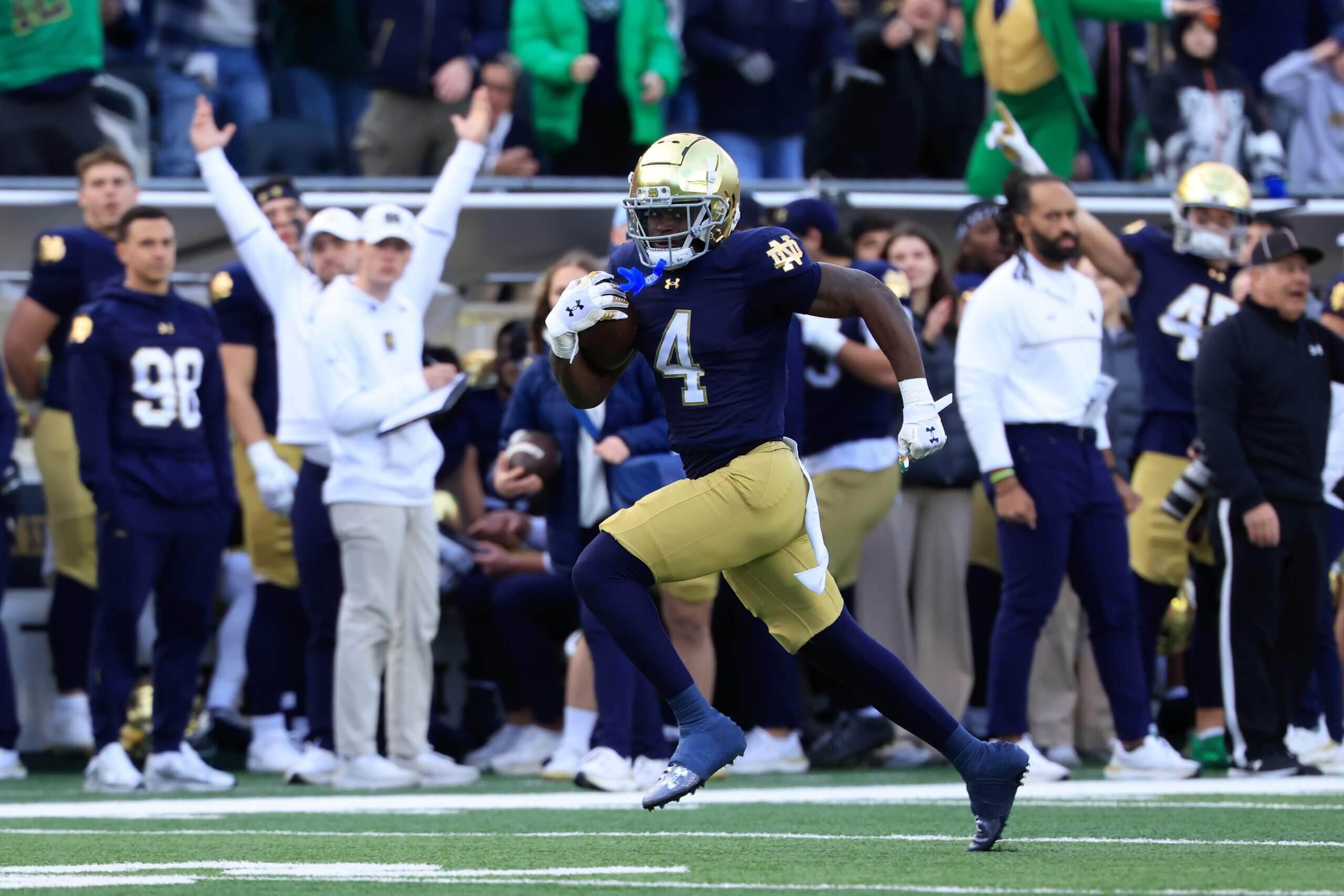
Before kickoff, Notre Dame’s communications team put Heisman materials by the seats of traveling beat reporters and sent mail out to potential voters. There was a metallic green graphic of hands making the heart emoji, plus a box of conversation heart candies imprinted with “Love on top” and “One Love.” A week earlier, before Love rushed eight times for 173 yards and three touchdowns in Notre Dame’s home finale against Syracuse, the program put glossy printouts of the running back’s Heisman credentials on every press box seat. And a week before that, Notre Dame released a video with author Nicholas Sparks, a 1998 graduate who wrote the famous love story “The Notebook.”
The greatest of these is LOVE 🫶
An ode to the Heisman from best-selling author and Notre Dame alumnus Nicholas Sparks.#GoIrish☘️ | @JeremiyahLove | @NicholasSparks pic.twitter.com/ddTuKvXwmJ
— Notre Dame Football (@NDFootball) November 17, 2025
For the season, Love finished with 199 carries, 1,372 yards and 21 touchdowns. These are not Heisman Trophy statistics by historical measure for the position. However, numbers did not turn Love into Notre Dame’s first Heisman finalist since linebacker Manti Te’o in 2012. He wouldn’t be the school’s first winner since Tim Brown because of box scores.
It was always going to take a lot more than statistics to turn Jeremiyah Love into a Heisman Trophy winner. It was just a matter of figuring out what.
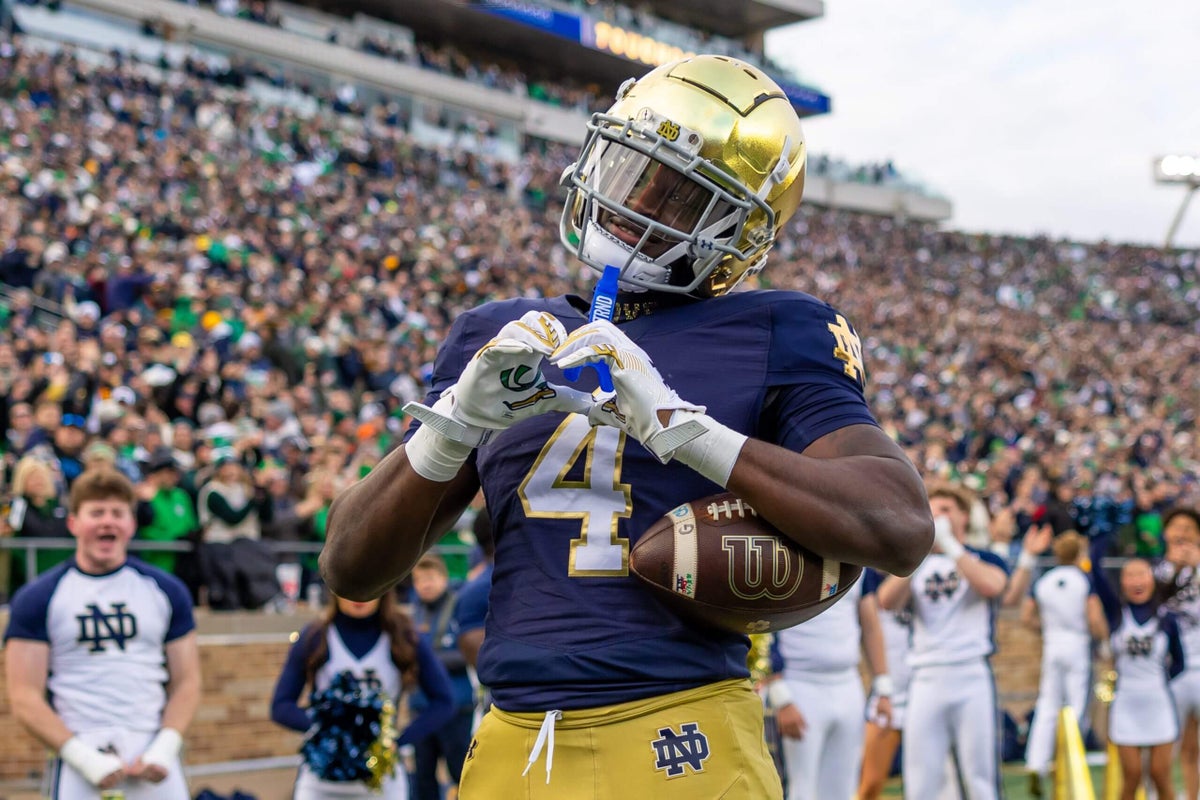
Love may have officially declared his candidacy for the Heisman Trophy at Boston College by striking the pose for the first time at the end of a 94-yard touchdown run, but his exploratory committee was formed about five months earlier. Katy Lonergan, associate athletics director and advisor to Marcus Freeman, was the chief strategist.
Lonergan has been at Notre Dame for six football seasons, joining the program under Brian Kelly. This wasn’t her first attempt to shape a national story coming out of Notre Dame. It wasn’t her first brush with a Heisman campaign, either, even though Notre Dame hasn’t produced a candidate since the 2017 season when running back Josh Adams inspired 33 Trucking hats.
Lonergan got into the athletic communications business at Ole Miss, her first year syncing with Deuce McAllister’s senior season. The school pushed the running back as a Heisman candidate before the opening kickoff with buttons, posters and mailers. Social media didn’t exist. McAllister got injured, and the push never gained momentum.
Three years later, Ole Miss had another Heisman candidate in Eli Manning and took the opposite approach because the quarterback wanted no part of a campaign. Manning still finished third, behind winner Jason White and runner-up Larry Fitzgerald.
With Love, Notre Dame split the difference, following a model closer to Caleb Williams at USC. The Trojans didn’t do much marketing of their quarterback, waiting for a Heisman moment on the field before declaring him a candidate. That moment happened against Notre Dame in 2022, when Williams accounted for as many touchdowns as he threw incompletions (four). When Williams scrambled for a 5-yard touchdown late in the first half of USC’s 38-27 win, he hit a Heisman pose while heading to the sideline.
“Their philosophy was let him do all the work, let other people call him a Heisman candidate, then be ready for the moment,” Lonergan said. “That’s the approach we took.”
Love and Lonergan talked through what a Heisman campaign could look like in June, the running back articulating what he liked and didn’t. Love was adamant about featuring the color green. He liked his heart-hands celebration as a touchpoint. The “Jeremonstar” comic book Love created wouldn’t be a focus.
“He wrote on my dry-erase board, and I still have everything he wrote up there,” Lonergan said. “In true Jeremiyah fashion, I was thinking bullet points, and he wrote in complete sentences.”
Love scored three touchdowns on just eight carries against Syracuse. (Justin Casterline / Getty Images)
Once they had ideas, Notre Dame looped in art director Mallory Hiser, who made the graphic that showed up at seats on press row at Stanford. Notre Dame’s communications teams set out to produce some extra Love content each week, all season — even if it didn’t include the word Heisman — priming the rest of college football to accept Love as a national figure.
Last year’s 98-yard touchdown run against Indiana to open the College Football Playoff helped set the stage. So did his bruising 2-yard touchdown against Penn State in the Orange Bowl. But Love’s 10 carries for 33 yards on opening night at Miami didn’t help, especially when paired with his disappearance in the national title game against Ohio State while playing through a knee injury.
So Notre Dame built Love’s campaign more on moments than statistics. Notre Dame believed it had a compelling package in Love’s story of self-awareness and growth, which paired well with his hurdles, spins and touchdowns.
When Love went for 24 carries and 228 yards against USC in mid-October, a Notre Dame Stadium record by an Irish player, it felt like all the advance work from the summer was about to pay off. That Heisman pose two weeks later at Boston College made sure of it.
The next week, Love’s Heisman odds dropped to +450 on FanDuel, after holding in the summer at +5000 on BetMGM, back when Arch Manning was the heavy preseason favorite along with Dante Moore, Ty Simpson and Jeremiah Smith. On The Athletic’s Heisman poll, Love surged to second by mid-November, trailing heavy favorite Fernando Mendoza.
Love was never going to approach Ashton Jeanty’s stats in his final year at Boise State: 374 carries for 2,601 yards and 29 touchdowns. He wasn’t going to approach past Heisman-winning running backs such as Mark Ingram or Derrick Henry, either; they averaged 333 carries, 1,939 yards and 28 touchdowns during their Heisman seasons. He had no electric punt returns like Reggie Bush, but he still had plenty of highlights.
“It’s hard to predict what they’re looking for anymore,” said running backs coach Ja’Juan Seider. “What does a running back have to do? You gotta have 3,000 yards now? I think yards per carry gotta mean something and being explosive. And you got a name.”
When Love hard-launched his Heisman campaign in November, Notre Dame added media appearances to his calendar, putting him on “The Pat McAfee Show” and “SportsCenter with Scott Van Pelt,” along with about a half-dozen other appearances. For how much Freeman talks about “team glory” around the program, Notre Dame also wanted to take its best shot at producing its eighth Heisman Trophy winner and first since Brown in 1987.
On Dec. 3, three days after voting for the Heisman opened, Notre Dame took Freeman, Love and running back Jadarian Price to New York for a round of media appearances. The trip was supposed to promote “Here Come the Irish: Season 2,” the docuseries on Peacock. However, during the trip, Notre Dame put a billboard of Love in Times Square. A week later, the Notre Dame Club of Los Angeles activated a “Love for Heisman” billboard just outside SoFi Stadium.
“They’ve been working it, man, I ain’t even gonna lie,” said Love’s father, Jason. “They were super aggressive. I don’t think there’s any other brand that can put my son in Times Square.”
Still, in terms of a closing argument, Notre Dame knew the season finale had hurt Love’s chances.
Not only did Love’s final game at Notre Dame get cut short by injury, but the late-night kickoff also made it the kind of performance plenty of voters reviewed via box score. A week later, Mendoza led Indiana to an upset of Ohio State in the Big Ten championship game. Mendoza was hardly a statistical marvel, finishing with 222 yards passing, one touchdown and one interception. However, like Love’s campaign, he had a moment and a story to sell, with Indiana lifting the Big Ten championship trophy and ascending to No. 1 for the first time in school history.
Whatever happens Saturday night at the Heisman ceremony, there’s not much question around Notre Dame about whether or not the campaign was a success. Love became the program’s first Doak Walker Award winner on Friday, and he will almost certainly be a unanimous All-American.
Statistically, the season didn’t rewrite the Notre Dame record books. Spiritually, it will endure beyond what any data set could suggest. Before the Heisman voting closed, Lonergan wondered if all the campaigning for Love had broken through. You never know if you’re winning hearts and minds until you’ve already done it.
“It’s really hard to measure any of it,” Lonergan said. “Him getting invited to New York, I (felt) like we played our role. If he (didn’t), do you consider that a failure? I don’t think we can.
“The biggest role is him. And he’s done his part.”