
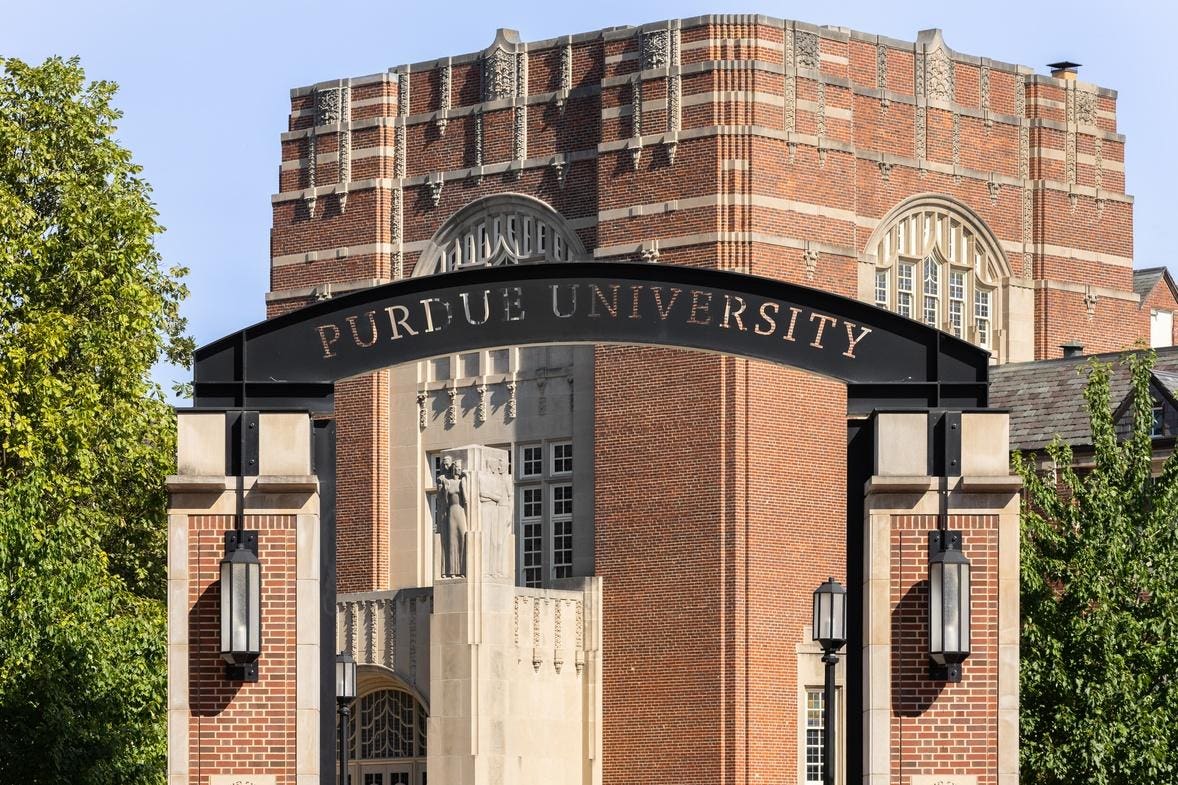
As part of its larger AI strategy, Purdue University will require all undergraduates to demonstrate basic AI competency, beginning next year.
getty
Purdue University will begin requiring that all of its undergraduate students demonstrate basic competency in artificial intelligence starting with freshmen who enter the university in 2026.
The new “AI working competency” graduation requirement was approved by the university’s Board of Trustees at its meeting on December 12. It’s part of a broader AI@Purdue strategy that spans five areas: Learning with AI, Learning about AI, Research AI, Using AI and Partnering in AI.
“The reach and pace of AI’s impact to society, including many dimensions of higher education, means that we at Purdue must lean in and lean forward and do so across different functions at the university,” said Purdue President Mung Chiang in a news release. “AI@Purdue strategic actions are part of the Purdue Computes strategic initiative, and will continue to be refreshed to advance the missions and impact of our university.”
The requirement will be embedded into every undergraduate program at Purdue, but it won’t be done in a “one-size-fits-all” manner. Instead, the Board is delegating authority to the provost, who will work with the deans of all the academic colleges to develop discipline-specific criteria and proficiency standards for the new campus-wide requirement. Chiang said students will have to demonstrate a working competence through projects that are tailored to the goals of individual programs. The intent is to not require students to take more credit hours, but to integrate the new AI expectation into existing academic requirements.
Although the requirement doesn’t officially kick in until next fall, some of the underlying educational resources and innovations will be made available to currently enrolled students as soon as the spring semester.
While the news release claimed that Purdue may be the first school to establish such a requirement, at least one other university has introduced its own institution-wide expectation that all its graduates acquire basic AI skills. Earlier this year, The Ohio State University launched an AI Fluency initiative, infusing basic AI education into core undergraduate requirements and majors, with the goal of helping students understand and use AI tools— no matter their major.
Purdue wants its new initiative to help graduates:
Understand and use the latest AI tools effectively in their chosen fields, including being able to identify the key strengths and limits of AI technologies;Recognize and communicate clearly about AI, including developing and defending decisions informed by AI, as well as recognizing the influence and consequences of AI in decision-making;Adapt to and work with future AI developments effectively.
Purdue Provost Patrick Wolfe said that it was “absolutely imperative that a requirement like this is well informed by continual input from industry partners and employers more broadly,” and therefore he has “asked that each of our academic colleges establishes a standing industry advisory board focusing on employers’ AI competency needs and that these boards are used to help ensure a continual, annual refresh of our AI curriculum and requirements to ensure that we keep our discipline-specific criteria continually current.”
Purdue already has BA and BS degree programs in AI, and it offers a Masters of Science in Artificial Intelligence as well. Recently, it has taken major steps to develop its AI research capacity in areas such as agriculture and food systems, manufacturing, transportation and logistics, and health sciences, and it has equipped faculty and staff with additional AI resources like Microsoft 365 Copilot.
In November, Purdue and Google announced plans to strengthen their educational and research partnership, and the university has collaborated with Apple to launch a Spatial Computing Hub on campus. You can learn more about Purdue’s overall AI resources and strategy here.
As nearly every business sector adopts artificial intelligence into its core operations, creating a growing demand for workers with basic AI skills, look for more colleges and universities to place a new emphasis on how best to educate students about artificial intelligence tools. New AI majors and minors are being introduced, interdisciplinary AI centers are being formed, and faculty and students are using AI tools to advance research in a wide range of fields.
Not too long ago, colleges’ main concern about AI was how to prevent students from using it to cheat on assignments, short-changing their learning in the process. Now, that apprehension is being replaced by a new priority — preparing students for the demands of a workforce rapidly being transformed by artificial intelligence technologies.