
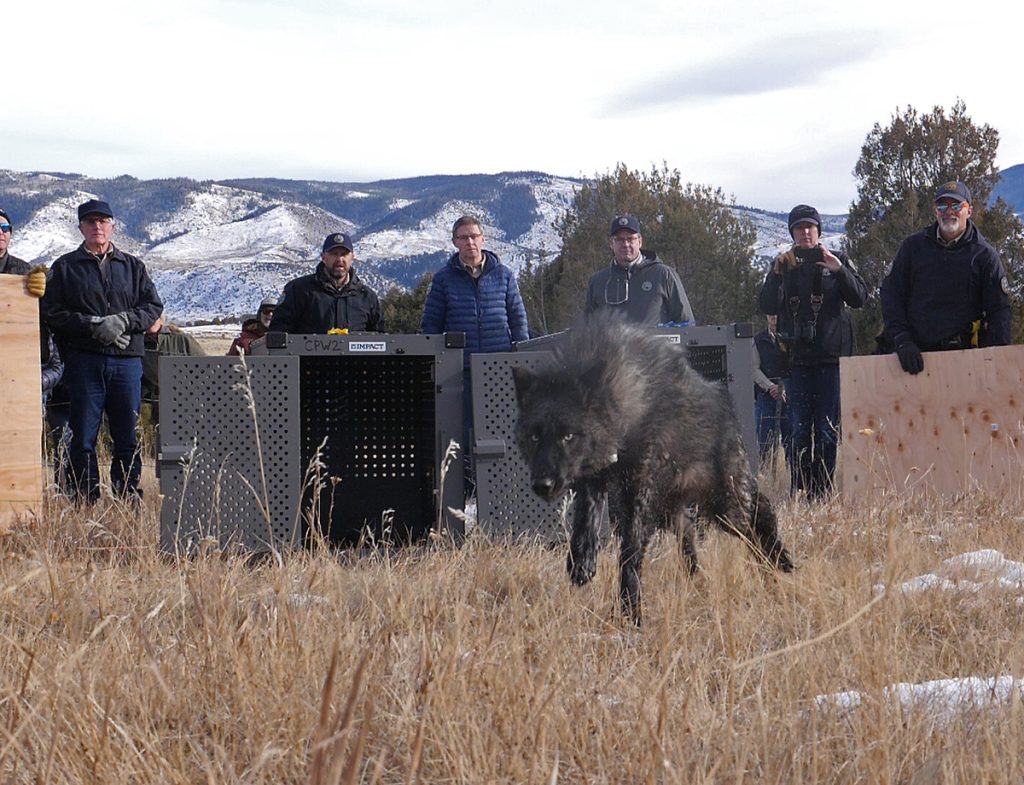
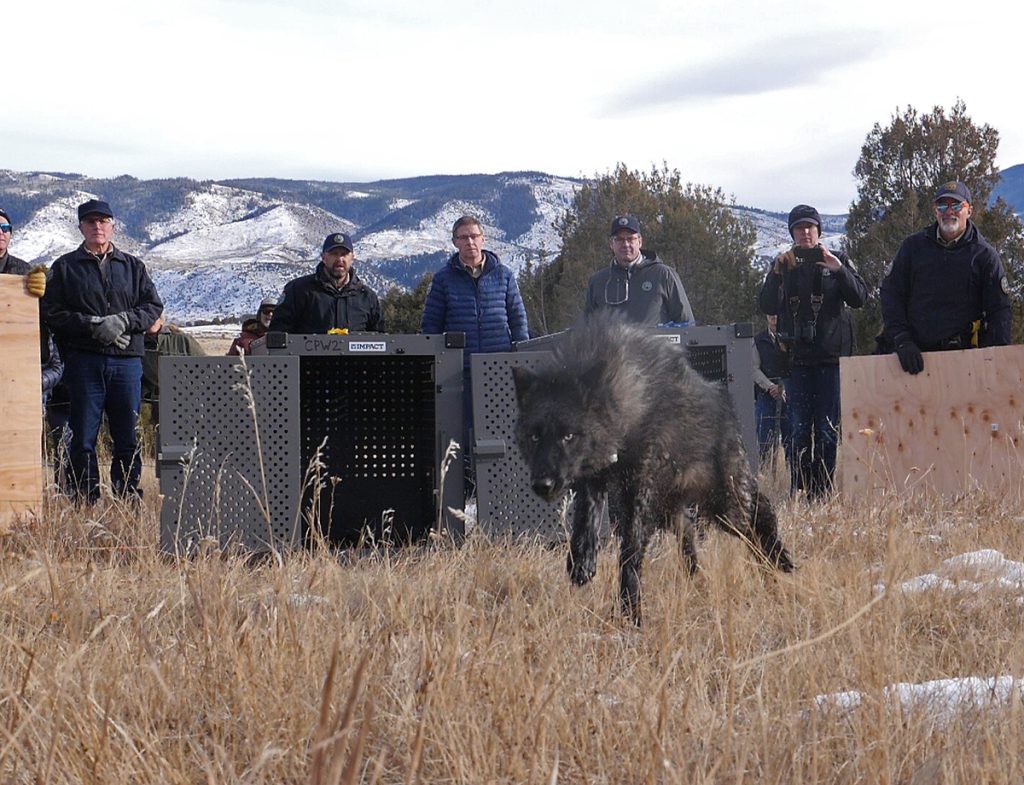
 Colorado Parks and Wildlife announced on Thursday, Dec. 11, that it had regained custody of one of its collared gray wolves after it ventured into New Mexico. The wolf, a member of the Copper Creek pack, was rereleased into Grand County. Pictured is wolf 2303-OR from when Colorado Parks and Wildlife released five gray wolves onto public land in Grand County on Dec. 18, 2023.
Colorado Parks and Wildlife/Courtesy photo
A Copper Creek wolf was released in Grand County on Thursday, Dec. 11, after being returned to Colorado by New Mexico wildlife officials.
The male wolf, collared and tagged as 2403, is among those born to the Copper Creek pack in 2024. According to Colorado Parks and Wildlife, the wolf dispersed from its pack this fall and entered New Mexico, where it was captured and returned to Colorado by the New Mexico Department of Game and Fish. Dispersal is common for young wolves as they leave their birth pack, attempt to make it on their own, and search for a mate.
Parks and Wildlife has a joint agreement with Utah, New Mexico, and Arizona in which any gray wolves from Colorado that enter these three states can be captured and returned to Parks and Wildlife.
The agreement was put in place to protect the genetic integrity of the Mexican wolf, a separately listed entity under the Federal Endangered Species Act. Mexican wolves are part of their own recovery effort in southern Arizona and New Mexico, which was initiated by the U.S. Fish and Wildlife Service in 1998. The interstate agreement also stipulates that any Mexican wolves leaving the experimental population area in Arizona and New Mexico will be returned to that area.
“Ultimately, the intent is to aid with the success of our program here in Colorado while minimizing any adverse impacts on Mexican wolf recovery efforts in our neighboring states,” said Eric Odell, Parks and Wildlife’s wolf conservation program manager, in a news release.
After being captured by New Mexico’s state wildlife agency, the Copper Creek wolf was returned to Parks and Wildlife custody. According to a news release, the decision for the Colorado wildlife agency to release the wolf in Grand County was determined by three factors: proximity to an unpaired female gray wolf in an effort to support pairing, nearby natural prey populations, and distance from livestock.
While this is the first of Colorado’s reintroduced wolves to venture south into New Mexico, three of them have died after venturing into Wyoming, where wolves lose their protections as an endangered species, and can be hunted in the vast majority of the state.
A brief history of the Copper Creek Pack
For the Copper Creek wolf that ventured into New Mexico, it marks its second relocation and a return to the county where it was born.
The Copper Creek pack initially denned in Grand County in the spring of 2024. However, shortly after the pups were born, the pack was tied to repeated livestock attacks and six members of the pack — including the two breeding adults and four pups — were removed from the area and placed in a wildlife sanctuary. Days after arriving at the sanctuary, the patriarch died from what Fish and Wildlife later determined was a gunshot wound sustained in the wild.
In January, the surviving adult female and four pups, then yearlings, were collared and released in Pitkin County. In the spring, the matriarch bred with one of the British Columbia wolves — also released in Colorado in January — and had additional pups.
The decision to re-release the Copper Creek pack members was a controversial one, as it went against the wolf plan’s recommendation that “the translocation of depredating wolves to a different part of the state will not be considered, as this is viewed as translocating the problem.”
At a July 1 legislative hearing about the wolf program, Jeff Davis, the former Parks and Wildlife director, said, “that decision on Copper Creek was mine and mine alone” and admitted it was one he questions every day. Davis was forced to resign from his position in November to avoid being fired, according to records obtained by 9NEWS and The Denver Post. He was offered another position within the Department of Natural Resources through May.
The decision regarding the Copper Creek pack came under additional scrutiny when members of the pack were tied to four livestock attacks in eight days in May, meeting Parks and Wildlife’s definition of chronic depredation. As such, the agency killed one of the pack’s yearlings, 2405, connected to the Pitkin County attacks in an attempt to change the group’s behavior.
However, the behavior continued after the yearling’s death — with an additional attack confirmed on July 18 — which prompted the agency to try and euthanize a second member of the pack. The agency ended its search in October after three months of searching and failing to locate the responsible wolf.
A fifth wolf born to the Copper Creek pack in Grand County — that evaded capture in 2024 and was never collared — was shot by Parks and Wildlife officials in mid-August. The wolf was shot during an operation with partners from the U.S. Department of Agriculture Wildlife Services, after the uncollared wolf was connected to three livestock attacks in the county between July 20 and Aug. 2.
While the agencies found evidence that the wolf had been shot, it was unable to locate the animal, dead or alive. It was the DNA collected from the scene which identified the wolf as the fifth Copper Creek Pack yearling. While Parks and Wildlife reported that additional livestock attacks in October in Rio Blanco County were connected to an uncollared wolf, the agency said it had no way to confirm — outside of a biological sample — whether it was the same wolf that was shot in August.