

Local homeless housing providers are in a state of limbo after federal officials earlier this week backed off, at least for now, new funding policies aimed at gutting long-term supportive housing programs in the name of promoting greater “self-sufficiency” in the population of homeless people.
The move, by U.S. Housing and Urban Development, is causing more confusion among homeless service providers who are facing significant lapses in funding, with some federal grants worth hundreds of thousands of dollars expected to expire early next year.
HUD’s new — and now shelved — funding rules would shift billions of dollars to more restrictive, transitional housing programs aimed to reduce reliance on government support, according to a HUD press release from November. The shift spurred legal challenges, and the about-face by the Trump administration this week came just as HUD representatives were set to appear in federal court to defend the move, Politico reported.
In Sonoma County, the change would mean HUD funds for permanent supportive housing programs, currently $4.2 million, would be restricted to about just under $1.3 million.
Chris Cabral, chief executive officer of Petaluma-based homeless services provider Community on the Shelterless, said funds from a $325,000 grant will run out at the end of February. She said 80% of that funding goes to leasing and direct housing costs.

CRISSY PASCUAL/Argus-Courier Staff
Chris Cabral, CEO of COTS in Petaluma. (Crissy Pascual/Argus-Courier file) 2022
“We’re moving people out of that housing already because we don’t have any funding beyond February,” Cabral said. “It looks like we’ll be lucky to get six of the 20 people transferred. There are no open units to transfer them to.”
Those who cannot be transferred are in danger of becoming homeless again, she said.
Chris Kughn, CEO of the North Bay social services nonprofit Buckelew Programs, called HUD’s effort to slash funds for permanent supportive housing “draconian.” The move comes with no assurance that funding for such programs will be restored and only creates more confusion, he said.
Kughn said the impact on Buckelew will be significant. Buckelew currently receives about $290,000 in HUD funding to support nine clients in permanent housing. That grant expires on Jan. 31, 2026.
‘Unfortunately we had to continue with what we knew at the time, issuing notices to our clients,” he said.
Kughn said Buckelew will continue to provide supportive services to its nine clients, even as it tries to help them find alternative housing. Buckelew. That means helping them reenter the county’s “Coordinated Entry” program, which puts them in competition with those who are currently homeless.
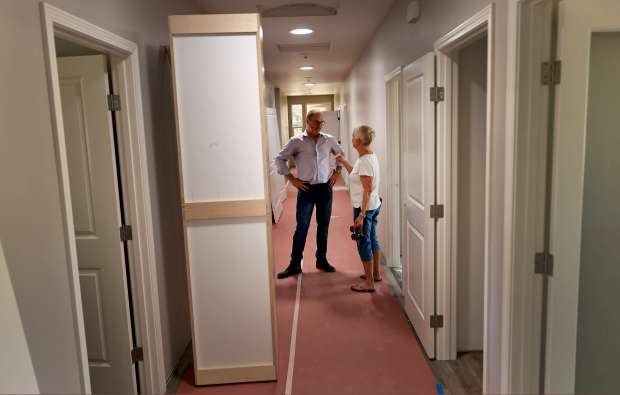
Kent Porter / The Press Democrat
Buckelew CEO Chris Kughn, left, and Cindy Gallaher discuss the progress of Hope Village in Santa Rosa, Tuesday, Aug. 15, 2023. (Kent Porter / The Press Democrat)
The withdrawal of HUD’s new funding framework on Monday came 90 minutes before the agency was scheduled to appear in federal court to defend the move, according to Politico. On its website, HUD said it withdrew its funding overhaul “to make appropriate revisions” to notice of funding opportunity, or NOFO.
Under the funding rules, only 30% of homeless housing funds could be used for permanent supportive housing programs. Currently, 90% can be use for those programs.
The change potentially represents staggering losses to nine permanent supportive housing projects that serve about 250 of Sonoma County’s most vulnerable homeless people, who currently live in 209 housing units, according to county officials.
The number of people affected includes about 40 people living with HIV, some 60 veterans and more than a dozen transitional age youth. Everyone receiving permanent supportive housing services has experienced years of homelessness and has lived with serious disabilities and chronic illness.
HUD grants are a major source of funding for local programs like 104-unit Palms Inn in Santa Rosa. Run by the nonprofit Catholic Charities, the Palms Inn receives $727,000 in HUD funding to cover supportive services and rental aid for 40 units.
Other large permanent supportive housing programs, also established at former lodging sites include Elderberry Commons in Sebastopol and St. Vincent de Paul Commons in Santa Rosa. The programs receive, respectively, $309,335 and $327,166 in HUD funds.
Michael Gause, the county’s ending homelessness program manager, said there’s been a dearth of information coming from HUD on what it intends to do next.
Legal challenges to HUD’s new policies are being heard by Judge Mary S. McElroy in the U.S. District Court in Rhode Island. The next hearing is scheduled for Dec. 19.
At Monday’s hearing, McElroy said of HUD’s last-minute policy withdrawal, “It feels like intentional chaos.”
Gause agreed. “It’s absolutely limbo, chaos,” he said, adding that even if HUD completely backed off of the changes “it’s so late in the game” lapses in funding are inevitable.
“It take months for those contracts to go through,” he said.
Cabral, of COTS, said she hopes HUD quickly resolves its funding priorities, whatever they end up being. The longer HUD waits, the worse the funding lapse will be, she said.
The impact of all the chaos and uncertainty, she said, will be more people in homeless shelters and longer wait lists for permanent housing, “which means more people on the street.”
“COTS has a waiting list that’s three months long, we don’t want that to be six months long,” she said.
You can reach Staff Writer Martin Espinoza at 707-521-5213 or martin.espinoza@pressdemocrat.com. On Twitter @pressfish.