
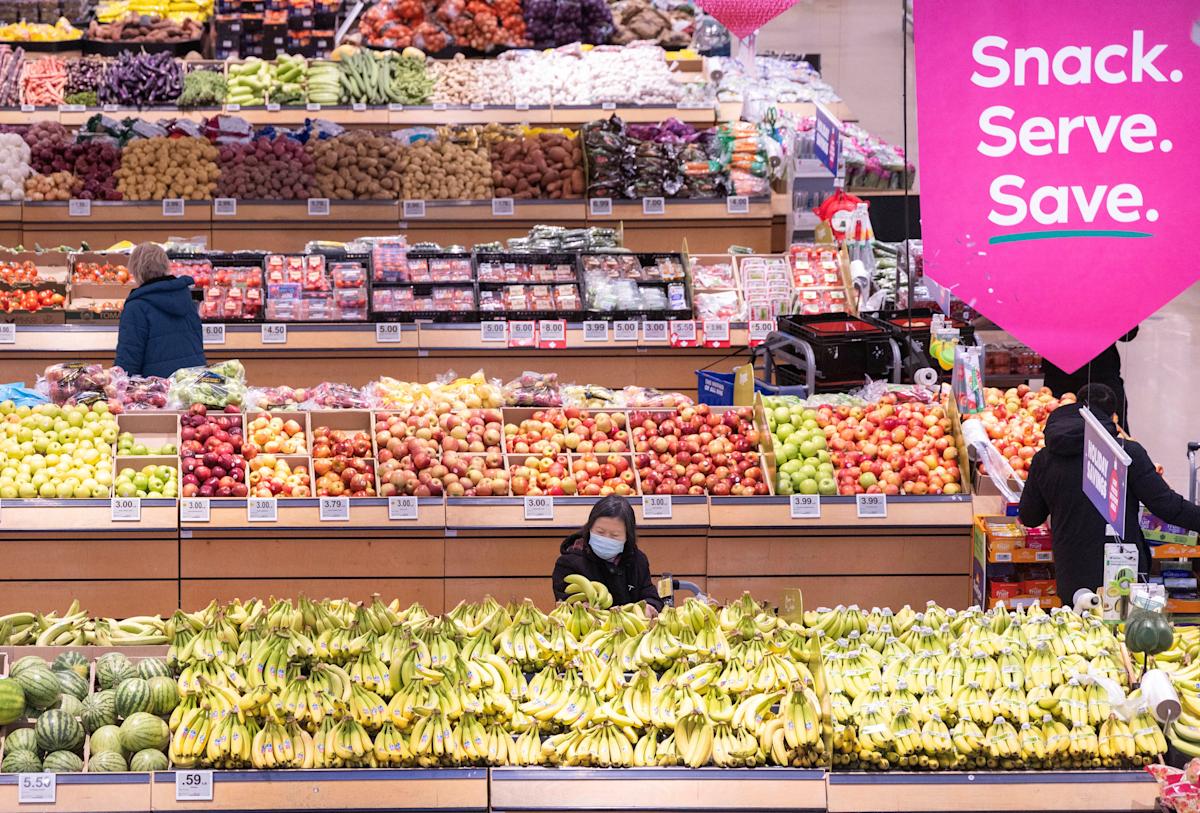
 Grocery prices have trended mostly upwards this year, say economists at RBC, “consistent with rising agricultural commodity prices over the first half of 2025.” (Photo by Zou Zheng/Xinhua via Getty Images) · Xinhua News Agency via Getty Images
Canada’s annual inflation rate held steady at 2.2 per cent in November, according to Statistics Canada data published Monday. Economists had expected the inflation rate to rise at a slightly faster pace than October, to 2.3 per cent, according to consensus estimates published by CIBC Economics.
Price increases slowed for services, including rent, travel tours and accommodation, but prices were higher for groceries, and the year-over-year decline in gasoline prices was less than in October. The Consumer Price Index (CPI) excluding gas rose 2.6 per cent year-over-year for the third consecutive month.
Grocery prices were 4.7 per cent higher year over year, the largest annual increase since December 2023. The 1.9 per cent increase from October was the largest monthly increase since January 2023, Statistics Canada says. Fresh fruit (up 4.4 per cent year over year) and other food preparations (up 6.6 per cent) were key factors in the rise.
Although gas and grocery prices rose “sharply,” Desjardins Group economist Royce Mendes wrote, “those categories can be very volatile, so there’s not much signal in those moves.”
“The latest inflation numbers point to generally benign price pressures,” Mendes added. “As a result, central bankers can take comfort that a stagflationary environment is not emerging.”
CPI-median and CPI-trim, long considered the Bank of Canada’s (BoC’s) preferred measures of core inflation, each slowed from the previous month. The BoC recently indicated it may turn to a wider “dashboard” of indicators to measure underlying inflation.
In a note responding to Monday’s data, CIBC economist Andrew Grantham pointed out that two other measures, CPI-X (which strips out the eight most volatile components) and CPI excluding food and energy, also slowed from November.
“Overall though, core inflation is still too high to allow further interest rate cuts, albeit not strong enough to justify recent market pricing for hikes before the end of 2026,” Grantham wrote. “We continue to forecast the Bank of Canada to hold its overnight rate steady at its current level throughout next year.”
“This month’s data is unlikely to sway the Bank of Canada’s current perception that underlying inflationary pressures are around 2.5 per cent,” CIBC economist Andrew Grantham wrote in a note Friday ahead of the release. “While that’s too strong to warrant talk of more cuts, it’s also not worrying enough to justify recent market pricing for hikes in 2026.”
CIBC expects the central bank to stay “firmly on the sidelines,” as it did in last week’s interest rate announcement, while it awaits more clarity on trade with the U.S. and further economic data.
Gasoline prices have been a key factor in recent monthly inflation fluctuations as year-over-year price differences have varied, but the end of the carbon tax last April means energy inflation is “tracking well below zero,” RBC economists Nathan Janzen and Claire Fan note. Grocery prices, however, have trended mostly higher, they say, “consistent with rising agricultural commodity prices over the first half of 2025.”
On a monthly basis, CPI increased 0.1 per cent in November. Seasonally adjusted, CPI rose 0.2 per cent per cent.
Service inflation cooled in November, rising 2.8 per cent year over year compared with 3.2 per cent in October, with travel-related categories a major factor. Prices for travel tours fell 8.2 per cent annually and 12 per cent month over month, while traveller accommodation declined 6.9 per cent year-over-year, partly reflecting a base-year comparison to 2024 hotel prices pushed up by Taylor Swift’s concert tour. Rent inflation also eased to 4.7 per cent from 5.2 per cent, with slower growth across most regions.
Prices for durable goods continued to firm, rising 2.7 per cent from a year earlier, following last year’s period of deflation, while cellular services posted a second straight annual increase, up 12.7 per cent with fewer industry-wide price promotions. Regionally, inflation accelerated in five provinces, led by New Brunswick, where prices rose 2.7 per cent year over year, up from 2.1 per cent in October. Manitoba and Quebec also posted notable increases.
This story will be updated.
John MacFarlane is a senior reporter at Yahoo Finance Canada. Follow him on X @jmacf.
Download the Yahoo Finance app, available for Apple and Android.