
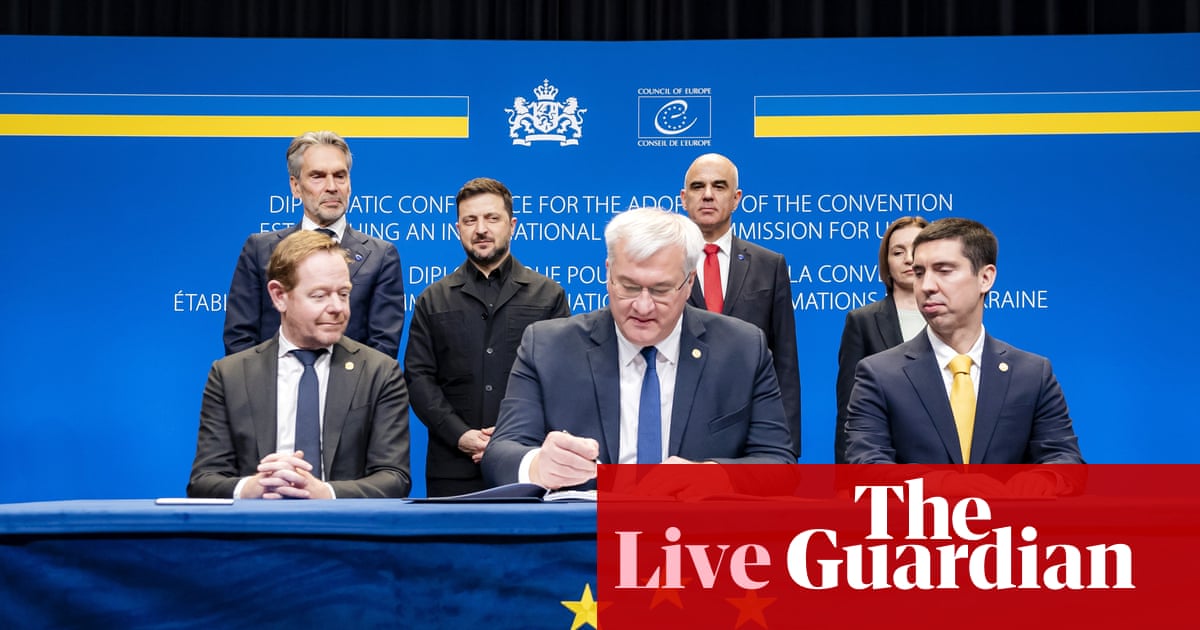
Leaders sign treaty establishing international Ukraine war damages body
The treaty is now signed, establishing the International Claims Commission of Ukraine.
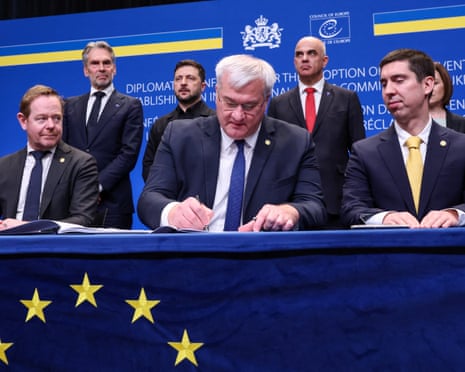 Ukrainian President Volodymyr Zelenskiy, Dutch Prime Minister Dick Schoof, Secretary General of the Council of Europe Alain Berset and Moldovan President Maia Sandu stand behind Ukrainian Foreign Minister Andrii Sybiha, Moldovian Foreign Minister Mihai Popsoi and Dutch Foreign Minister David van Weel during the signing of a treaty to establish the International Claims Commission for Ukraine in the Hague. Photograph: Piroschka Van De Wouw/ReutersShare
Key events
18m ago
Estonia ferry disaster in 1994 caused by bow failure not explosion, report confirms
37m ago
EU to water down landmark ban on new petrol and diesel cars
1h ago
Russia labels Deutsche Welle ‘undesirable’ organisation
2h ago
‘Russia remains threat today, tomorrow, and for foreseeable future,’ Finnish PM says
2h ago
Zelenskyy, Schoof back EU reparations loan as Ukraine could face ‘financial challenges’ without it
3h ago
Peace plans ready to be presented to Russia in days, says Zelenskyy
3h ago
‘If you start a war, you will be held to account,’ EU’s Kallas says
4h ago
Leaders sign treaty establishing international Ukraine war damages body
4h ago
Zelenskyy, leaders call for accountability for Russia’s acts against Ukraine
4h ago
Kremlin says Christmas truce depends on broader peace deal, Russia wants ‘achieve our goals’
5h ago
‘Every single detail matters,’ Zelenskyy says of peace talks, as he warns against rewarding Russia for aggression
5h ago
Zelenskyy warns ‘winter cold can become one of most dangerous weapons’
5h ago
Zelenskyy urges Netherlands to back EU reparations loan, use of frozen Russian assets
5h ago
‘We must make Russia accept there are rules in world,’ Zelenskyy says
5h ago
‘Most intense and focused negotiations’ since war started, Zelenskyy says
5h ago
Ukraine’s Zelenskyy about to speak in Dutch parliament
6h ago
Russia yet to see details of proposals, Kremlin says
6h ago
New European body to assess claims for reparations on Ukraine to be set up
6h ago
Morning opening: What are you saying, Russia?
Show key events only
Please turn on JavaScript to use this feature
Estonia ferry disaster in 1994 caused by bow failure not explosion, report confirms
The sinking of the Estonia ferry more than 30 years ago was caused by the failure of its bow section, not an explosion or collision as claimed by some, authorities have said, in a report aimed at finally closing the case on Europe’s worst civil maritime disaster since the second world war.
The bow door of the Estonia ferry being lifted from the bottom of the sea off Utö island in November 1994, nearly two months after the ferry sank in the Baltic Sea. Photograph: Jaakko Avikainen/LEHTIKUVA/AFP/Getty Images
“The MV Estonia sank as a result of the collapse of its bow construction,” Estonian, Swedish and Finnish investigators said. “There is, therefore, no reason to start a new full-scale … investigation of the accident.”
On the night of 28 September 1994, the roll-on, roll-off ferry sank in the Baltic Sea during a storm, claiming the lives of 852 people.
An official investigation in 1997 concluded that the ferry’s bow shield had failed, causing rapid flooding and sending the vessel to the bottom.
But alternative theories have continued to propagate and in 2020, video from a television documentary showed hitherto unseen holes in the ship’s hull, prompting authorities to take a fresh look at the disaster.
The report, which was based on six separate examinations of the wreck site, interviews with survivors, modelling and technical analysis, concluded that the damage to the hull was caused by rocks on the sea bottom.
“The inspections do not reveal any signs that the MV Estonia collided with any other vessel or object during its voyage,” the investigators said. “Nor are there any signs that an explosion occurred on the ship.”
A preliminary report in 2023 blamed rocks for the holes in the hull. It also concluded that the ferry was not seaworthy at the time of its final voyage.
ShareEU to water down landmark ban on new petrol and diesel cars Lisa O’Carroll
The EU has confirmed it will water down its landmark 2035 ban on the sale of new petrol or diesel cars, yielding to heavy pressure from the car industry and leaders from several EU member states including Germany and Italy.
Workers assemble an Volkswagen’s ID.3 electric car on a production line at the Volkswagen electric car factory in Zwickau, Germany. Photograph: Jens Schlueter/Getty Images
Under current legislation manufacturers were obliged to ensure that 100% of production of cars and vans had zero emissions up to 2035.
The European Commission confirmed on Tuesday that this will now be reduced to 90%, enabling the continued manufacture of a portion of plug-in hybrid electric cars, or even combustion engines beyond 2035.
However, in a carrot-and-stick approach, the remaining 10% of assembly line output that is not carbon neutral will need to be compensated by other green measures on the factory floor, including the use of green steel made in Europe or use of biofuels in non-electric vehicles.
“This will allow for plug-in hybrids (PHEV), range extenders, mild hybrids, and internal combustion engine vehicles to still play a role beyond 2035, in addition to full electric (EVs) and hydrogen vehicles,” the commission said.
The commission has also relaxed targets for electric vans, reducing the requirements for a 50% reduction in carbon emissions by 2030 to 40%.
The move, which follows lobbying by chancellor Friedrich Merz and Italian prime minister Giorgia Meloni, will be seen as a victory for the European car industry which has struggled to make the transition to electric and now faces growing competition from Chinese rivals.
The decision, which had been widely anticipated in recent days, has already been denounced by the Green party in the European parliament which has said it amounts to a “gutting” of flagship legislation aimed at cutting Europe’s emissions.
Share Jakub Krupa
Let’s take a quick look at other news across Europe.
ShareRussia labels Deutsche Welle ‘undesirable’ organisation
Russia has blacklisted Germany’s news broadcaster Deutsche Welle (DW) as an “undesirable” organisation, which means anyone who works or supports such a group could be prosecuted in the country.
DW had already been declared a “foreign agent” by Kremlin, along with several other organisations or groups critical of Moscow’s invasion.
DW has a Russian-language service but closed its Moscow bureau in 2022 after threats it would be expelled. This was seen as a tit-for-tat move against Germany banning broadcasts by Russia’s RT state broadcaster in 2022.
Updated at 09.44 EST
They reinforced commitments to advancing “the Eastern Flank Watch”, which includes a European drone defence network.
They also outlined again Nato’s Article 5 significance and said EU specific defence efforts were complementary to that foundational defence and deterrence standing
Strengthening Europe’s defence readiness… in alignment with NATO plans and requirements is essential. Complementarity between NATO and the EU is not optional— it is a strategic imperative”
By uniting at the highest political level, we send a clear and unequivocal message: Europe’s Eastern Flank is a common responsibility and must be defended with urgency, leadership and resolve.
The security environment has changed irreversibly, and we must adapt with determination and speed.”
Updated at 08.58 EST
Some more from the Eastern Flank summit where leaders of the eight EU countries most exposed to Russia have met in Helsinki to shore up defence collaboration.
They led off their joint statement saying Russia is the “most significant, direct and long-term threat to security, peace and stability in the Euro-Atlantic area” and said that besides the invasion in Ukraine, Russia’s hybrid operations and sabotage against Europe were increasing.
Attempts to destabilise our societies must be viewed as part of Russia’s ongoing war of aggression against Ukraine,” the statement read.
We remain committed to increasing our support for Ukraine while ramping up pressure on Russia. We will also continue to work closely with our partners being targeted by Russian hybrid activities, especially the Republic of Moldova.
Updated at 09.05 EST
‘Russia remains threat today, tomorrow, and for foreseeable future,’ Finnish PM says
Leaders of the eight “eastern flank” countries – that’s the Nordics, the Baltics, Bulgaria, Poland and Romania – are now speaking at a joint press conference after their talks in Helsinki and they have a strong message on Russia.
Bulgaria’s prime minister Rossen Jeliazkov, Poland’s prime minister Donald Tusk, president of Lithuania Gitanas Nauseda, Finland’s prime minister Petteri Orpo, Romania’s president Nicusor Dan, Latvia’s prime minister Eviika Silina, prime minister of Sweden Ulf Kristersson, and Estonia’s prime minister Kristen Michal brief the media at the Eastern Flank Summit at the House of the Estates in Helsinki, Finland. Photograph: Sergei Grits/AP
Speaking alongside the leaders of Bulgaria, Estonia, Latvia, Lithuania, Poland, Romania, Sweden, Finland’s prime minister Petteri Orpo says the meeting takes place as “Europe is facing some of the most serious and existential questions of our time.”
Orpo says that “we are closer to peace than ever before,” but warns that “we do not see any signs that Russia really wants peace.”
Russia remains a threat today, tomorrow, and for the foreseeable future, for the whole of Europe. This is the reason we are strengthening our cooperation.
He says:
“We share a strong political will to reinforce our common security and Europe’s defence, starting from the eastern flank.”
Estonian prime minister Kristen Michal hit similar tones as he says that “Europe’s security is closely tied to Ukraine.”
“If Russia is not strategically defeated in Ukraine, it will become bolder,” he warns.
He also calls for the adoption of the EU reparations loan for Ukraine at this week’s European Council.
“It is the best option to give Ukraine the financing it needs quickly, and it puts Ukraine into stronger position for a just and sustainable peace,” he says.
Sweden’s Ulf Kristersson repeats the warning:
“Russia is the long term defining threat to Euro-Atlantic security and the war of aggression against Ukraine threatens literally, not only the eastern border of the European Union, but the continent as a whole.”
Just a little bit of newsy nugget there at the very end of Zelenskyy/Schoof press conference, as the Ukrainian president says that the US is now expected to take the documents discussed last night in Berlin to Russia to talk about the proposed security guarantees, 20-point peace plan, and a reconstruction plan for Ukraine.
Zelenskyy and Schoof also get asked about the prospect of Ukraine joining the European Union.
Schoof stresses the Dutch “are fully supportive” of membership for the EU.
Zelenskyy says he sees the EU accession process as part of a broader discussion on Ukraine’s security guarantees, in the context of economic security.
He says “we know why and who is trying to block” the accession process.
(He means Hungary, which has long argued that, essentially, it would be wrong for the bloc to admit a country at war.)
Zelenskyy and Schoof get also asked about the European-led multinational force expected to help with maintaining the peace in Ukraine, if a deal is reached.
Schoof goes first and says that during the Berlin talks the new security guarantees “became very strong,” and the package being discussed “gives the real opportunity for Ukraine to negotiate with Russia.”
He says that the Netherlands would have to go through a parliamentary procedure if the country was to confirm its participation in the force.
Zelenskyy says that different countries will have different roles, from logistics through intelligence to troops deployment. He says “a lot of countries are really ready to help.”
ShareZelenskyy, Schoof back EU reparations loan as Ukraine could face ‘financial challenges’ without it
Ukraine’s Zelenskyy is now speaking at a press conference with the Dutch prime minister, Dick Schoof, and the pair just got asked about the use of frozen Russian assets and the EU’s proposal for a reparations loan.
Schoof says the Netherlands sees the loan as “the preferred option,” but he acknowledged legal concerns from a number of countries, including, critically, Belgium where Euroclear is based.
He says he agrees with Belgium that the risk needs to be shared by all countries with legally guarantees, so that “all EU member states take their fair share.”
“It will be a difficult decision, but I sincerely hope that we come to an agreement on Thursday and that the financial needs of Ukraine can be solved with the help of the frozen assets,” he says.
Zelenskyy acknowledges that Ukraine “definitely” faces “financial challenges,” and says “it is definitely not easy for Ukraine.”
He says it would be difficult for Ukraine to “stand strong” without this support and cover some of the financial issues it faces.
But he generally repeats his points on how important it is for the EU leaders to agree to the loan.
SharePeace plans ready to be presented to Russia in days, says Zelenskyy
Shaun Walker and Peter Beaumont
Volodymyr Zelenskyy says proposals negotiated with US officials on a peace deal to end Russia’s war in Ukraine could be finalised within days, after which American envoys will present them to the Kremlin.
Ukrainian president Volodymyr Zelensky and German chancellor Friedrich Merz (not pictured) hold talks at the Chancellery in Berlin, Germany. Photograph: Action Press/Shutterstock
After two days of talks in Berlin, US officials said on Monday they had resolved “90%” of the problematic issues between Russia and Ukraine, but despite the positive spin it is not clear that an end to the war is any closer, particularly as the Russian side is absent from the current talks.
In the early hours of Tuesday morning the Ukrainian president said the US Congress was expected to vote on security guarantees and that he expected a finalised set of documents to be prepared “today or tomorrow”. After that, he said, the US would hold consultations with the Russians, followed by high-level meetings that could take place as soon as this weekend.
“We are counting on five documents. Some of them concern security guarantees: legally binding, that is, voted on and approved by the US Congress,” he said in comments to journalists via WhatsApp. He said the guarantees would “mirror article 5” of Nato.
The main sticking point between the Ukrainian team and US negotiators remains the issue of land. Trump wants Ukraine to give up the parts of the Donbas region it still holds, while Ukraine wants to freeze the lines at the current point of contact. “We are discussing the territorial issue. You know it is one of the key issues. At this point, there is no consensus on it yet,” Zelenskyy said after the Berlin talks.
It is not clear how the two sides will proceed on the territorial issue, with Zelenskyy previously suggesting that a compromise solution such as a free economic zone could be theoretically possible if the Ukrainian people voted for it in a referendum. The critical stumbling block is likely to be when the plans are put to the Russian president, Vladimir Putin, who has given no sign he is willing to compromise on his war aims.
“If Putin rejects everything, we will end up with exactly what we are experiencing on our plane right now – turbulence,” said Zelenskyy, recording the comments after his plane took off from Berlin for the Netherlands for a series of meetings on Tuesday.
Share‘If you start a war, you will be held to account,’ EU’s Kallas says
Speaking at the event in the Hague, EU foreign policy chief Kaja Kallas said Russia cannot escape paying the bill for its war in Ukraine.
The commission, which will validate war damages in Ukraine to be paid by Russia, sends a message to future aggressors, Kallas said in comments reported by Reuters, that “if you start a war, you will be held to account”.
She also announced the EU would provide “up to one €1m” to pay for the preparatory work for the new commission.
Updated at 07.05 EST
Leaders sign treaty establishing international Ukraine war damages body
The treaty is now signed, establishing the International Claims Commission of Ukraine.
Ukrainian President Volodymyr Zelenskiy, Dutch Prime Minister Dick Schoof, Secretary General of the Council of Europe Alain Berset and Moldovan President Maia Sandu stand behind Ukrainian Foreign Minister Andrii Sybiha, Moldovian Foreign Minister Mihai Popsoi and Dutch Foreign Minister David van Weel during the signing of a treaty to establish the International Claims Commission for Ukraine in the Hague. Photograph: Piroschka Van De Wouw/ReutersShareZelenskyy, leaders call for accountability for Russia’s acts against Ukraine
Ukraine’s Zelenskyy has just been speaking again at the launch of The International Claims Commission for Ukraine (10:39).
In his very brief remarks, he largely followed the same lines as in the Dutch parliament, saying that “all pressure on Russia must remain in place for as long as occupation of our land continue.”
“As long as our people remain in Russian captivity and until the Ukrainian children abducted by Russia are brought home, sanctions must limit Russia, until it shows respect for peaceful for peaceful life and the rights of its neighbours. And of course, of course, every Russian war crime must have consequences for those who committed them,” he said.
He said that making Russia accountable for its crimes is needed to “that others learn not to choose aggression.”
Speaking before him, the caretaker Dutch PM, Dick Schoof, warned that “there must be no impunity” for Russia’s acts in Ukraine.
“Today is all about justice, because without it, there can be no just and lasting peace. But justice doesn’t just follow automatically. We need to lay the groundwork and prepare as carefully as possible,” he said.
Similar sentiment was expressed by Moldova’s president Maia Sandu, as she warned that “where accountability is avoided or postponed, violence returns, often in more destabilising forms.”
“Accountability is a condition of security today and for the future. But accountability is not only about Ukraine, and it is not only about one aggressor and one victim. Accountability is about Europe, about every country in Europe, it is about whether Europe as a whole is willing to defend its peace,” she said.
Updated at 06.31 EST