
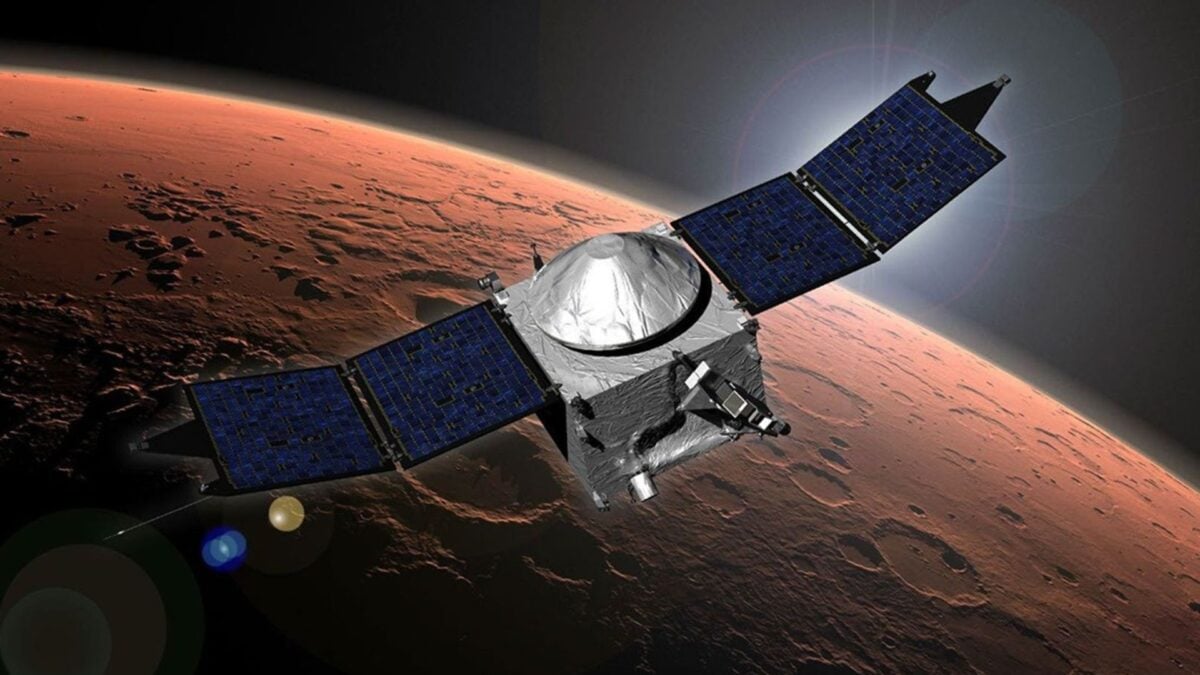
Last week, NASA revealed that it lost contact with a vital Martian probe that’s been studying the Red Planet for more than a decade. Despite the mission team’s efforts to restore communication with the orbiter, their latest status report does not bode well.
On Monday, NASA confirmed that it hasn’t received telemetry from the MAVEN (Mars Atmosphere and Volatile EvolutioN) spacecraft since December 4, but said the team did recover a brief fragment of tracking data from December 6. Analysis of that signal suggests that the orbiter was rotating in an “unexpected manner” and that its orbital trajectory may have changed.
“The team continues to analyze tracking data to understand the most likely scenarios leading to the loss of signal. Efforts to reestablish contact with MAVEN also continue,” the NASA statement reads.
MAVEN, do you copy?
The probe launched toward the Red Planet in November 2013 and entered Martian orbit 10 months later. It’s been studying the planet’s atmosphere ever since, working to determine how much of it has been lost over time by measuring the current processes and rate of atmospheric escape and extrapolating backward.
MAVEN also plays an important role in NASA’s exploration of the Martian surface. It’s one of four orbiters that relay communications between ground control and the Perseverance and Curiosity rovers. Fortunately, the other three orbiters (NASA’s Mars Reconnaissance Orbiter, Mars Odyssey, and the European Space Agency’s ExoMars Trace Gas Orbiter) remain operational.
“For the next two weeks of scheduled surface operations, NASA is arranging additional passes from the remaining orbiters, and the Perseverance and Curiosity teams have adjusted their daily planning activities to continue their science missions,” NASA stated Monday.
An existential threat
This isn’t the first time the aging spacecraft has been in peril. MAVEN was out of commission for most of 2022 after NASA lost contact with it. Once communication was restored, the ground team discovered an issue with the orbiter’s Internal Measurement Units (IMUs), which are crucial for navigation, orientation, and stabilization.
The mission team overcame this by putting MAVEN in a state of hibernation called “safe mode,” then uplinking new software that allowed the spacecraft to navigate using the stars as static reference points instead. MAVEN still relies on this “all-stellar” navigation system today, but now, the spacecraft appears to be disoriented again.
When MAVEN first launched, it was only meant to spend one year in Martian orbit. It’s now in its 11th year. If NASA can get it up and running again, the orbiter has enough propellant to remain operational through at least the end of the decade. But even then, it will face another existential threat.
The proposed NASA budget for fiscal year 2026 aims to cancel funding for MAVEN and other NASA missions that are operating far beyond their originally planned lifespans. The Senate appropriations bill could save them, but that remains to be seen.
For now, the more important question is whether there will be a functioning MAVEN spacecraft to save. NASA will continue to provide updates as its engineers work to regain contact with the orbiter.