
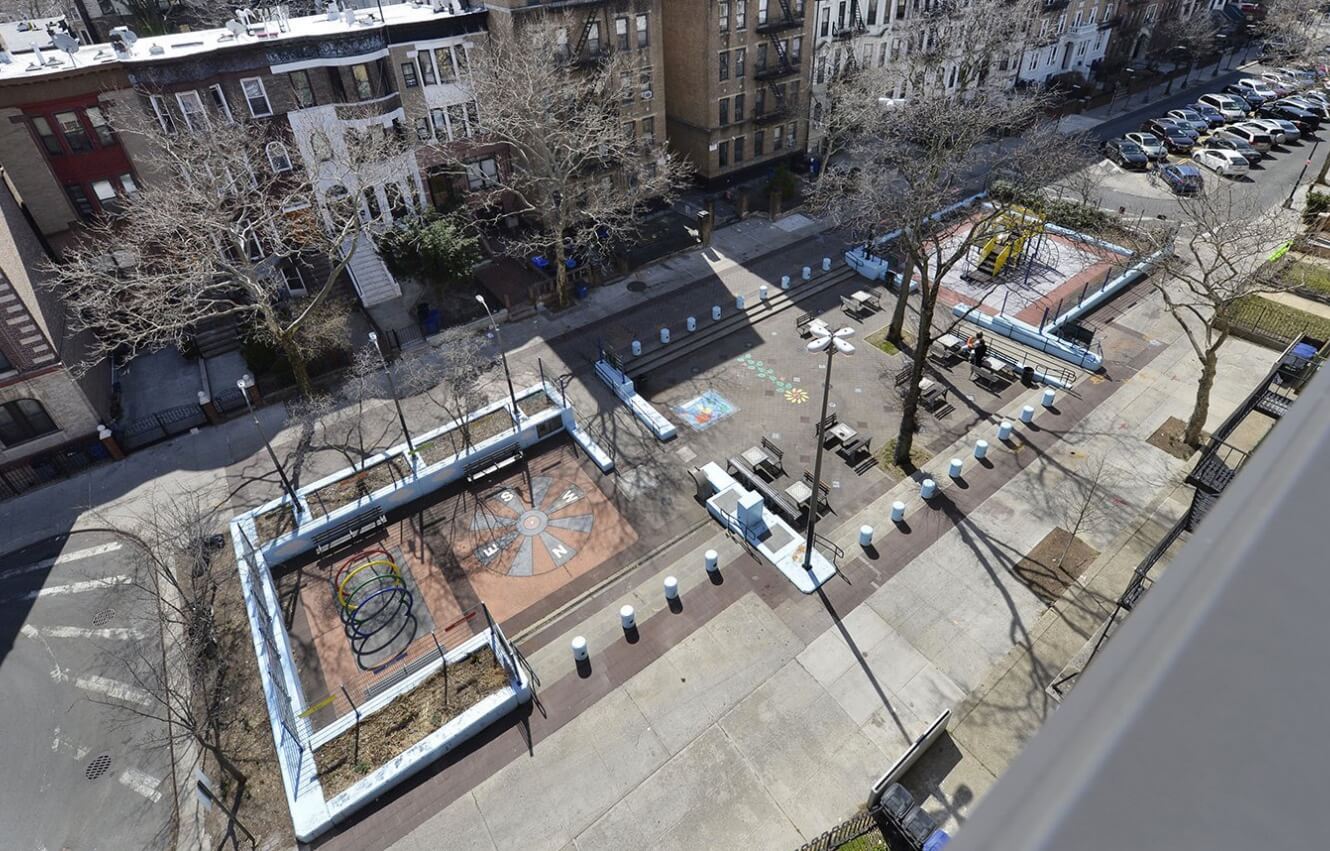
A Brutalist public plaza completed in 1969 by I. M Pei and M. Paul Friedberg in Crown Heights, Brooklyn, will be reconstructed by the New York City Department of Parks & Recreation (NYC Parks). The project entails replacing “fencing, walls, and pavers” the Landmarks Preservation Commission (LPC) said today, December 16, in a hearing. LPC approved the proposal this morning in a 7-to-1 vote.
The historic site is located on St. Mark’s Avenue between Kingston and Albany Avenues. It is closed off to traffic, but not resident parking—diagonal rows of cars edge the mid-block park on both sides. Pei was the urban designer and Friedberg conceived the play equipment. Many of the original features were lost over time.
NYC Parks says the renovation is essential for increasing children’s amenities, better integrating the park into the streetscape, enhancing sight lines, and improving public safety. (Motorists often drive on the mid-block plaza, endangering children.) Michael Gotkin, a New York–based landscape architect and historian, has been advocating to preserve the park’s Brutalist integrity while adhering to public safety concerns.
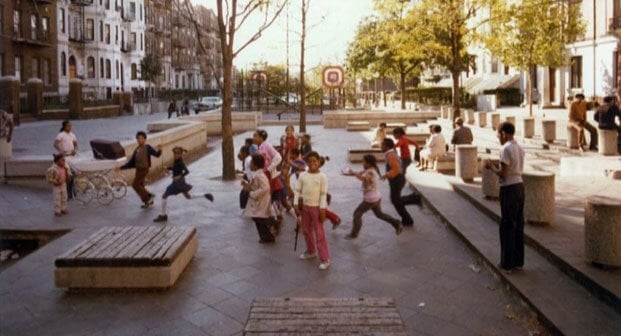 St. Mark’s Playground circa 1970s (Courtesy Gil Amiaga/NYC Parks)
Gotkin characterized the original design as “a Brutalist landscape very much of its time: sharply geometric, mostly rectilinear with contrasting regular geometric circles, exposed concrete tempered by warm brown asphalt and brick pavers, simple ‘lollipop’ globe pedestrian-scale lights, seating incorporated fully into the design, and a fountain centerpiece that was a harmony of circles within a square.”
The new proposal by NYC Parks “shows a variety of pavements and furnishings from their standard catalog, resulting in a hodge-podge of styles and materials within the remaining bones of the Pei design,” Gotkin told AN before adding that the park “can and should be restored to be more sympathetic to its original details and to the historic design of the superblock in which it exists.”
A Super History
Pei Cobb Freed & Partners completed a master plan for the Bedford Stuyvesant Restoration Corporation (BSRC) in the 1960s—envisioning two pilot “superblocks” on St. Mark’s Avenue and Prospect Place with widened sidewalks, narrower roads, and new street furniture, playgrounds, and tree-lined pedestrian spaces.
Gotkin noted that the St. Mark’s superblock can be understood as a “corrective” to Pei’s Society Hill Towers in Philadelphia where the “physical design was highly praised, but the programmatic removal of the original neighborhood residents was widely loathed,” marred by the “forcible removal” of Black families to make way for the urban renewal project.
“The same Brutalist design elements that Pei had used to great acclaim at Society Hill were transposed to the Brooklyn superblock, featuring geometric wood and concrete seating, walls, planters, and fountains and also brick paving that collectively became the hallmarks of Pei’s urban interventions,” Gotkin said.
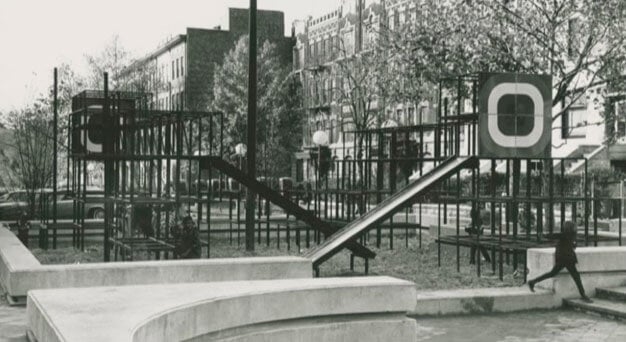 The play equipment was designed by M. Paul Friedberg, who died earlier this year. (Courtesy Gil Amiaga/NYC Parks)
New York Senator Robert F. Kennedy tasked the BSRC with preparing a revitalization plan for Bedford-Stuyvesant and Crown Heights in 1966. That year, Kennedy described the combined neighborhoods as “653 blocks, stretching over nine miles […] crammed with 450,000 people” with abnormal infant mortality, delinquency, dropout, unemployment, and poverty rates.
Plans by Pei and Friedberg were rolled out in 1967 and St. Mark’s Playground opened in 1969. Ethel Kennedy attended the ribbon cutting after her husband’s assassination in 1968, as did then-New York City Mayor John Lindsay, and Senators Jacob Javits and Charles Goodell, as reported by The New Yorker in an article aptly titled, “Super Block.”
“This day belongs to someone who is not here,” Lindsay said at the opening. “This is Robert Kennedy’s day. It was his energy that brought together men from the community and from the city to build a new Bedford-Stuyvesant.”
A “superblock youth patrol” staffed by local teenagers was assembled to assist with public safety, and make sure that motorists follow the area’s parking rules. Square benches were speckled in the sunken plaza that was to be flooded with water in the hot months, stemming from a bespoke fountain. It used the same benches as the 1964 New York World’s Fair in Queens.
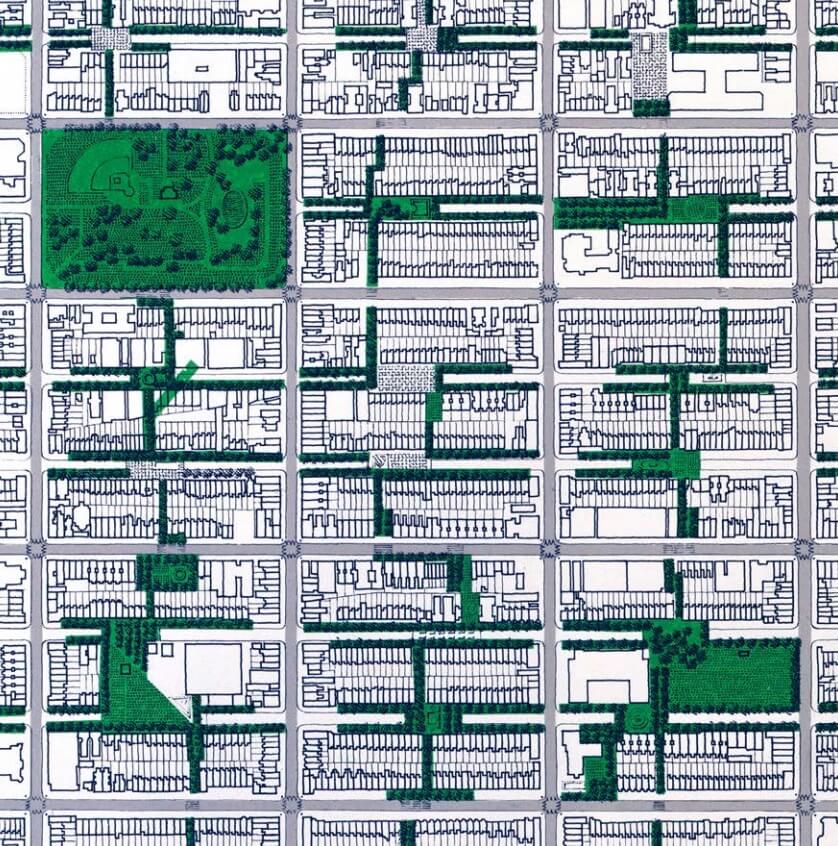 The master plan by Pei conceived other superblocks spread throughout Bedford-Stuyvesant and Crown Heights, but those were never realized. (Courtesy NYC Parks)
Inspired by Jane Jacobs, the masterplan called for more superblocks all throughout Bedford-Stuyvesant and Crown Heights (Kennedy wanted to build them in cities throughout the country) but those never came to fruition.
The St. Mark’s superblock was renovated by NYC Parks in 2002. The redesign removed the original fountain, and several trees. The semi-circular concrete catch basin for fountain runoff was removed and replaced with steps. Gotkin called the redesign “ill-conceived” and said it “damaged but did not destroy the integrity of the original superblock.”
Today, Pei’s Crown Heights superblocks are much lesser known in comparison to his other New York City projects like the Silver Towers in Greenwich Village, which also employed a superblock concept. NYC Parks officials presented a renovation plan for St. Mark’s Playground in summer 2025 and estimate the proposed reconstruction project will cost $2.8 million.
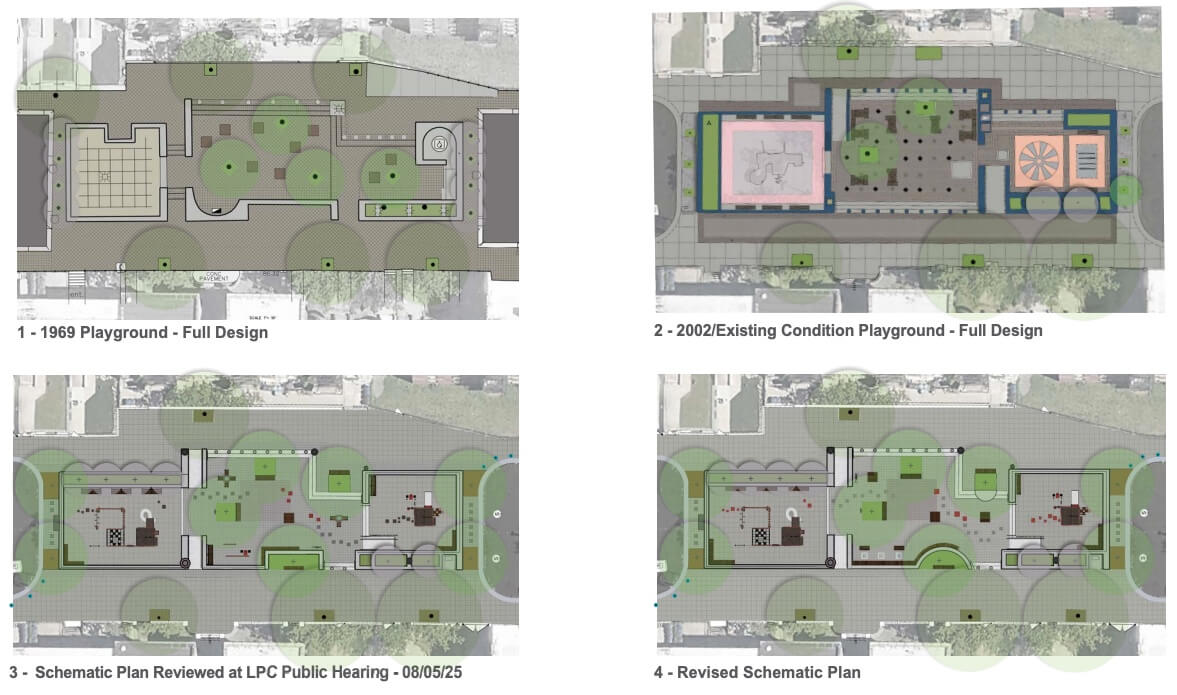 Site plans of the playground and public plaza, from 1969 to today. (Courtesy NYC Parks)
Revised plans show the return of some existing features from the 1969 version, like the semi-circular concrete form. Playground cubes would be changed to red, as per the original design. Gotkin, however, believes NYC Parks can do better.
“Pei’s original Brutalist site furnishings, custom designed but easy to produce, should be restored rather than the disparate, off the shelf furnishings that Parks is proposing,” Gotkin said, in his critique of the NYC Parks proposal. “The spirit and integrity of Friedberg’s original integrated geometric play equipment can be reinterpreted while being upgraded for current safety standards.”