

In Washington, D.C. Maryland Congressman Jamie Raskin introduced legislation today to preserve the White House. The AIA is working with Congressman Raskin’s office on the bill.
Carole Wedge, the AIA’s executive director, told AN this “legislation will ensure that any future alterations to the White House, including large-scale projects like the East Ballroom addition, are subject to transparent review and public accountability processes that reflect the building’s historic and symbolic significance to the American people.”
“The American Institute of Architects supports The People’s White House Historic Preservation Act,” Wedge affirmed.
The People’s White House Historic Preservation Act would require the president to submit White House renovation proposals to the National Capital Planning Commission (NCPC) and U.S. Commission of Fine Arts (CFA), establishing a new formal review and public comment process to hold the executive office accountable to the American people.
The legislation is in response to “President Donald Trump’s demolition of the East Wing to build a massive ballroom funded by corporations and wealthy donors,” Raskin’s office said in a statement. “Americans watched in horror as President Trump reduced the East Wing of the White House to a pile of rubble to pave the way for his self-appointed Marie Antoinette ballroom,” Raskin affirmed.
“My legislation returns power to the American people to protect the house we built for our presidents,” the Maryland Congressman continued. “The White House belongs to all of us—not to one lawless president building a ballroom funded by tech oligarchs and his fellow plutocrats.”
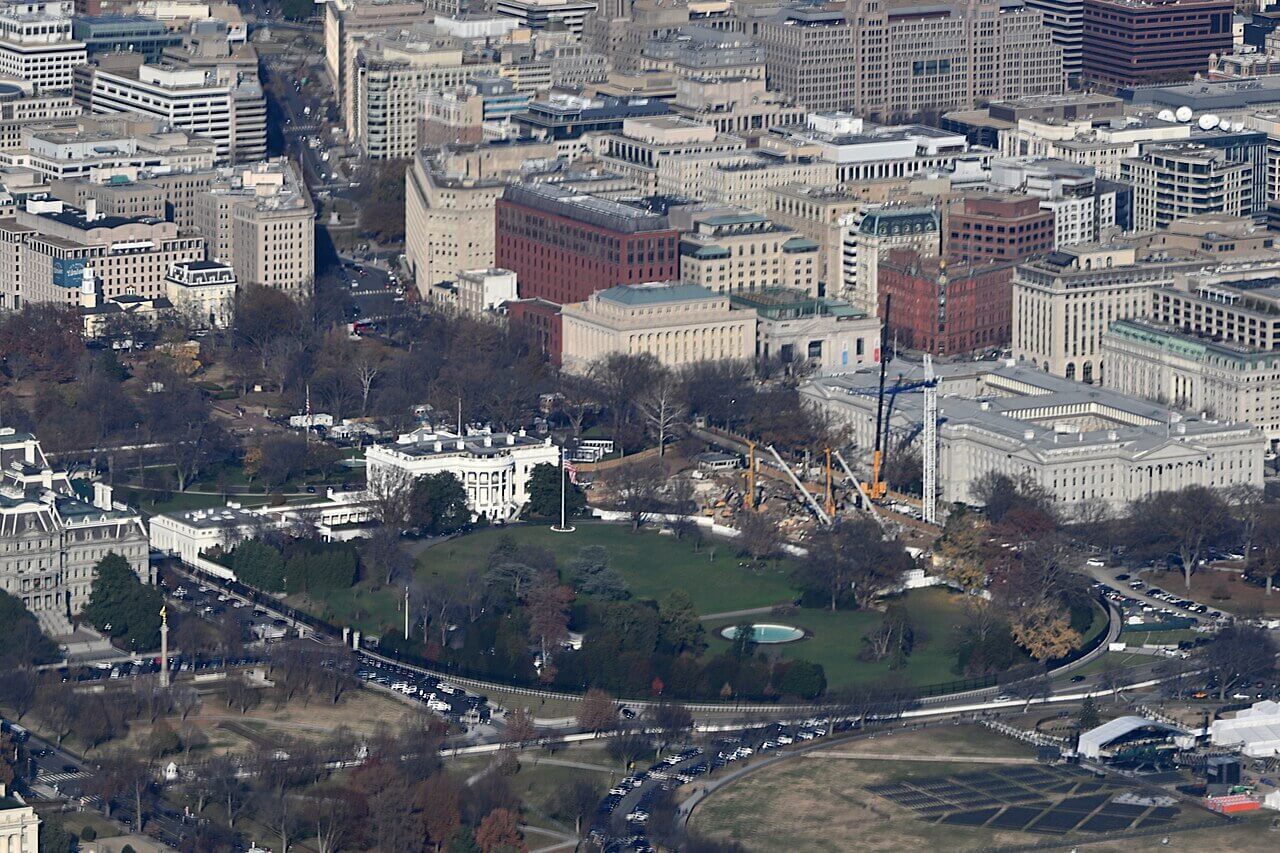 Aerial view of the former East Wing construction site on December 3 (G. Edward Johnson/Wikimedia Commons/CC BY-SA 4.0)
If approved, the bill would remove the White House’s statutory exemption from the National Historic Preservation Act’s Section 106 review process, an exemption the Department of Justice (DOJ) invoked yesterday to defend President Trump’s actions. “The president possesses statutory authority to modify the structure of his residence, and that authority is supported by background principles of executive power,” DOJ stated in a filing.
The bill would give NCPC, CFA, and other stakeholders authority to reject “potentially adverse” changes to the White House by the president. The parties would need to agree on a resolution and record it though a Memorandum of Agreement or Programmatic Agreement. If the parties cannot reach a resolution, the proposal would be brought before the Advisory Council on Historic Preservation, which would have the final say.
Co-sponsors of Raskin’s bill are representatives Andre Carson, Troy Carter, Judy Chu, Yvette Clarke, Bonnie Watson Coleman, Danny Davis, Madeleine Dean, Veronica Escobar, Valerie Foushee, Robert Garcia, Dan Goldman, Steny Hoyer, Sydney Kamlager-Dove, Raja Krishnamoorthi, Dave Min, Gwen Moore, Eleanor Holmes Norton, Chellie Pingree, Jan Schakowsky, Mark Takano, Bennie G. Thompson, Dina Titus, Nydia Velázquez, Mark Pocan, Sylvia Garcia, and Jared Huffman.
This news comes after a lawsuit was filed December 12 by the National Trust for Historic Preservation that said “dozens of workers [are] driving piles, stockpiling materials, and amassing heavy machinery” at the former East Wing site, where the gilded $300 million ballroom is underway.