
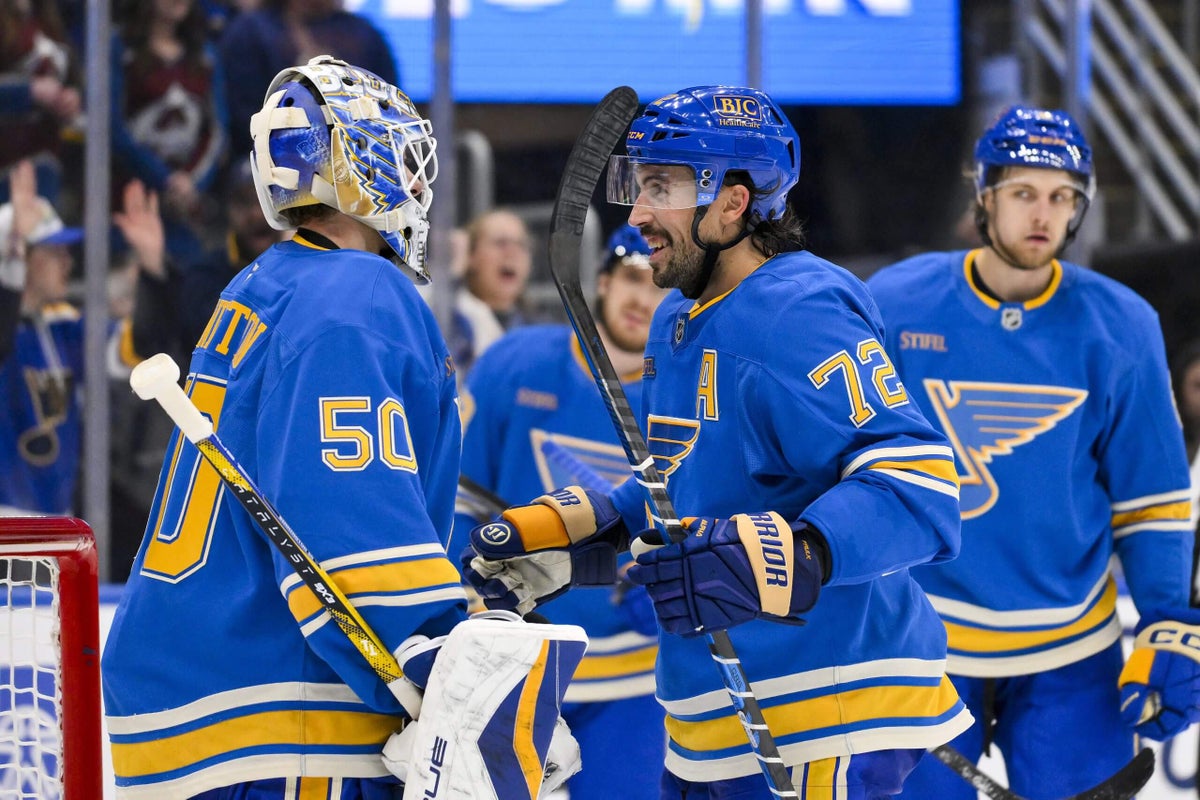
ST. LOUIS — Doug Armstrong has always been a realist.
So while the St. Louis Blues’ game Wednesday against the Winnipeg Jets is only their 35th this season and they are just four points out of a playoff spot, their president of hockey operations and general manager knows the Blues’ .456 points-percentage is more indicative of their playoff potential.
That’s why when he was asked Tuesday about the Blues still being in the mix mathematically — as they were when they went on an incredible run after the 4 Nations Face-Off last season — he answered the question practically.
“Yeah, I hope they go on a run,” Armstrong said. “I hope a lot of things. But hope is a bad strategy. The reality of our industry is, as a group, they’ve got to go on a run, so when the phone rings I say, ‘No.’”
Answering the phone and saying “No” is a reference to NHL teams calling the Blues and asking them about potential trades. That’s what it’s come to for the club, even 80 days out from the league’s March 6 trade deadline.
“I’m not doing this to threaten anybody, but as (former NFL coach) Bill Parcells said, ‘You are what you are,’ and right now we’re 28th in winning percentage, so everything has to be considered and addressed.
“The way the league operates, when we were a highly functioning team, you would call teams that weren’t highly functioning and say, ‘What are you going to do?’ We’re starting to field those calls that we don’t want to field. I can’t stop people from calling, and we’re not doing our due diligence if we’re not listening.”
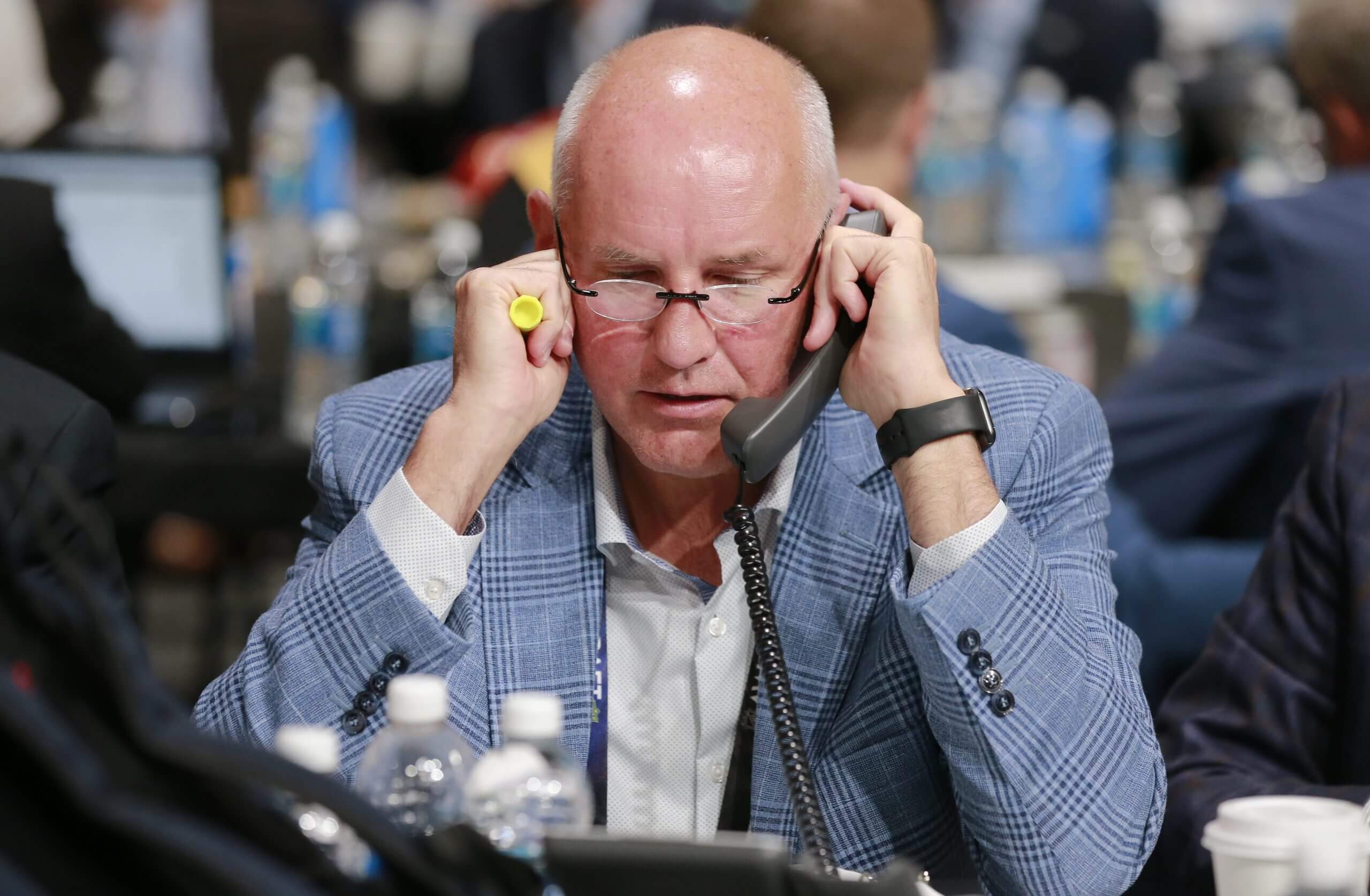
Doug Armstrong is listening on trades with the Blues in the NHL cellar. (Jeff Vinnick / Getty Images)
They’re actually 30th in points percentage as of Tuesday, but if you’re looking for the Blues (12-15-7) to start wheeling and dealing soon, you might be waiting.
As Armstrong has noted in the past, he reminded everyone again on Tuesday that the NHL is a “deadline league,” which means trades typically don’t come to fruition until being forced by a deadline.
The first deadline is the NHL holiday freeze that runs Dec. 19 to 27, but that’s what Armstrong calls an “artificial deadline.”
“So, yeah, teams are starting to kick tires and starting to ask where we’re at, and we’re saying, ‘We’re certainly not pleased with where we’re at. What are your ideas?’” Armstrong said. “Historically, you look when trades happen, they don’t happen right now. The meat of what teams do is closer to the deadline.
“If it made sense today, we would do it today, but a lot of it is, ‘Well, I’m not there yet, but keep me in the loop.’ They’re setting the table for when you’re actually going to do it.”
There’s another date to keep in mind this season, and that’s the start of the 2026 Winter Olympic break, which runs Feb. 4 to 24. There will be another trade freeze in place during the Olympics, but teams also may not want to make deals before Feb. 4 because the salary-cap hits of players they acquire would be on their caps throughout the three-week break.
“The majority of the (general managers), especially in Olympic years, the teams that are close to the cap, they want to make that deal the day after the Olympics because they don’t want that cap eating away at their cap when they’re not playing them,” Armstrong said. “When they’re not playing, they don’t want to pay. It’s not the money; it’s the cap space.”
So while Armstrong isn’t ruling out the possibility of a December move — he referenced the recent Quinn Hughes trade to the Minnesota Wild as an example — he’s being realistic.
“Our job is to prepare for anything on any given day, but our job is to also understand the natural flow of the NHL and when things happen,” he said. “I’m just going on the actuary table, but there are situations that could just take one phone call for something.”
So if the Blues are open for shop, who would they be willing to send packing?
A few of the names rumored to be trade options — Brayden Schenn, Justin Faulk and Jordan Binnington — are players the Blues may have an incentive to move because they’re in their early-to-mid 30s with term left on their contracts.
Schenn, 34, has two more seasons left on his deal ($6.5 million average annual value) and generated trade interest last season. Faulk, 33, has one more season on his deal ($6.5 million AAV) and has played better than in recent years. Binnington, 32, has one more season left ($6 million AAV), and while he’s had a dismal season, he’s still considered one of the most competitive netminders in the league and someone who plays well in big games and can get on a roll in the playoffs.
Armstrong said he’d be willing to have discussions with those players, knowing that Schenn and Faulk each have 15-team no-trade lists and Binnington has a 14-team list.
“I’ve done that in the past,” Armstrong said. “You want a shared vision. I hope it doesn’t get to that. But I’m hoping they hope I don’t call them and say, ‘This is what we want. Are you OK with it?’ I would want to do what’s right for them, by them, because whatever success I’ve had, big or small, it’s off their backs.
“But I also want to make sure everyone is aware, too, that my loyalty is to the St. Louis Blues more than anything else. It’s to the organization. It’s to the fanbase. More than the owners or anyone else, my loyalty is to the Blues. I’m going to do whatever I think is right for Blues.”
Regarding Binnington, the franchise leader in games played and wins for a goaltender, Armstrong said: “If he gets to a point where he’s playing his best and we’re not there and he comes to me, or we go to him, I understand. That’s part of the business. I don’t view Binnington any different than I view other guys that I’ve worked with for a long time. Our job is to listen to how other people view us and view them, and respond to that.”
If the Blues were to move them, what would Armstrong be looking for?
“We would like to add into that group of players that are the (Jake) Neighbours, (Dylan) Holloways, (Philip) Brobergs, (Logan) Maillouxs, (Joel) Hofers,” he said. “I’m not saying those are all core players, but there’s an age group that you would like to add into. (But) to move anyone that could bring you a first-round pick, that’s likely to a team that has playoff aspirations, and that’s a pick (Nos.) 18 to 31, and historically that shows you those guys click in the league two to three to four years later.
“Well, that doesn’t do that group I’m talking about a lot of good because then they’ll be aged out. But that is an asset that you can use at a later date to get a player in that age group. So we have to be open to anything, meaning if it is the picks, then we’ll take that pick and do something with it at the draft. Our goal would be, if we acquire things, they have a name attached to them now, not a (draft pick) number.”
The Blues, of course, have younger core players in Robert Thomas, Jordan Kyrou, Colton Parayko and Pavel Buchnevich. Parayko, Thomas and Kyrou, in particular, would generate significant trade interest. Moving them would significantly shake up the team’s roster, which Armstrong may deem necessary if he doesn’t believe the departure of the aging veterans will cure what ails the Blues.
“There’s really no untouchables — not (just) on the St. Louis Blues, (but) there’s really few untouchables in the league,” Armstrong said. “There’s a lot of other guys that, when things aren’t going well, I would say that (trade) list grows. Things aren’t going well, so the list couldn’t be, ‘No, we could never ever consider that.’”
The issue is that all four are underperforming.
Thomas has seven goals and 23 points in 30 games. Kyrou has eight goals and 16 points in 28 games and is currently out with a lower-body injury. Buchnevich has five goals and 17 points in 34 games. Parayko has no goals and 10 points in 34 games and a minus-10 rating.
And while Thomas and Kyrou carry attractive AAVs ($8.125 million) for their potential production, they, along with Buchnevich ($8 million), all have five more years left on their contracts. If they’re not part of the solution in St. Louis, that’s a long time to keep them around.
But Armstrong wanted to make one thing crystal clear.
“We’re not selling 50 cents on the dollar out of anger,” he said. “We’re not considering trading players less than the value we think that they’re worth.”
One thing that’s also clear after hearing Armstrong speak Tuesday is that he’s not trying to kid himself about the Blues’ situation, and while it may take some time to play out, change appears inevitable.