
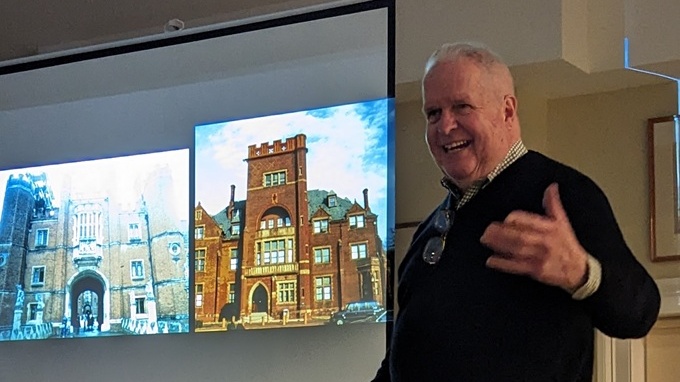
Ed Slipek teaching a class for Historic Richmond. The longtime architectural historian and critic died Monday after a brief illness. (Photo courtesy Historic Richmond)
“If the asphalt could speak, it’d remind us that this eastward sloping hillside was once a densely populated, mixed-use caldron of human activity.”
So wrote Edwin “Eddie” Slipek, in his signature eloquence, of the lost Council Chamber Hill neighborhood – an area just east of modern-day Capitol Square – in one of the dozens of guest commentaries and architectural reviews he contributed to Richmond BizSense since 2021.
In those years and over decades prior to that, for publications such as Style Weekly and Richmond Mercury, Slipek gave voice to innumerable stories behind the buildings and places that make up Richmond, establishing along the way his earned reputation as an expert in architectural history – and in conveying that history in his writings and lectures.
A native Richmonder and VCU alum, Slipek, who died Monday at age 75, wrote scores of architectural reviews and critiques over the years, and led classes and seminars at his alma mater’s arts school, at Maggie Walker Governor’s School and for Historic Richmond, the preservation nonprofit that he served occasionally as a board member and where in recent years he kept an office.
Cyane Crump, Historic Richmond’s executive director, called Slipek’s storytelling “engaging and accessible” and his contributions to the city “immense.”
“He was an unparalleled raconteur who could tell a story that was the hidden story behind the traditional history that you may have heard about a place…which really helped you understand why places looked the way they do today and who the people were who helped shape the way they look today,” Crump said.
Slipek’s journey into journalism and architectural history started in Ginter Park, where he grew up in a house on Seminary Avenue and attended John Marshall High School before studying at Boston University. He returned to Richmond to study architecture and art history at VCU, where he was also the head editor of the Commonwealth Times student newspaper, and went on to write for the Richmond Mercury, a short-lived alt weekly that ran from 1972-75.
Edmund Rennolds, the Mercury’s publisher, said Slipek’s talents stood out among its staff, which he described as made up mainly of Ivy Leaguers and UVA journalism grads. Recruited to the paper by the Mercury’s Garrett Epps, Slipek had skills that Rennolds said put to rest any debate over the value of a public college kid vs. Ivy League pedigree.
“Slipek more than held his own. He was one of the stars,” Rennolds said.
It was at the Mercury that Slipek got folks talking with his architectural reviews. Rennolds recalls Slipek coming to him with an idea for a piece titled: “The 10 ugliest buildings in Richmond.” No. 1 on the list was City Hall, which had just been built in 1971. The Mercury ran it and the fallout from Slipek’s take found its way to Rennolds in short order.
“Literally the next night I was at a banquet and I ended up sitting next to the guy who was the architect of City Hall. I was waiting for him to take a fork to me,” Rennolds said, laughing.
Those critiques would carry Slipek well beyond the Mercury and deep into a long career in journalism. He spent more than three decades writing such pieces at Style Weekly, before becoming a regular contributor to Richmond BizSense four years ago. Even in the weeks leading up to his sudden death, Slipek was working on two year-end columns that were set to be published in this publication.
While his career kept him firmly planted in Richmond, Rennolds said Slipek’s writing could have taken him anywhere.
“I think he was the best architectural reviewer in the country. I kept thinking, ‘Why don’t you go to Washington or New York, because you’re better than those guys,’” Rennolds said. “He was just always devoted to Richmond. He just didn’t want to leave. And thank God, because we were better for it.”
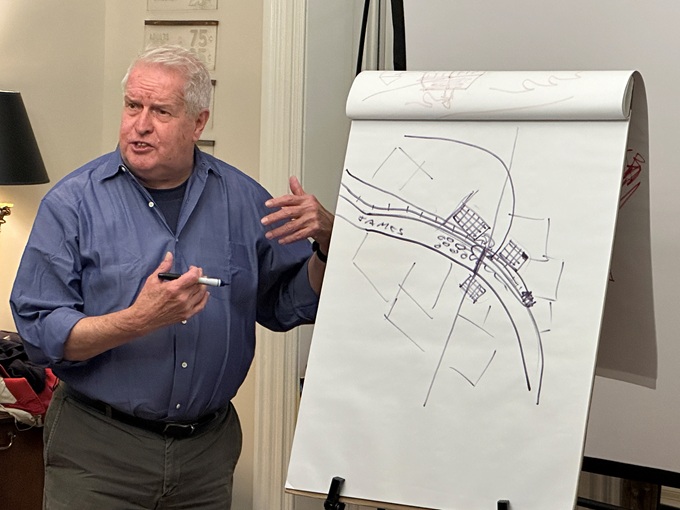
Slipek leading a discussion about Richmond’s development over decades in relation to the river, topography and street grid. (Photo courtesy Historic Richmond)
Bob Steele, a local architect who was introduced to Slipek after moving from New York in 1986, said Slipek’s critiques helped heighten the standard for architecture in Richmond in the decades that followed.
“The work that was being done in those decades was shameful, and Ed’s voice elevated the game. It takes decades, but look at where we are today. I have to attribute that to Ed,” Steele said. “Slowly but surely, he turned the ship, and I will be eternally grateful.”
Jennie Dotts, a local real estate agent who focuses on historic preservation, said Slipek was skilled at balancing his critiques with a desire to help the city improve. She recalled as an example Slipek’s writings about Union Hill long before the neighborhood became one of the city’s hotspots.
“Back then, it was crime-ridden and had lots of vacant buildings and was just not a pretty sight. But he just wrote lyrically about it, about the pattern of the street grid, and the charm of the old raised cottages. He helped amplify the importance of preserving it,” Dotts said.
“He was an educator. He always wanted to inform and enlighten people, and that’s not easy if you’re a critic and you have opinions,” she said. “He always had a way of tempering that criticism with his impulse to improve. He was never deprecatory or meanspirited. He was always looking to make things better.”
Architect Joe Yates, who befriended Slipek over the years as members of Second Presbyterian Church, visited Slipek the morning before he died. He said the two had been planning a trip to England next year to view country houses, and despite his speech being limited after a recent stroke, Yates said Slipek was in good spirits.
“I wound up by saying it was a pretty cheeky way to get out of going to England. He laughed and grabbed my hand,” Yates recalled. “He knew everything about Richmond and Richmond history, and was obviously such an advocate for the built environment in the city. He and I had our differences about certain buildings and projects, but we could joke with each other about it.”
Steele agreed.
“While he could blister in his reviews or his critiques, it was for the right reasons. He wasn’t a mean-spirited person at all. He did it in a way that nobody felt hurt or harmed, other than perhaps a few egos of real estate developers who cut corners or didn’t ask the right questions, or perhaps just frankly didn’t care. ” Steele said. “He wasn’t self-righteous or egotistical. He stuck by his principals of what was good and bad, and how could any architect not respect him for doing that? His opinion mattered to architects. They used his words to inspire our clients to do better.”
Architect Walter Parks said he ran into Slipek in recent weeks and, while he had somewhere he needed to be, ended up spending over an hour talking with Slipek – a conversation he especially cherishes now.
“He was very insightful. He was straightforward. He looked at the architecture holistically, how it sat in its neighborhood, how it related to its surroundings, how it existed for itself,” Parks said. “He was phenomenal at that, and he looked at architecture from very different perspectives: what is it to the city, what is it to somebody who’s lived here for years, what is it to somebody’s who’s new, how it affects people.
“He was a big proponent of not losing the Richmond he loved, to not lose all the little buildings,” Parks added. “I think there’s so many great articles that he had left to write that were in that kind of vein.”

Slipek was a regular contributor to BizSense’s guest commentary section since 2021.
That begs the question: who might take up the mantle for Slipek and write those unwritten articles?
“I’m heartbroken for the city, because we don’t have another Eddie Slipek,” said Dotts. “We don’t have another person who is advocating for the beautiful sense of space and excellence in architecture. There’s lots of wonderful people out there who are writing about architecture and architectural history, but he was an advocate.”
“He helped generations of people understand and appreciate Richmond’s historic built environment,” Crump added. “His legacy is that love of Richmond’s architecture. I can’t think of anyone out there with those same qualities, so he’s going to leave a big hole in our community.”
In what ended up being his last column for BizSense, Slipek in June reviewed the University of Richmond’s Burying Ground Memorial, which features, as he described: “stencil-like, cut-out forms” that, while appearing to be modernist and abstract, “are graphic symbols of African spiritual expression.”
“Themes represented include the existence of a supreme being, knowing the past as preparation for the future, and the bonds between family and community,” Slipek wrote.
To those who were close to him, those bonds continue.
“He didn’t talk about it, but you could just tell he was a very spiritual person,” Yates said. “He was just such a good man. He just lit up a room. He wasn’t bombastic, he never touted himself or his accomplishments; it was always about somebody else and somebody else’s achievements, and he was just so modest.”
“He was just so alive,” Dotts added, describing Slipek as “always smiling, his eyes twinkling and always on the verge of saying something.”
“I just can’t even imagine him static. His feet were moving, his mouth, his eyes, ears always open to what he was saying,” she said. “I just can’t even think of him not being alive. He’s very alive to me.”
A memorial service for Slipek is scheduled to be held Jan. 24 at 2 p.m. at Second Presbyterian Church. A visitation will be held the day before, details of which were being finalized.
BizSense editor Michael Schwartz contributed reporting.
Print Article