
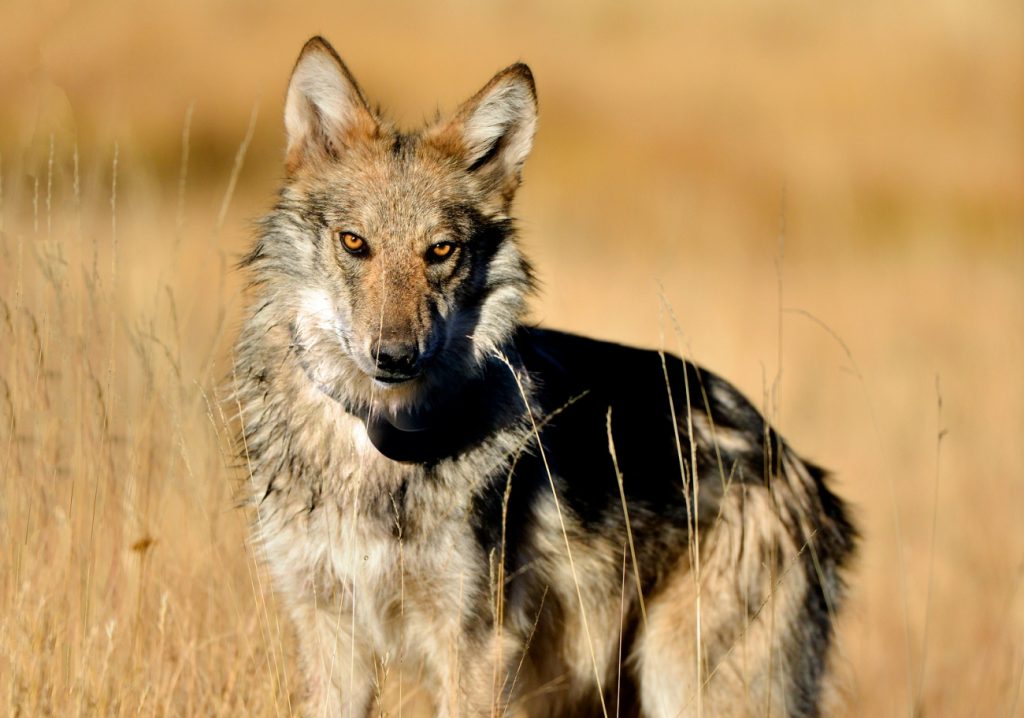
Colorado Parks and Wildlife released a gray wolf in Grand County last week after the animal was returned to the state by the New Mexico wildlife agency.
While the action was guided by an interstate agreement between Colorado and New Mexico, it has drawn animal welfare, public safety and policy concerns.
According to a statement from Eric Odell, Parks and Wildlife’s wolf conservation program manager, in the news release announcing the wolf’s release, the agreement — which enables New Mexico to return any of Colorado’s gray wolves that enter the southern state — is meant to protect the genetic integrity of Mexican wolves, “while also establishing a gray wolf population in Colorado.”
The agreement extends to both Arizona and Utah, although the latter does not have any known Mexican wolves in the state.
The Mexican wolf is a separately listed entity under the Federal Endangered Species Act that is subject to a U.S. Fish and Wildlife Service recovery effort in southern Arizona and New Mexico. The interstate agreement also stipulates that any Mexican wolves leaving the experimental population area in Arizona and New Mexico will be returned to that area.
“Gray wolf 2403 has been returned to Colorado and released in a location where it can best contribute to CPW’s efforts to establish a self-sustaining wolf population while concurrently attempting to minimize potential wolf-related livestock conflicts,” said the statement from Laura Clellan, the acting director for Parks and Wildlife. According to the agency, the location was selected for its distance from livestock and for its proximity to an unpaired female wolf and prey populations.
Grand County sheriff, commissioners speak out
The Grand County commissioners and sheriff individually sent letters to Gov. Jared Polis this week, demanding answers for the wolf’s re-release in the county of its birth.
The male wolf, collared and tagged as 2403, is among those born to the Copper Creek pack when it first denned in Grand County in 2024.
In an interview with the Vail Daily, Grand County Commissioner Merrit Linke said the wolf’s release last week was “strike four” when it comes to the Copper Creek pack.
Strike one, he said, was sourcing wolves from Oregon with known histories of depredation, referring to the pack’s original patriarch, which was a member of Oregon’s Wenaha Pack. The pack had been involved in a confirmed depredation two months before his relocation to Colorado.
While Colorado’s wolf plan stipulates that no wolves from known depredating packs would be selected for release in Colorado, it also holds that if a pack has “infrequent” depredation events, they should not be excluded as a source. Parks and Wildlife has said that the male patriarch’s pack fell into this latter category.
This May wolf died in September 2024 in a wildlife sanctuary from a gunshot wound sustained in the wild. The male and five other members of the Copper Creek pack — including the matriarch and four pups, 2403 among them — were removed from the area and placed in a wildlife sanctuary after the pack was tied to repeated livestock attacks in Grand County.
Linke said that “strike two” was the agency’s failure to adequately address the problem earlier in Grand County. Before the pack’s relocation, Parks and Wildlife denied a chronic depredation permit from Middle Park Stockgrowers, requested after the loss of cattle and sheep.
In January, the surviving adult female and four pups, then yearlings, were collared and released in Pitkin County, which Linke called “strike three.”
In the spring, the matriarch bred with one of the British Columbia wolves — also released in Colorado in January — and had additional pups. The pack was again connected to several livestock attacks in Piktin County, leading the agency to euthanize one of the yearlings born in 2024.
According to Colorado Parks and Wildlife, the 2403 wolf dispersed from its pack this fall and entered New Mexico, where it was captured and returned to Colorado by the New Mexico Department of Game and Fish.
“Strike four is taking that pup and releasing him in Grand County,” Linke said. “In baseball, you’re only supposed to get three. So that’s not helping to build back any trust. We keep doing these things over and over and not taking care of problems.”
Linke said he was alerted by the local Parks and Wildlife wildlife manager that the wolf had been released in Grand County about 30 minutes to an hour before the news release was sent at 9:45 p.m. on the night of Thursday, Dec. 19.
“It’s not that we were given a chance to give any input as to whether or not that was a good idea. It was just ‘this is what we’re doing,’” Linke said. “But they did notify me, so we’ll give them credit for that this time.”
In their letter, the Grand County Commissioners reported that this release, as well as the January release in Pitkin, went against Colorado’s wolf plan as well as the agency’s “commitment made to our agricultural community and landowners.”
The wolf plan stipulates that “the translocation of depredating wolves to a different part of the state will not be considered, as this is viewed as translocating the problem along with the wolves.”
At a July 1 legislative hearing about the wolf program, Jeff Davis, the former Parks and Wildlife director, said, “that decision on Copper Creek was mine and mine alone” and admitted it was one he questions every day. Davis was forced to resign from his position in November.
The commissioners wrote that the latest release of 2403 reflected another dereliction of the plan, and called for immediate adherence to it “to ensure the safety and economic viability of our county’s ranching families and their operations.”
House Speaker Julie McCluskie, D-Dillon, and Sen. Dylan Roberts, D-Frisco, sent a joint statement on Friday, Dec. 19, expressing support for the commissioner’s letter and calling the decision to re-release the wolf in Grand County “incredibly alarming,” urging the wildlife agency to follow its wolf plan in the future.
“Our constituents are rightfully concerned about returning this wolf to an area of the state where it has already caused significant harm and cost to the ranchers and taxpayers,” they stated.”Ranchers and landowners in our community have been deeply impacted by wolf reintroduction, and actions like this, which appear to have violated the management plan, create further distrust and resentment between (Parks and Wildlife) and the rural communities most impacted.”
Grand County Sheriff Brett Schroetlin also wrote a letter to the governor in which he called attention to similar issues but also said the re-release caused “grave public safety concerns for Grand County,” claiming it would cause habitatuation and reduced fear of humans as “wolves involved in chronic depredation often exhibit an alarming level of comfort operating near human activity and infrastructure.”
Schroetlin added that Parks and Wildlife not following its plan could cause “frustrated citizens” to take “potentially unlawful but necessary action to protect their families, livestock and livelihood.”
Wildlife advocates speak out
The wolf’s relocation also sparked outcry from several conservation groups. On Friday, WildEarth Guardians, Wildlife for All, Wild Arizona, The Grand Canyon Wolf Recovery Project and New Mexico Wild sent a news release, saying that the interstate agreement and the policy of capturing and returning wolves who cross borders “treats wolves like contraband rather than wildlife and undermines effective recovery.”
Wolves who roam are “fulfilling their critically important niche and benefiting ecosystems,” said Michelle Lute, the executive director of Wildlife for All. Lute also has a PhD in wolf conservation.
“A wolf walking across a border is not a problem,” Lute said in the news release. “The problem is agencies trying to herd wolves into political boxes instead of designing nature-based solutions that work with evolving, functional ecosystems, especially in an era of massive human-driven declines in wildlife diversity and abundance.”
In an interview with the Vail Daily, Lute added that nature-based solutions mean letting wolves lead: “They know what they’re doing and just need protection from humans.”
Odell, in the news release, said that the agreement between Colorado, Utah, New Mexico and Arizona was protectively implemented with the ultimate intent to “aid with the success of our program here in Colorado while minimizing any adverse impacts on Mexican wolf recovery efforts in our neighboring states.”
Lute, however, claimed that the agreement “is generally more about goals related to the Colorado reintroduction effort.”
Sally Paez, staff attorney for New Mexico Wild, said in the news release that “genetic integrity is maintained through robust recovery planning — not by removing every northern wolf that enters New Mexico.”
Current populations of Mexican wolves are under “very serious and existential threats of low genetic diversity,” Lute said. The Mexican wolves are confined to an experimental population boundary in southern Arizona and New Mexico, which Lute called “arbitrary “as it “has no bearing in ecology or the historic ranges of wolves.”
“Generally, gray wolves can interbreed with the subspecies Mexican gray wolves, which many geneticists argue would help diversify the gene pool of highly inbred Mexican gray wolves. This is referred to as genetic rescue,” Lute said. “The opposing concern is genetic swamping, where gray wolf genes dominate the Mexican gray wolf population. Agencies have emphasized this concern, but it must be noted that it conveniently supports their agenda to contain wolf recovery to limited ranges.”
In agencies creating and enforcing boundaries, such as state lines and experimental population boundaries in New Mexico and Arizona, there are not only concerns about the risks of death and injury inherent in any wildlife capture, but also a greater concern that transcends potential impacts on individual wolves, Lute said.
“Such high-level and sustained intervention focused on only allowing certain wolves in certain places doesn’t allow widespread and meaningful recovery of wild wolves across their historic range and may be an ineffective use of taxpayer and conservation dollars,” Lute said. “Priority of time, funding and other resources should be dedicated to actually conserving and protecting wolves, not moving them according to political whims.”