
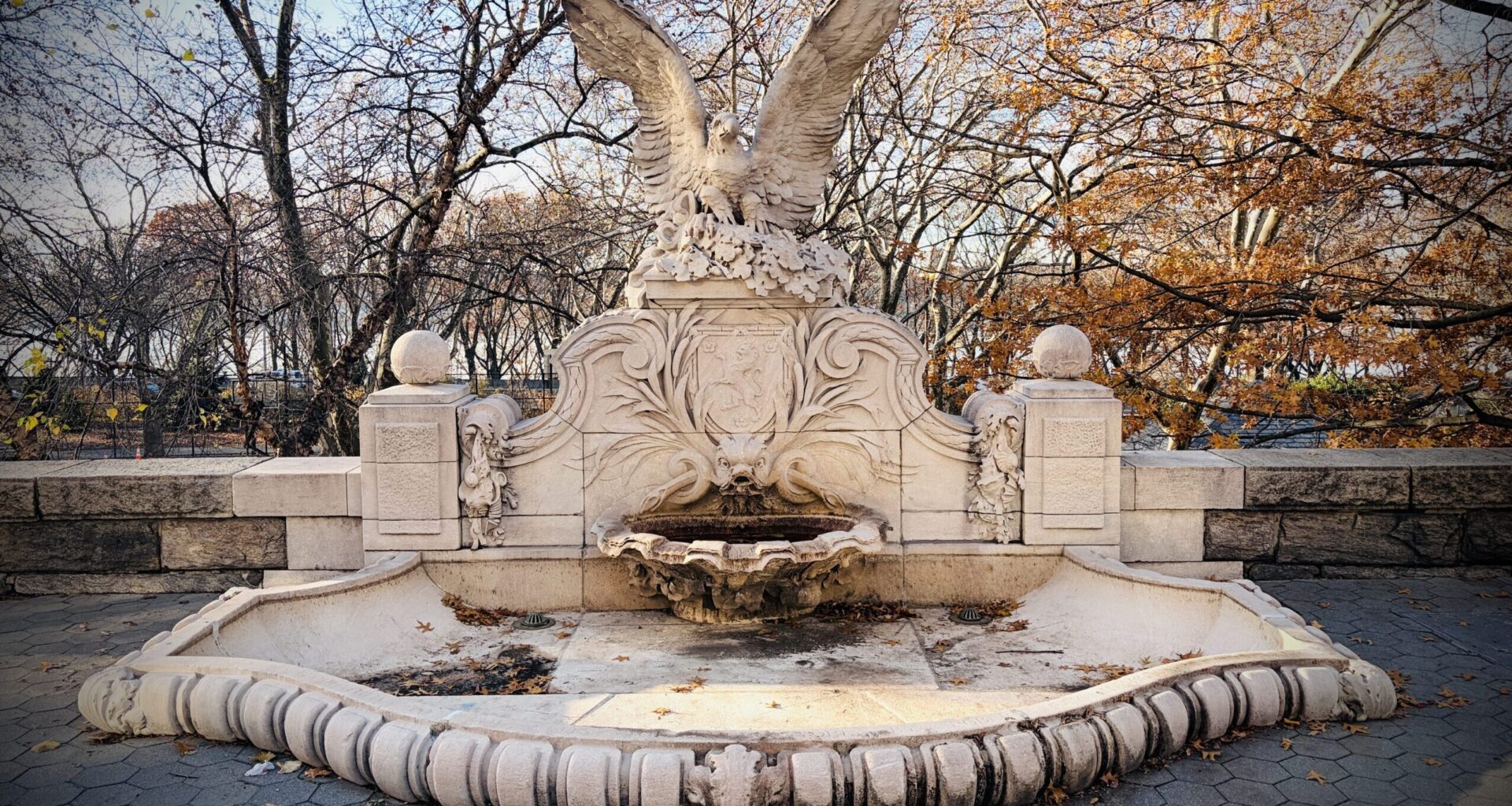
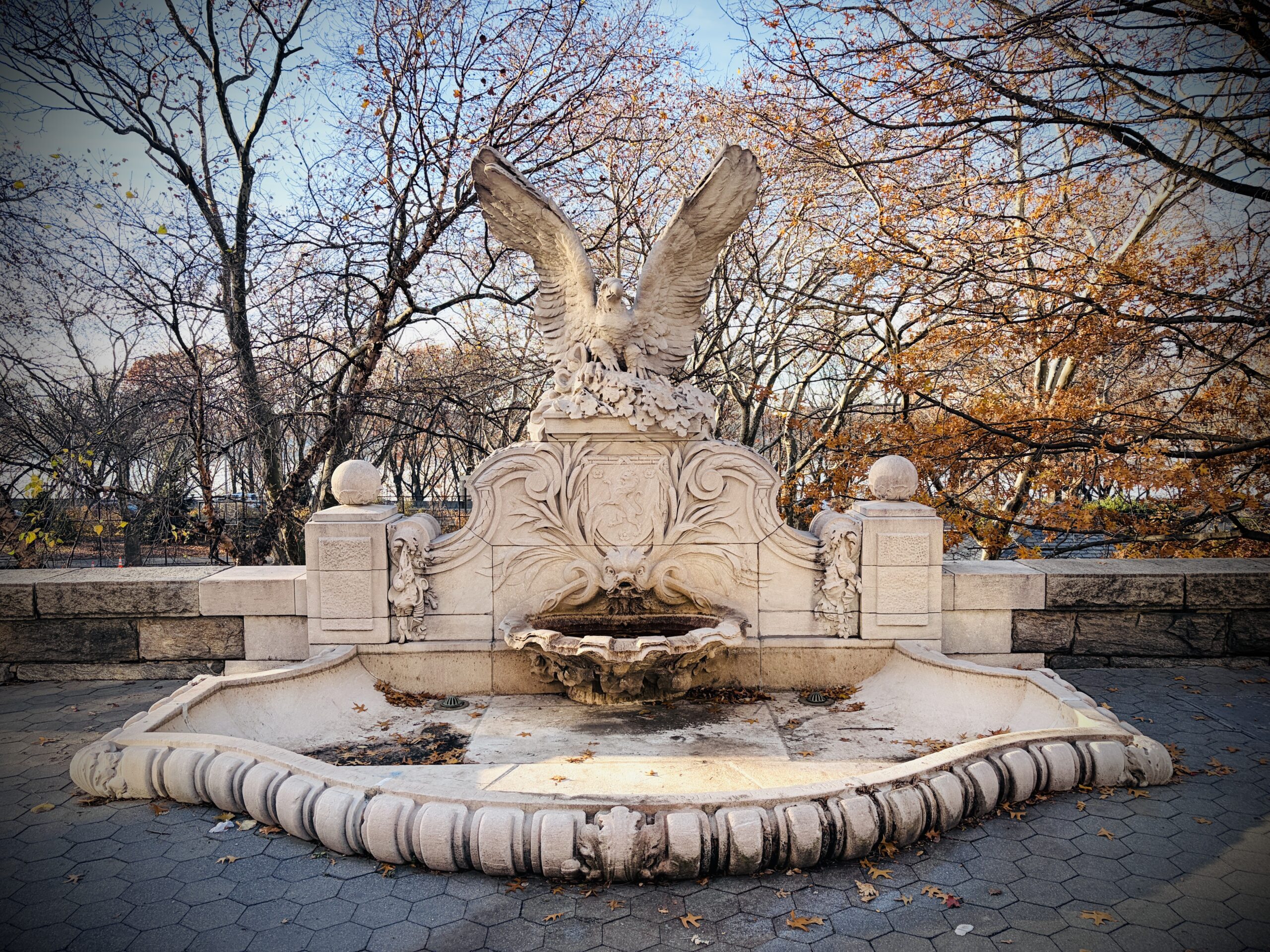
 The fountain near West 76th Street and Riverside Drive. Photos by Yvonne Vávra
By Yvonne Vávra
Something happened on West 76th Street and Riverside Drive. I know this because Lieutenant Louie, my dog, refused to leave the scene. Which is how I ended up lingering by the fountain at the wall of Riverside Park. Pretty fountain, I thought, circling it, checking out the big eagle on top, touching the marble. Louie kept sniffing. I got bored. Bored enough to read the plaque.
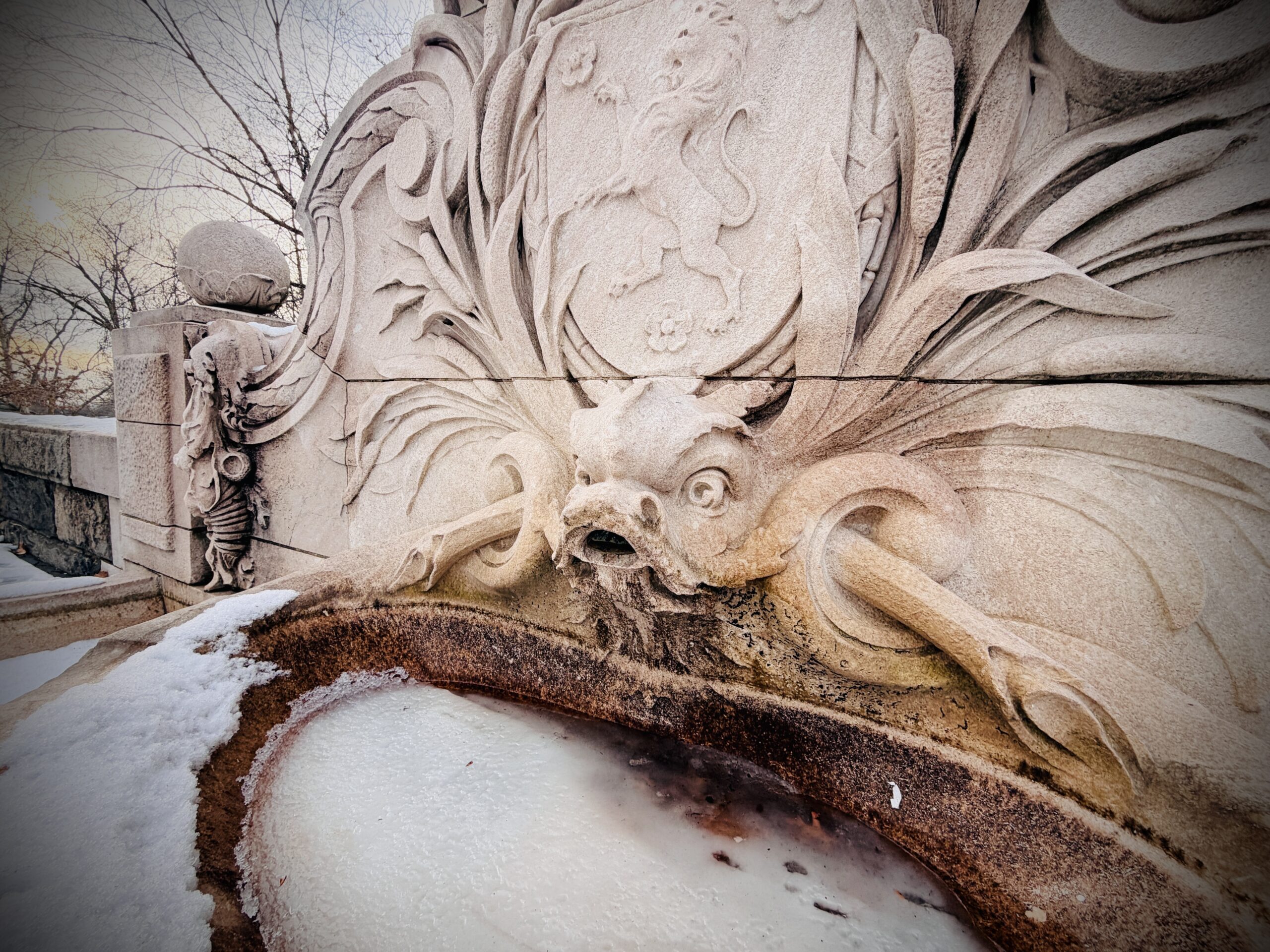 The ‘dolphin.’
It was full of fascinating details, but one baffling claim derailed me. It said that the “lavishly carved fountain” is surmounted by an eagle with wings spread – true – a coat of arms – yep – and a dolphin’s head spray feature – what now? A dolphin? I looked back at the fountain. I would have noticed a dolphin, I’m a fan. But all I could see was what looked like a curious carp, at best. There’s an agitation to its expression that just isn’t giving dolphin vibes. At all. I consider myself a friend and admirer of marine mammals. In fact, I adopted a whale when I was a teenager, certificate and all, so I think I know what I’m talking about.
I started looking for other spray features. But there were none. Fine, the googly-eyed carp is a dolphin. So be it. Let the experts have their dolphin.
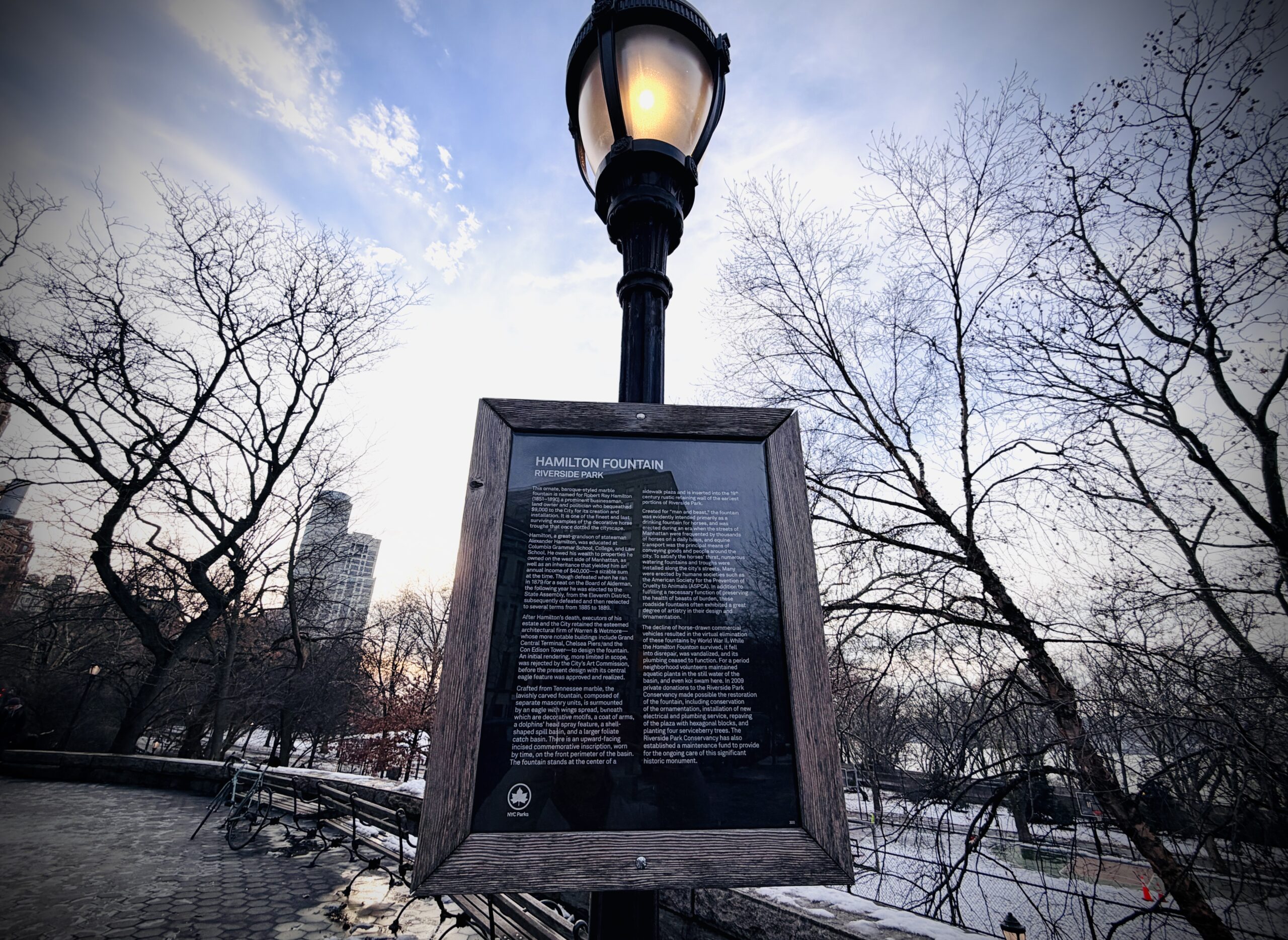 The plaque had more to offer, though. The Hamilton Fountain is named not for famous Alexander, but for his great-grandson, Robert Ray. He bequeathed $9,000 to the city to have it created and installed, and today, it’s one of the “finest and last surviving examples of the decorative horse troughs that once dotted the cityscape.”
It’s fun to imagine that the Upper West Side was once crawling with horses, its streets lined with fountains like this one, built for “man and beast” to rehydrate. But my mind was still on the dolphin. Back home, I searched for mentions of it in turn-of-the-century news reports about the fountain. But I found something much better.
Robert Ray Hamilton was a well-educated, well-off businessman, landowner, and politician – one with a juicy scandal attached to him. He had an affair with Evangeline Steele, later called by newspapers “a notorious woman” with “a disreputable life,” who neglected to mention that she was married. According to historian Tom Miller, she schemed with her husband to buy a baby from an illegal orphanage for $10, convincing Hamilton he was the father. But the baby died of starvation because Evangeline had no breast milk. So the couple bought another baby for $10, and this time made sure to care for it properly. Hamilton knew nothing of this and honored his responsibility by marrying Evangeline in 1889. They moved in together, with Evangeline’s husband renting nearby and living off Hamilton’s wealth while happily benefiting from the fact that politicians are often out of town.
The newlyweds fought constantly, not least over the baby nurse, who saw right through Evangeline. One day, things got out of hand. The two women got into a physical fight, the nurse winning at first but ending up sprawled dead on the sofa, a knife through her heart courtesy of Evangeline.
The story made the front page of New York papers and hundreds more nationwide for two weeks straight. A Hamilton! Involved in a tale of second husbands, purchased babies, and a murder! Hamilton fled to the Rocky Mountains, where in 1890—at just 39 years old—he was “found drowned in the Snake River under suspicious circumstances,” according to Miller. New York investigators later unearthed him from a hole where strangers had stuffed him into a box far too small for his size.
After all the chaos of his life, Hamilton at least had a will and a love of fountains, and he wanted one built in New York City. His family, however, fought his wishes, declaring in The New York Times in 1891 that they wanted to “let him be forgotten.” But the city pressed on, if slowly. The still-young architectural firm Warren & Wetmore – later famous for Grand Central Terminal and the Con Edison Tower – was commissioned to design it, and by 1906, the fountain was finally up and running. Evangeline, who had served her prison sentence and died penniless in 1904, never got to see it.
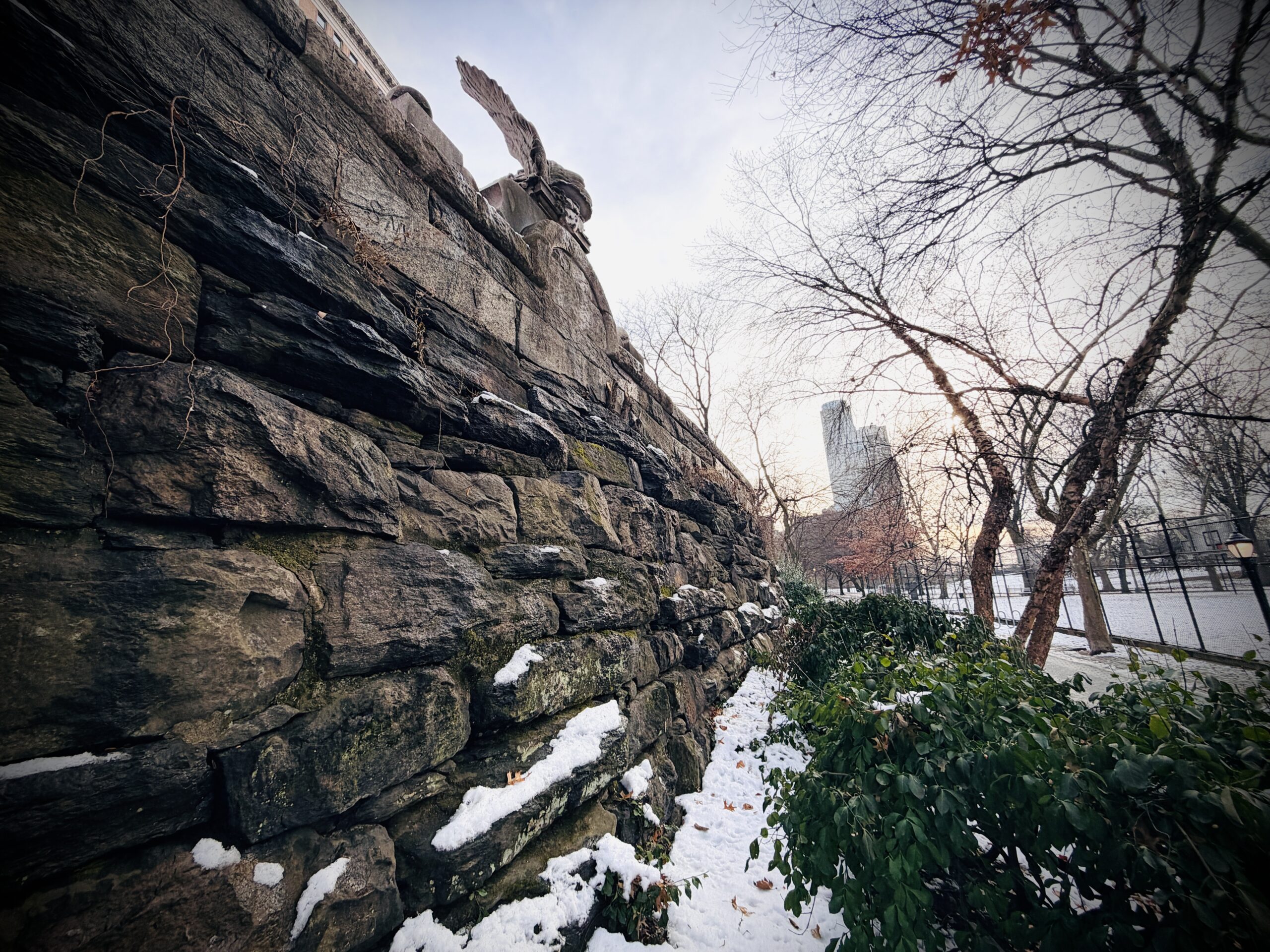 The wall behind the fountain.
There’s still one more curious layer to the story. The fountain, embedded in a wall along the sidewalk, is widely thought to have been a horse trough. But historian Tom Miller points out that on the other side of that wall, down in the lower part of Riverside Park, there used to be a small marble bowl. Could that have been the part meant for the horses? Did they never drink from this stunning fountain after all?
The bowl was eventually covered by dirt. It might still be—who knows? Not me, because I’m not one to brave the brush and thicket looking for horse troughs. I’m just a city walker, happy to have paused at the fountain that day and let the neighborhood surprise me with a story. And this one definitely cries out for a second Hamilton musical.
Subscribe to West Side Rag’s FREE email newsletter here. And you can Support the Rag here.