
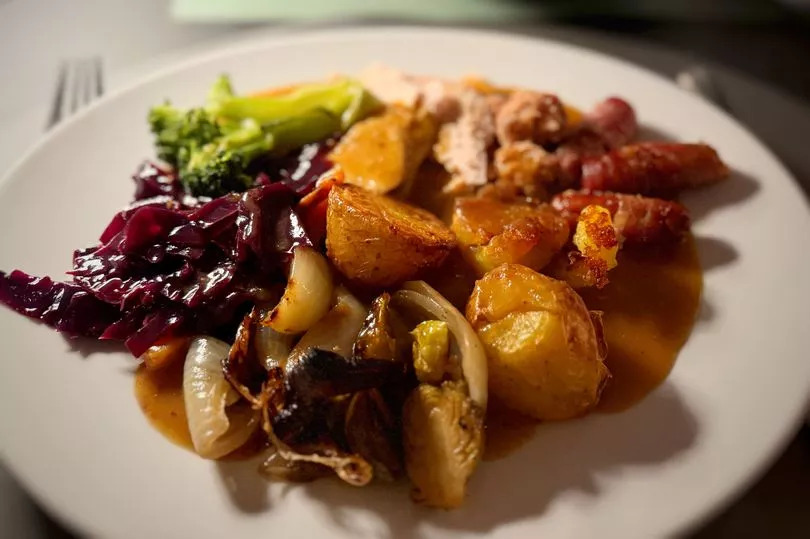
With Christmas Day just days away, millions of us are getting in the last of the food needed for the festive period. But what you might not know is there is a direct link between cancer and one of the most popular items on your plate on Christmas Day.
Many people believe sugar causes cancer, but this is not the case. Only two foods are known to have a direct link to cancer. They are alcohol and processed meats. And, given this Christmas favourite is made up of bacon and sausages, the beloved pigs in blankets fall firmly into the processed meats category.
Of course, no one is suggesting that you are going to get cancer because you ate some pigs in blankets on Christmas Day, just as no one is suggesting you will be diagnosed with cancer as a result of a glass of wine or sherry. That said, recent scientific studies say there is no safe amount of alcohol to drink and that even a small amount increases your chance of getting cancer. In a recent report, Vivek Murthy, the former surgeon general of the US Public Health Service, warned that alcohol use had been directly linked with at least seven types of cancers. He also warned that even light or moderate alcohol consumption can increase a person’s risk of cancer.
Processed meat and alcohol are classified as Group 1 carcinogens by the World Health Organisation, meaning they are carcinogenic to humans. The WHO says: “There is convincing evidence that the agent causes cancer.” Tobacco smoking and asbestos are also Group 1 carcinogens, though the WHO stresses that this does not mean that alcohol and processed meat are equally as dangerous as smoking and asbestos. Cancer Research UK says unequivocally: “We know for definite that processed meat is a cause of cancer. We are sure about this link like we are for other proven causes of cancer, like tobacco and alcohol.”
What is processed meat?
The World Health Organisation says processed meat refers to “meat that has been transformed through salting, curing, fermentation, smoking, or other processes to enhance flavour or improve preservation”. Sausages and bacon are among the examples of processed meats given by the WHO and Cancer Research UK.
Cancer Research UK explains that chemicals found in processed meat, added during processing or produced when cooking it, include nitrates and nitrites, which are used to keep processed meat fresher for longer. It adds: “When we eat them, nitrates and nitrites can become N-nitroso chemicals (NOCs) that can damage the cells that line our bowel. This damage can lead to bowel cancer.”
Why does processed meat cause cancer?
Research has linked three meat-related chemicals to increased bowel cancer risk. These chemicals are either naturally found in meat, added during processing or produced when cooking:
Haem, a red pigment found mostly in red meat
Nitrates and nitrites, which are used to keep processed meat fresher for longer
Heterocyclic amines (HCAs) and polycyclic amines (PCAs), which are produced when meat is cooked at high temperatures.
Cancer Research UK explains that all three can damage the cells in our bowel, and it’s the accumulation of this damage over time that increases cancer risk.
Why does alcohol cause cancer?
Alcohol causes cancer through biological mechanisms as the compound breaks down in the body. This means that any drink containing alcohol, regardless of its price, quality or strength, poses a risk of developing cancer and that there is no “safe” amount of alcohol to drink. The WHO says the risk of developing cancer “increases substantially the more alcohol is consumed” but that “latest available data indicate that half of all alcohol-attributable cancers… are caused by ‘light’ and ‘moderate’ alcohol consumption – less than 1.5 litres of wine or less than 3.5 litres of beer or less than 450 millilitres of spirits per week”.
Does processed meat increase risk of heart disease?
In 2021, Oxford University said the “largest review of all large-scale studies to date finds red and processed meat increase the risk of heart disease”.
Across the world, coronary heart disease claims nearly nine million lives a year, the largest of any disease. Researchers at the University of Oxford’s Nuffield Department of Population Health said evidence from its analysis “indicated that each 50g/day higher intake of processed meat (eg bacon, ham, and sausages) increased the risk of coronary heart disease by 18%”.