
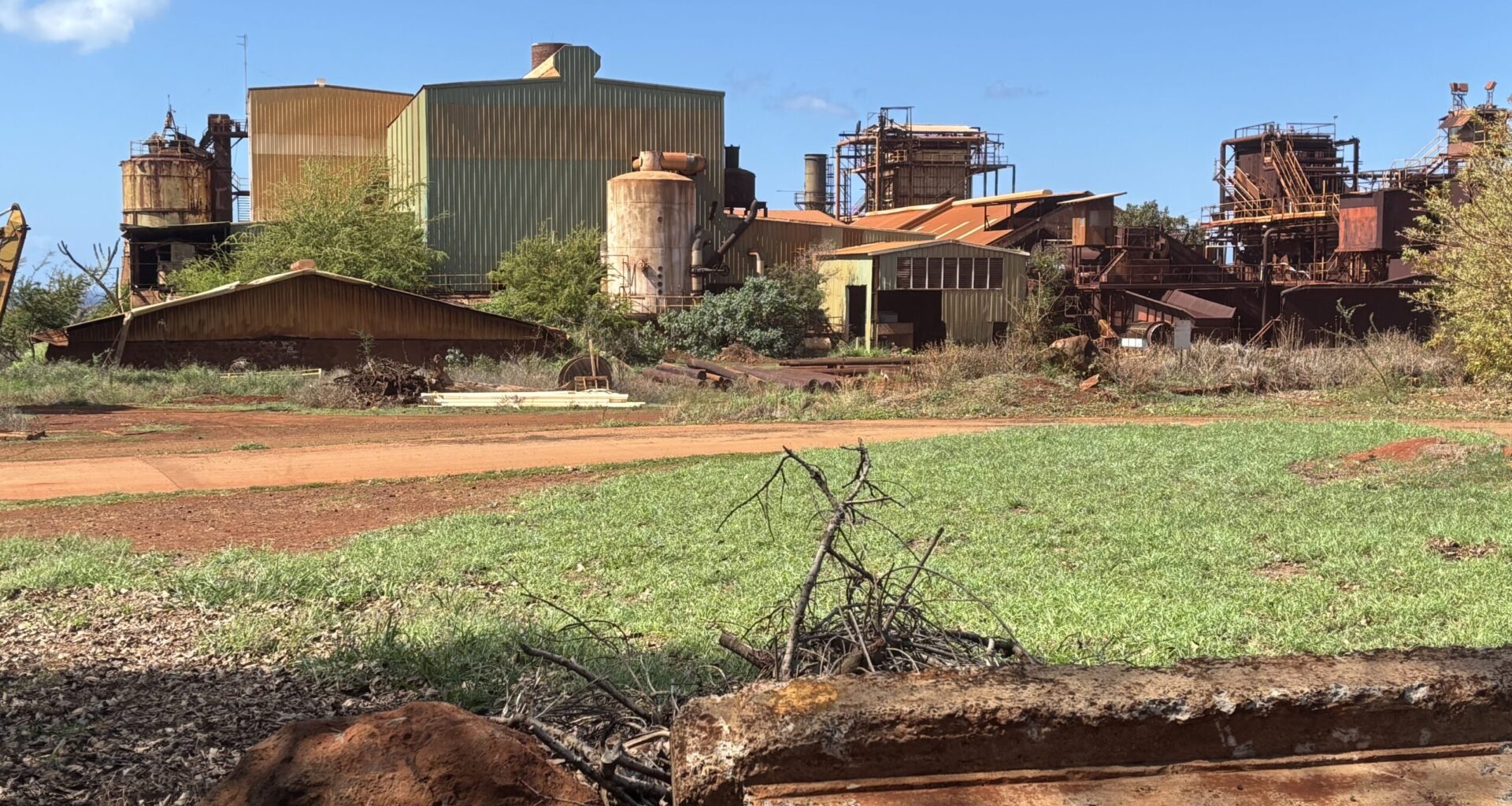
On Oct. 30, 2009, hundreds of workers gathered in front of the Olokele Mill in a bittersweet ceremony marking the end of sugarcane on Kaua‘i.
For decades, the mill had served as an economic engine for both the Gay & Robinson plantation and Kaua‘i’s Westside. At its peak, Gay & Robinson was among the most productive sugarcane plantations in the world, capable of processing nearly 500 tons of sugar a day. It was the last plantation to close up shop on Kaua‘i, following the shuttering of Lihu‘e and Kekaha operations around the turn of the century.
Today, the Olokele Mill is relatively quiet, still fronted by a wooden board displaying decades-old sugar production statistics. But soon, it may see a second life.
An internal Gay & Robinson document obtained by Civil Beat shows plans to develop the area around the mill as an industrial park, the first of its kind on the rural Westside. The site is projected to open up a substantial revenue stream for Gay & Robinson, which is seeking new sources of income in a post-sugar landscape.
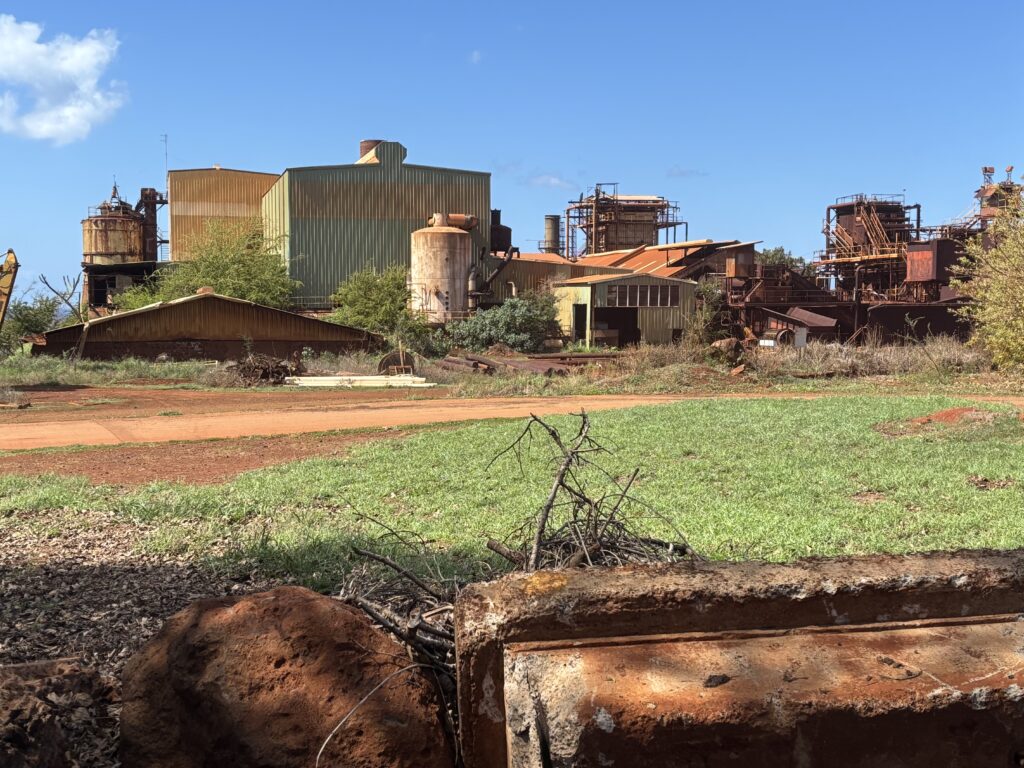 The old Olokele sugar mill would be converted into an industrial site under a proposal from landowner Gay & Robinson. (Guthrie Scrimgeour/Civil Beat/2025)
“We subsidize or barely break even on our agricultural land and our housing,” said Gay & Robinson Vice President Howard Greene. “We anticipate that we could supplement that tier of our business with these industrial rents.”
The county rezoned the area around the Olokele Mill from agricultural to industrial use in 2020. Using the land near historic mills for agriculture is tricky, due to potentially hazardous soil conditions caused by years of heavy use by the sugarcane industry.
“Nobody is going to go through the effort to clean up the scrap metal and deal with the environmental issues to grow vegetable crop,” said Greene. “This land is just going to sit there unless we can put it to a better use.”
Since the rezoning, the area around the mill has housed a handful of businesses, including sustainable energy company Pacific Biodiesel and conservation organization Ho‘omalu Ke Kai. It also serves as the storage site for the Department of Land and Natural Resources’ firefighting equipment.
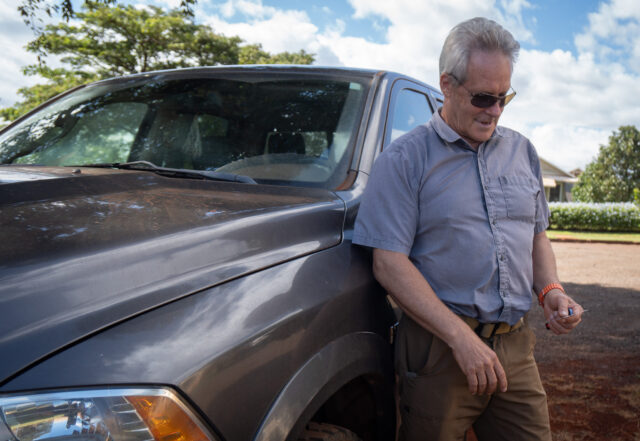 Gay & Robinson Vice President Howard Greene said converting the old Olokele sugar mill into an industrial park creates a lot of local business opportunities. (Craig Fujii/Civil Beat/2025)
If the Gay & Robinson plan were to go into effect, the site would see a large-scale buildout, likely complete with new roads, electric, wastewater and additional industrial buildings, that would allow for more tenants.
At its September meeting, the Gay & Robinson board of directors authorized the company to spend $200,000 to conduct studies, surveying work and site layouts to apply for Class IV Zoning permits, which would allow the development to go forward. This is the first of a three-phase plan that would take place over the coming decade.
Additional tenants for the industrial park might include the boating industry, welding, fabrication, autobody, painting and equipment repair, Greene said. Gay & Robinson is also interested in partnering with Kaua‘i County on a waste-to-energy and recycling facility at the site.
“There’s really no industrial areas on the Westside,” Greene said. “It could create a lot of opportunities for guys to open up businesses that are more disruptive than you’d find in a commercial area — things that go 24 hours a day or might have noise, and smells and slight nuisances.”
While the site is located near hundreds of Robinson tenants who live on former sugar plantation camps, Greene expects they will be broadly supportive of the project due to its potential to bring jobs to the area.
Robinsons Search For Revenue Post-Sugar
There is possibly no actor more important in shaping Kaua‘i’s Westside than the Robinson family — the island’s largest private landowner and the driving force behind a series of development projects currently underway.
The Robinson family controls about 55,000 acres on Kaua‘i, along with the entire 45,000-acre island of Ni‘ihau, purchased from the Hawaiian Kingdom in the 1860s.
The family lands are managed through several entities, including Robinson Family Partners, which owns much of the land, and Gay & Robinson, which holds a long-term lease and handles business operations. The boards of both organizations are made up largely of Robinson family members. Other Robinson lands, such as Ni‘ihau, are owned and operated independently by brothers Bruce and Keith Robinson.
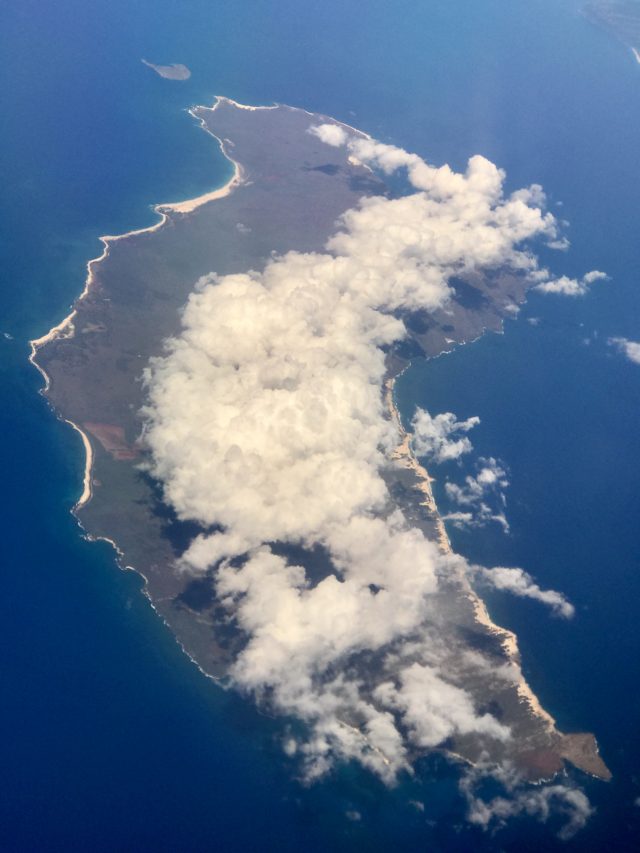 Ni‘ihau, also known as the Forbidden Island, is part of Kaua‘i County but is privately owned by the Robinson family. (Nathan Eagle/Civil Beat/2022)
The bulk of Gay & Robinson’s income today comes from its hydroelectric mill, supplemented by land leases to Aloun Farms, Corteva Agriscience and Island Helicopters, rents from its housing units, and cattle sales from Makaweli Ranch, the internal document shows. Leases on the Olokele Mill property currently generate about $1 million for the company, and the proposed industrial park is projected to roughly double that income stream.
As their sugarcane operations wound down, the Robinsons have scrambled to find new sources of revenue to stay afloat — changing the Westside in the process. The family is partnering with energy company AES on a new solar facility in Makaweli. Bruce and Keith Robinson have opened up Ni‘ihau to the U.S. Navy, which operates two sites supporting Pacific Missile Range Facility activities. The family is also considering expanding their plantation housing stock, and hopes to build a 135-room resort near Pākalā Beach.
“They’re very important,” said state Rep. Dee Morikawa on the Robinsons’ role in the region’s development. “They have more history here than I ever did.”
Morikawa, who has lived on Kaua‘i since 1974 and served as a representative for the Westside and Ni‘ihau for the past 14 years, wasn’t familiar with the Olokele Mill plans, but is broadly cautious about the prospect of additional Westside development.
“I can’t say I support more development until we can handle the infrastructure first,” she said.
Her primary concern is the potential for increased traffic on Kaumuali‘i Highway, which features one lane in each direction for most of the route out to the Westside. A single accident can shut down the road completely for hours.
Money has been allocated at the Legislature for a highway expansion, Morikawa says, but that project is likely several years away. Greene says he expects traffic generated by the industrial park to be less substantial than that created by the sugar mill.
Resort Goes Before Planning Commission
Recent Robinson-led development projects have raised the ever-relevant question of how best to balance economic development with preserving Kaua‘i’s local, rural character.
Among the most contentious of these projects is the proposed 135-room low density resort at the old Robinson family compound near Pākalā Beach. The county approved permits and zoning for the resort nearly 20 years ago, but progress has been sluggish. This September, Kaua‘i Planning Director Ka‘aina Hull filed a brief to revoke the permits, citing inaction on the land.
The Robinson family and new Dubai-based development group Kerzner International, have pushed back against this move, leading to passionate Kaua‘i Planning Commission hearings. The meetings have generated hundreds of pages of testimony, in which a majority voice opposition to a resort development.
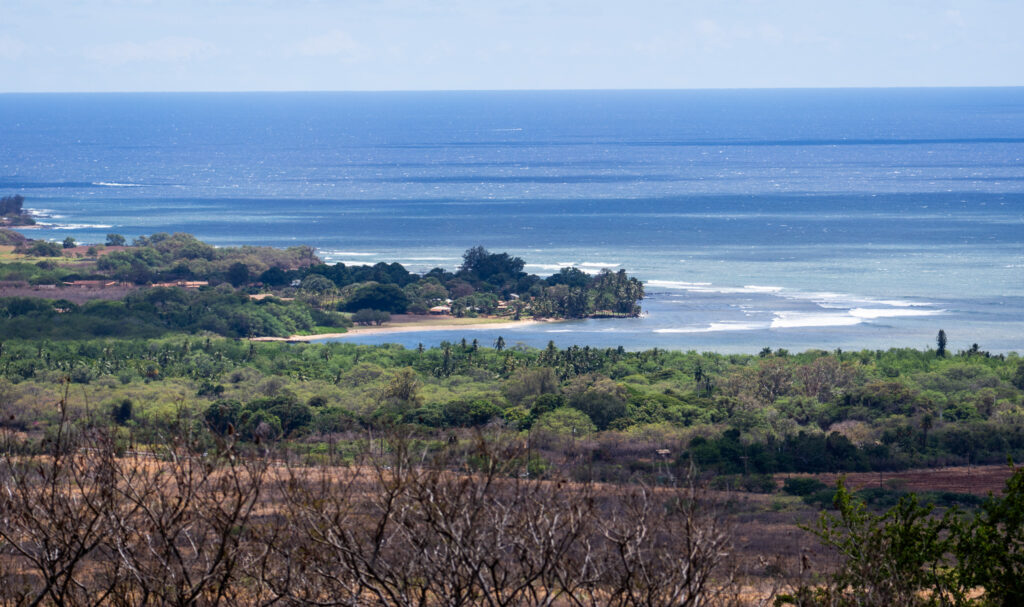 The Kapalawai resort project site is mostly undeveloped land. The county had changed the property’s zoning to resort from agriculture but now wants to change it back. (Craig Fujii/Civil Beat/2025)
Clarisse Kauwe, a Kalaheo resident who was born and raised on the Westside and often takes her family to Pākalā Beach, was among those to submit testimony opposing the development.
“It would be so disheartening to see Pākalā turn into a Po‘ipu or Hanalei, where it has been inundated with tourists to the point where us residents no longer go to those beaches,” she said. “G&R already own thousands of acres of land. I’m sure they could figure out another way to make money.”
While she was skeptical of the resort, she was generally supportive of the concept of an industrial development at the Olokele Mill site.
“I’m not against the Robinson family trying to sustain themselves. I know they must have to pay a ton in taxes,” she told Civil Beat. “But I wish they could work with the community and hear us out rather than go behind closed doors.”
At its Dec. 9 meeting, the Planning Commission transferred the resort matter to the Office of Boards and Commissions as a contested case hearing.
Civil Beat’s reporting on Kauaʻi is supported in part by a grant from the G. N. Wilcox Trust. “Hawaiʻi’s Changing Economy” is supported by a grant from the Hawaiʻi Community Foundation as part of its work to build equity for all through the CHANGE Framework.

Sign up for our FREE morning newsletter and face each day more informed.
Sign Up
Sorry. That’s an invalid e-mail.
Thanks! We’ll send you a confirmation e-mail shortly.