
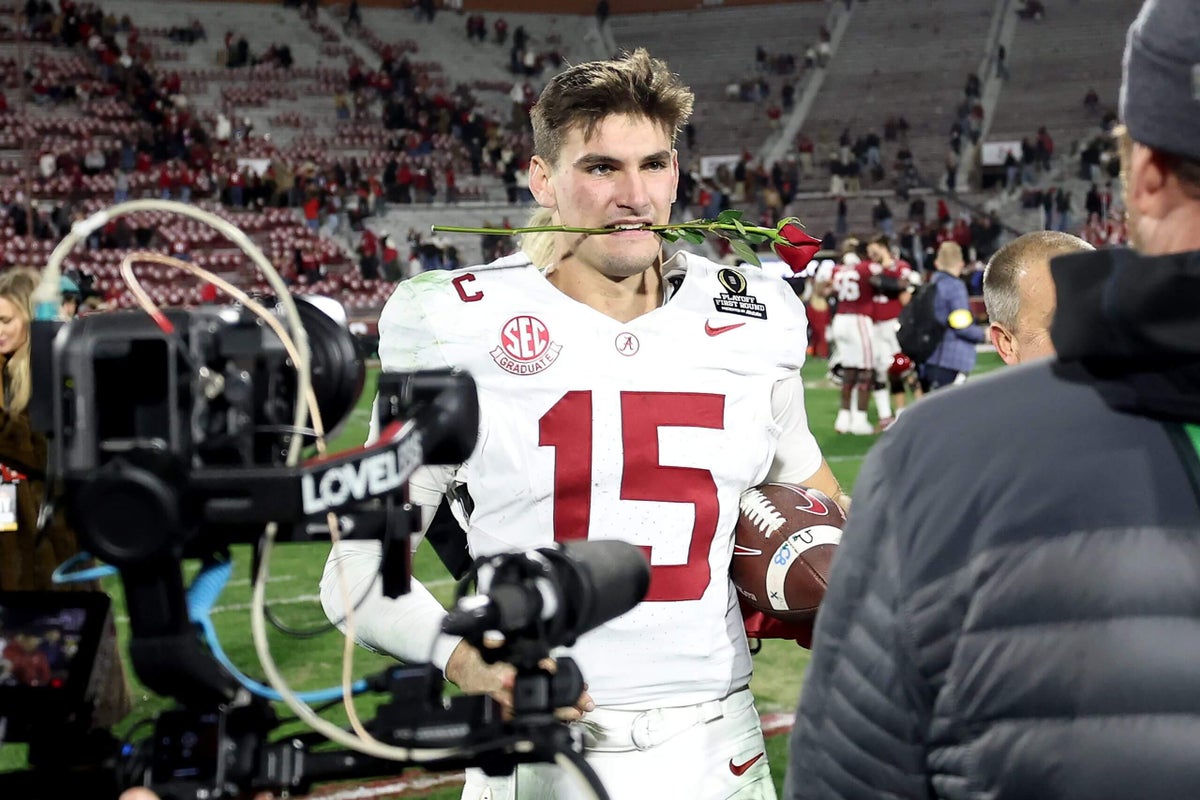
The College Football Playoff quarterfinals will feature a matchup of multi-time national champions, a game pitting two programs searching for natty No. 1, an SEC rematch and the first meeting between Indiana and Alabama.
A tweak to the seeding format after the first 12-team CFP to allow the highest-ranked teams to also be the top seeds has the second round looking like a potential banger. Though half the first round ended up being routs, the quadruple-header that starts New Year’s Eve night in Texas and ends Jan. 1 in New Orleans should be ripe with storylines and — hopefully — competitive games. Here’s a first look.
No. 2 Ohio State (12-1) vs. No. 10 Miami (11-2)
Where: Arlington, Texas (Cotton Bowl)
When: 7:30 p.m. ET, Dec. 31 (ESPN)
BetMGM line: Ohio State -9.5
The Athletic’s projections: Ohio State 72 percent
History lesson: Get ready for oodles of retrospective content related to the 2002 Fiesta Bowl. In one of the greatest college football games, No. 2 Ohio State ended No. 1 Miami’s 34-game winning streak with a 31-24 double-overtime victory for the BCS title thanks in part to a controversial pass interference penalty in the first OT.
The Buckeyes hold a 3-2 lead in the series, also winning in 1977 (10-0) and 2010 (36-24) in Columbus, the latter of which was vacated for NCAA rules violations. Miami beat Ohio State in the 1999 Kickoff Classic (23-12) and at home in 2011 (24-6).
The Hurricanes have played just once in the Cotton Bowl, when they crushed Texas 46-3 following the 1990 season in a game known more for Miami’s 202 penalty yards than for its dominance.
This is the third consecutive season the Buckeyes will play in the Cotton Bowl and the fifth time overall. Ohio State has won three of its previous four appearances, including a CFP semifinal en route to its 2024 national championship. The Buckeyes upended Texas 28-14 in a game sealed by defensive end Jack Sawyer’s 83-yard sack-and-scoop touchdown return. Ohio State became the first Big Ten team to compete in the Cotton Bowl when it beat Texas A&M 28-12 in 1986. The Buckeyes also topped USC 24-7 in 2017 and lost 14-3 to Missouri two years ago.
First look: Ohio State spent 14 weeks atop the AP poll before falling 13-10 to Indiana in the Big Ten Championship Game. A missed 27-yard field goal and a failed fourth-down attempt inside the Hoosiers’ 5-yard line cost the Buckeyes. Ohio State still leads the nation in both total and scoring defense by considerable amounts, and three players finished in the top nine of the Heisman Trophy voting (QB Julian Sayin fourth, WR Jeremiah Smith sixth, safety Caleb Downs ninth).
Miami squeaked into the postseason after a long and protracted battle — with a public relations nudge from the ACC — to leap past Notre Dame. The Hurricanes beat the Irish 27-24 in Week 1, but the outcome didn’t seem to matter to the CFP selection committee, which ranked Notre Dame ahead of Miami for five weeks, until they lined up alongside one another the final week. The Hurricanes, who rank sixth in scoring defense, clearly were the ACC’s best team, but two close losses in league play hurt them in tiebreaking scenarios and kept them from the championship game. But after bypassing the Irish, the Hurricanes beat Texas A&M 10-3 in the first round.
Why we should be excited: Some of the nation’s best skill players compete for these teams, especially at wide receiver. Smith was the nation’s most exciting freshman last year, and he seemingly tipped the field in each of the Buckeyes’ Playoff games with 19 catches for 381 yards and five touchdowns in four CFP games. This fall, Smith has grabbed 80 passes for 1,086 yards and 11 touchdowns en route to unanimous All-America honors.
Miami receiver Malachi Toney takes over for Smith as the nation’s most talented true freshman. Toney has 89 catches for 992 yards and seven touchdowns. Against Texas A&M, he took in a forward pitch around the right end for 11 yards with 1:44 left and the game’s only touchdown. Toney is an all-purpose threat, averaging 15.8 yards per punt return, and he has thrown two touchdowns and rushed for another.
The teams have competed head-to-head in recruiting, especially in South Florida, for some of the nation’s elite prospects. Smith, a Miami native, chose the Buckeyes over the Hurricanes as the nation’s No. 1 recruit one day in December 2023. In 2022, Miami running back Mark Fletcher Jr. was committed to Ohio State for seven months before flipping to Miami. — Scott Dochterman
No. 4 Texas Tech (12-1) vs. No. 5 Oregon (12-1)
Where: Miami Gardens, Fla. (Orange Bowl)
When: Noon ET, Jan. 1 (ESPN)
Line: Oregon -1.5
The Athletic’s projections: Even
History lesson: In a matchup of new money (Oregon) vs. newer money (Texas Tech), the Ducks and Red Raiders both have to travel a long way for their fourth and by far most important meeting.
Oregon is 3-0 in the previous matchups, the last coming in 2023 at Lubbock. The Ducks also swept a home-and-home in the early 1990s, when both could only dream of contending for national championships.
None of that matters. This Texas Tech-Oregon game will feature next-level versions of each program, both going to the Orange Bowl for the first time.
Texas Tech transformed its roster through transfer portal investments to assemble one of college football’s best defenses, overwhelm most of its Big 12 opposition and win an outright conference title for the first time since 1955. Simply, the Red Raiders are in the midst of the greatest season in program history — with all due respect to the late, great Mike Leach’s incredibly fun 2008 team. Texas Tech enters the postseason with a chance to win the national title for the first time. In fact, it’s never finished in the top 10.
Oregon has been here before — the Ducks lost national title games after the 2010 and 2014 seasons — but in many ways the program has never been better. Oregon entered the Big Ten last year and immediately proved it not only would survive, but thrive. The Ducks are 25-2 the past two seasons with two Playoff appearances.
After getting bounced in the quarterfinals as the No. 1 seed by eventual national champion Ohio State last year, the Ducks received a more favorable draw this time. Oregon buried Sun Belt champion James Madison 51-34 on Saturday night.
First look: Ducks-Red Raiders should be a heavyweight fight in the trenches, especially when Oregon has the ball.
The Red Raiders’ ferocious defensive line is led by All-America edge rusher David Bailey (13.5 sacks) and tackles Lee Hunter and A.J. Holmes Jr. Linebacker Jacob Rodriguez is the headliner and fifth-place Heisman Trophy finisher on a defense that ranks third in yards per play (3.96) and points per game (10.9) allowed and fifth in sacks per game (3.0).
The Ducks are great at protecting quarterback Dante Moore, and their offensive line — anchored by All-America guard Emmanuel Pregnon — is talented and healthier than it was during a November stretch run where Oregon went 4-0 against teams with winning records.
The Ducks have a top-10 offense, but we’ve seen an elite defense that creates havoc slow them down. In a loss to Indiana, the Ducks averaged only 4.17 yards per play, by far a season low, and scored only one touchdown. Of course, Texas Tech has seen nothing quite like Oregon’s offense, with a potential high first-round draft pick at quarterback and an offensive line with pros from side-to-side.
Why we should be excited: The best of what an expanded Playoff can provide. It’s a rarely played intersectional matchup between two teams that have a legit chance to win this whole thing. Though it might be nice if it was a little closer to at least one of their homes. — Ralph D. Russo
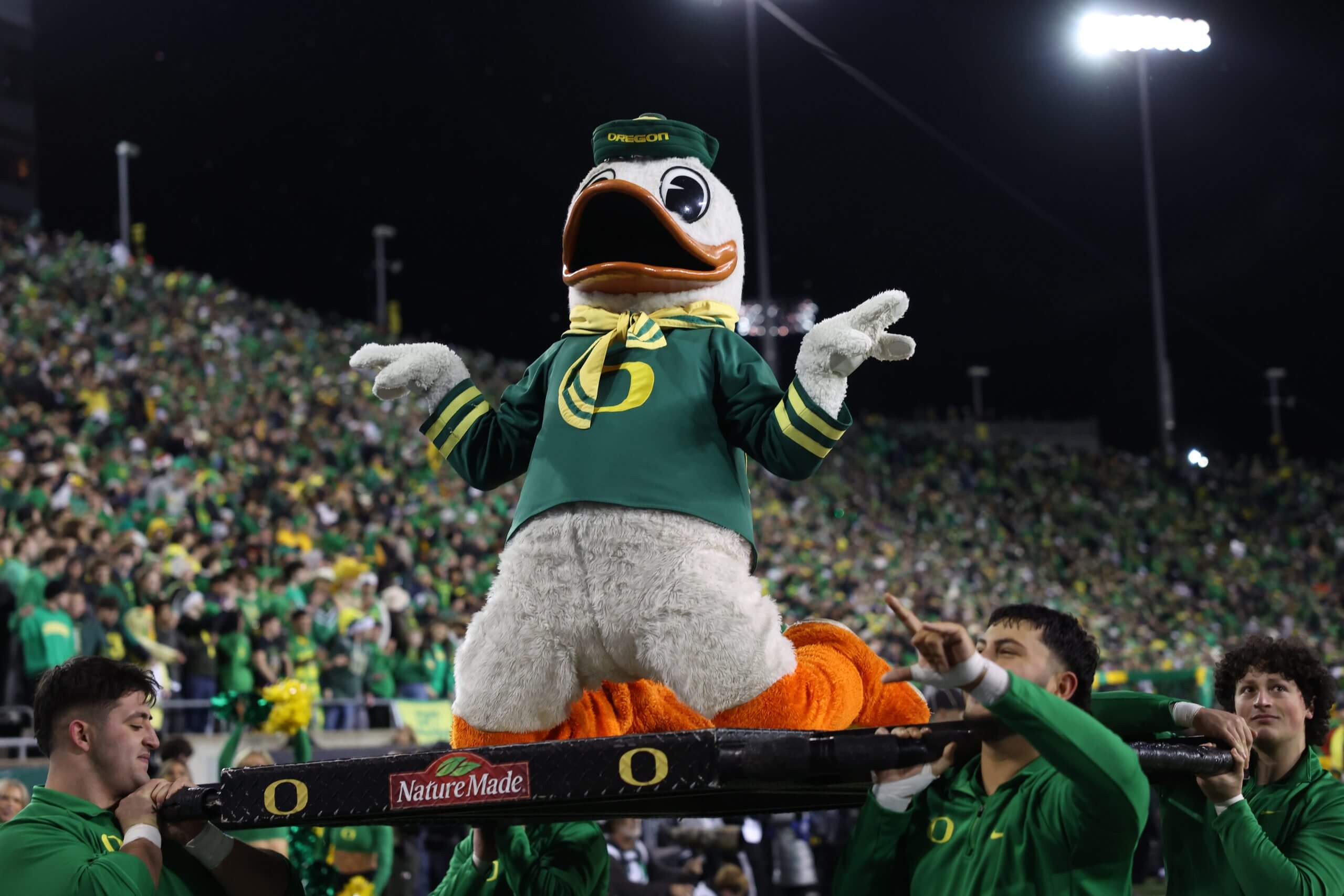
Oregon and Texas Tech will both be playing in their first Orange Bowl. (Tom Hauck / Getty Images)
No. 1 Indiana (13-0) vs. No. 9 Alabama (11-3)
Where: Pasadena, Calif. (Rose Bowl)
When: 4 p.m. ET, Jan. 1 (ESPN)
Line: Indiana -6.5
The Athletic’s projections: Indiana 66 percent
History lesson: In the most hallowed environment in sports, we have the most upside-down matchup in bowl history between two teams that have never met. Until early November, Indiana had the most losses in college football annals. Alabama sits third all-time in victories. After their Big Ten championship, the Hoosiers ranked No. 1 for the first time. At 141 weeks, Alabama sits first in total appearances atop the AP poll.
That historical disparity spills over to the Rose Bowl Game itself, where the Hoosiers have competed just once. The Tide have played in the Rose Bowl Game eight times, plus the BCS championship in Pasadena in 2009. This appearance marks the 100th anniversary of the Tide’s 20-19 Rose Bowl upset of Washington, which is considered the game that announced the South’s arrival as a college football powerhouse.
First look: In year one under Curt Cignetti, Indiana won a school-record 11 games and made the inaugural 12-team College Football Playoff. This season, the Hoosiers turned what was considered impossible into reality. Indiana won tough games at Oregon, Iowa and Penn State, then ended a 30-game series losing streak in a 13-10 win against then-No. 1 Ohio State for the Big Ten title.
Alabama dropped two of its final four games entering the CFP, and there were plenty of detractors that believed the Tide didn’t deserve a spot. In the season opener, Alabama lost at Florida State, which finished 5-7, and it fell 28-7 to Georgia in the SEC Championship Game. The critics nearly were proven right when the Tide trailed Oklahoma 17-0 in the second quarter of their CFP first-round game. But under second-year coach Kalen DeBoer, Alabama stormed back with 27 consecutive points and won 34-24 in Norman on Friday night.
Why we should be excited: It’s possible two NFL first-round quarterbacks will lead their teams in this matchup. Indiana is led by Heisman Trophy winner Fernando Mendoza, who has thrown for 2,980 yards and 33 touchdowns while rushing for six more. Alabama’s Ty Simpson has passed for 3,500 yards and 28 touchdowns. Both are redshirt juniors with NFL decisions to make after this season.
Neither head coach came up through the ranks in silver-spoon fashion. Cignetti spent the first eight years of his career coaching quarterbacks at Davidson, Rice and Temple. He left Alabama in 2010 to become a head coach at Division II Indiana (Pa.), where his father was a coaching icon. After six years there, Cignetti led Elon (2017-18) and James Madison (2019-2023) before taking over at Indiana in 2024. DeBoer spent his first 13 years in coaching either in high school or his alma mater, then-NAIA powerhouse Sioux Falls. He then totaled nine years as an assistant at either FCS or Group of 5 programs before accepting his first power-conference job as Indiana’s offensive coordinator in 2019. He’s since been the head coach at Fresno State, Washington and now Alabama.
On television overheard shots, it might be difficult to tell which crimson-clad group of fans will fill the Rose Bowl. But up close, you’ll see IU supporters perhaps double up their Tide counterparts. To traditional Big Ten fans, the Rose Bowl still means something — and that’s especially true for a program that hadn’t competed in the game since Jan. 1, 1968, when Indiana lost to USC. Next year, the Big Ten champion is no longer guaranteed a spot in the Rose Bowl, when the quarterfinals become geographically based. — Dochterman
No. 3 Georgia (12-1) vs. No. 6 Ole Miss (12-1)
Where: New Orleans, La. (Sugar Bowl)
When: 8 p.m. ET, Jan. 1 (ESPN)
Line: Georgia -6.5
The Athletic’s projections: Georgia 58 percent
History lesson: For two teams that have been in the same conference for nearly 100 years, the Bulldogs and Rebels don’t have much notable history with each other. But it’s picking up lately. The programs have played 48 times, with Georgia winning 34. They have met each of the past three seasons, with both teams ranked in the top 16 in all those games.
The most significant win of Lane Kiffin’s tenure as Rebels coach came last year against the Bulldogs, 28-10 in Oxford. Ole Miss looked as if it was going to make it two straight against Kirby Smart’s team earlier this season, taking a nine-point lead into the fourth quarter. The Bulldogs then scored the last 17 points, handing the Rebels their only loss of the season.
Georgia has become a Playoff fixture under Smart, with five appearances and two national titles (2021 and 2022). The Bulldogs were knocked out in the quarterfinals of the first 12-team Playoff last season by Notre Dame. Ole Miss hasn’t been this close to a national championship since Johnny Vaught roamed the Rebels’ sideline. Ole Miss finished second in the AP poll in both 1959 and 1960. The school claims three national titles from that era, but it never finished the season No. 1 in one of the major polls.
Oddly, last year’s Ole Miss team that beat Georgia was probably more talented up and down the roster, but this year’s Rebels avoided the upsets that kept them out of the CFP last year. Then Kiffin bailed for LSU after the regular-season finale, and Ole Miss promoted defensive coordinator Pete Golding to head coach.
The Kiffin-less Rebels had no problem against No. 11 seed Tulane in the first round. With offensive coordinator Charlie Weis Jr. calling plays before he joins Kiffin in Baton Rouge, Ole Miss won its Playoff debut 41-10 in front of a raucous home crowd at Vaught-Hemingway Stadium.
First look: Ole Miss scored touchdowns on its first five possessions in the regular-season meeting, then managed just 13 yards on three possessions in the fourth quarter in a game that now looks like a turning point for the Georgia defense.
Georgia has tightened its secondary, with Ellis Robinson IV developing into one of the SEC’s best cornerbacks. The Bulldogs have not allowed more than 322 yards or 5.02 yards per play in any of their past six games. In the SEC Championship Game, linebacker CJ Allen and the Bulldogs throttled Alabama, holding the Crimson Tide to minus-3 yards rushing.
Ole Miss has taken a step back defensively from last year, but the emergence of former Division II star Trinidad Chambliss kept the Rebels as potent as ever after Austin Simmons was injured in September. Chambliss averages 292.6 yards of total offense per game and has accounted for 27 touchdowns with just three picks.
The Rebels also feature the SEC’s second-leading rusher in Kewan Lacy (1,366 yards rushing and a school-record 21 touchdowns), though he appeared to injure his left shoulder in the first half against Tulane and left the game in the second half. He has about 11 days to heal up.
Why we should be excited: Rematches between conference rivals are a good argument against an expanded playoff, but on the bright side the Ole Miss-Georgia meeting in Athens on Oct. 18 was one of the best games of the season. It’s also in a great location for each fan base, especially the Rebels. Oxford, Miss., to New Orleans is about a six-hour drive, and it’s half that from Jackson, the Magnolia State’s biggest city.
For those who can’t make it, this should be a great way to cap a New Year’s Day spent on the couch watching football, as God intended. — Russo