
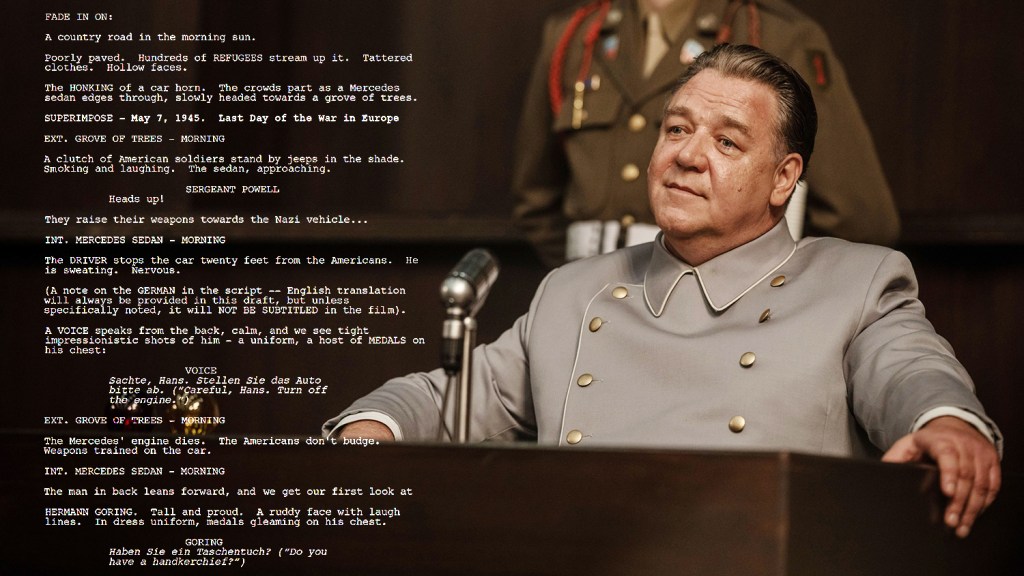
Deadline’s Read the Screenplay series spotlighting the year’s most talked about scripts continues with Nuremberg, writer-director James Vanderbilt‘s edge-of-the-seat courtroom drama that centers on the real-life work at the end of World War II to bring the Nazi regime to justice.
Vanderbilt adapted the screenplay from Jack El-Hai’s nonfiction book The Nazi and the Psychiatrist, which spotlighted the work done by Army psychiatrist Lt. Col. Kelley (played by Oscar winner Rami Malek), who was tasked with evaluating Nazi officials — including the powerful Hermann Göring (fellow Oscar winner Russell Crowe), the highest-ranking Nazi left after Hitler’s death at war’s end — over their mental fitness to participate in what would become known as the Nuremberg trials.
The pic, which also stars Michael Shannon, Leo Woodall, Richard E. Grant, Colin Hanks, Mark O’Brien and John Slattery, made its world premiere at the Toronto Film Festival in September and hit theaters in early October via Sony Pictures Classics. It has grossed $23.4 million worldwide.
Vanderbilt said he became obsessed with cracking the story for younger audiences as the actual events slipped into history. While El-Hai’s book centered on Kelley, he also wanted to also focus on the creation of the unprecedented tribunal — in this case made up of Allied powers the U.S., the Soviet Union, France and the UK, led by U.S. Supreme Court Judge Robert H. Jackson (Shannon) — and what would become the legal foundation for the international court system.
The drama then becomes two-fold: the courtroom drama as the first international war tribunal was launched from scratch, and two-hander interviews between Göring and Kelley, as the latter sought to dissect essentially what made men evil (there is no easy answer to that here; Kelley’s findings that Göring and others in custody were not psychopaths or monsters but rather shockingly normal eventually got him ousted, a whole other part of the story).
“Evil isn’t always going to put on a scary uniform,” Vanderbilt says. “It’s not always going to announce itself. It can be insidious. It can be – as Göring was – the nicest guy at the dinner party. That’s a much scarier thought than good guys versus bad guys.”
Read the screenplay below:
More from this Story Arc
Read The Screenplay Series