
SOUTH BEND, Ind. — At the end of every semester, Notre Dame professor Jeff Speaks asks his roughly 140 students in Introduction to Metaphysics and Epistemology course to pick a final discussion topic. By that point, the class has covered arguments for the existence of God and the concept of free will. Grappling with the nature of reality every Tuesday and Thursday can be a bit heavy. So Speaks ends on a lighter note.
Last year, the class wanted a philosophical proof of whether hot dogs are sandwiches. This semester, junior James Cressy had a better idea. He wanted Speaks to give a logical articulation of whether Notre Dame got screwed by the College Football Playoff selection committee.
“I already had very strong views on this topic,” Speaks said. “So I was delighted to spend about an hour or two writing them up and putting them in presentation form.”
As the College Football Playoff’s first round kicked off two weeks later, few around Notre Dame had made peace with the subject matter. The Irish, despite ending the season on a streak of 10 straight wins all by double digits, slid behind Alabama in the committee’s penultimate rankings, then were swapped out for Miami on selection Sunday for the final at-large spot in the 12-team field. For one of college football’s most polarizing programs, that path from red-hot title hopeful to first team out left a scar. The ways in which Notre Dame has coped since, from the team’s bowl opt-out to public shots at ESPN and the ACC to simple, private mourning, show the depth of the cut.
Around campus, professors like Speaks worked the snub into lesson plans. Elsewhere, fans turned to defiance, pushing back on the school’s critics. Even something as benign as a book signing turned into a potential battleground. Athletic director Pete Bevacqua made a week’s worth of headlines lashing out at the ACC’s self-promotion tactics and the CFP’s structure, but he did not walk the warpath alone.
On Friday night, one year after Notre Dame was the center of the college football universe and Jeremiyah Love went 98 yards through the Indiana defense to electrify the first home game in CFP history, the campus sat silent, other than the winter winds whipping across the quad. No “College GameDay”. No history. Nobody at all.
Among the five stages of grief, Notre Dame feels stuck somewhere in the first four: denial, anger, bargaining, depression. The fifth, acceptance, feels a long way off. And there’s reason to think it won’t arrive, considering the fan base has still not gotten over head-to-head outcomes not mattering to the national championship picture in 1993, when Notre Dame beat No. 1 Florida State, lost a week later to Boston College and then watched the Seminoles win a title.
Ask Speaks. That was his freshman year at Notre Dame. As a 13-year-old, he attended the “Catholics versus Convicts” game against Miami in 1988. He witnessed the controversial Bush Push sealing an epic loss to No. 1 USC 20 years ago. His grandfather and his brothers used to rent space on freight train cars from Cincinnati headed to South Bend to attend games before World War II, bringing a keg with them. Now his older daughter is a freshman in the marching band.
So, no, Speaks is hardly a neutral observer of Notre Dame football. But he has a Ph.D. in philosophy from Princeton and is a tenured professor and published author. When he gives a presentation on the competence and honesty of the CFP committee (or its incompetence and corruption), it’s worth unpacking, even if that requires an understanding of Bayes’ theorem and probabilities.
Speaks’ proof allowed for four outcomes: the committee was either competent and honest, incompetent and honest, competent and corrupt or incompetent and corrupt. Before getting into the proof, he flashed on the screen a photo of selection committee chairman Hunter Yurachek, mouth agape, while reminding his students that philosophy relies on arguments, not visual evidence.
“Oh, the class lost it at that photo,” Speaks said. “I put some time into finding that. It was probably a full 5 to 10 minutes of Google searches.”

A portion of Speaks’ final presentation of the semester. (Courtesy of Prof. Jeff Speaks)
Speaks told students the committee relied on ‘absurd principles’ in its 11th-hour flip of Notre Dame and Miami, then laid out whether moving Notre Dame back twice without the Irish playing a game, in defiance of the betting markets and mathematical probabilities, suggested corruption. His conclusion: There was a 98.2 percent chance the CFP committee was both incompetent and corrupt.
“You know what? I’m gonna go ahead and feel vindicated,” Cressy said. “He was incredibly elegant in his conclusion with that quantitative proof.”
Speaks made this presentation two days after Notre Dame’s exclusion and barely an hour after Bevacqua’s press conference on campus, when he tore into the CFP committee and the ACC’s social media campaigning. Bevacqua said the ACC had done “permanent damage” to its relationship with the Irish, who park every sport but football and hockey in the conference and play five games a year against a rotation of ACC foes. It’s supposed to be a mutually beneficial football scheduling agreement.
“Are we looking for an apology?” Bevacqua wondered aloud. “To be quite frank, I don’t think an apology does anything or unwinds what has happened.”
Notre Dame’s week living in the upside-down was just getting started.
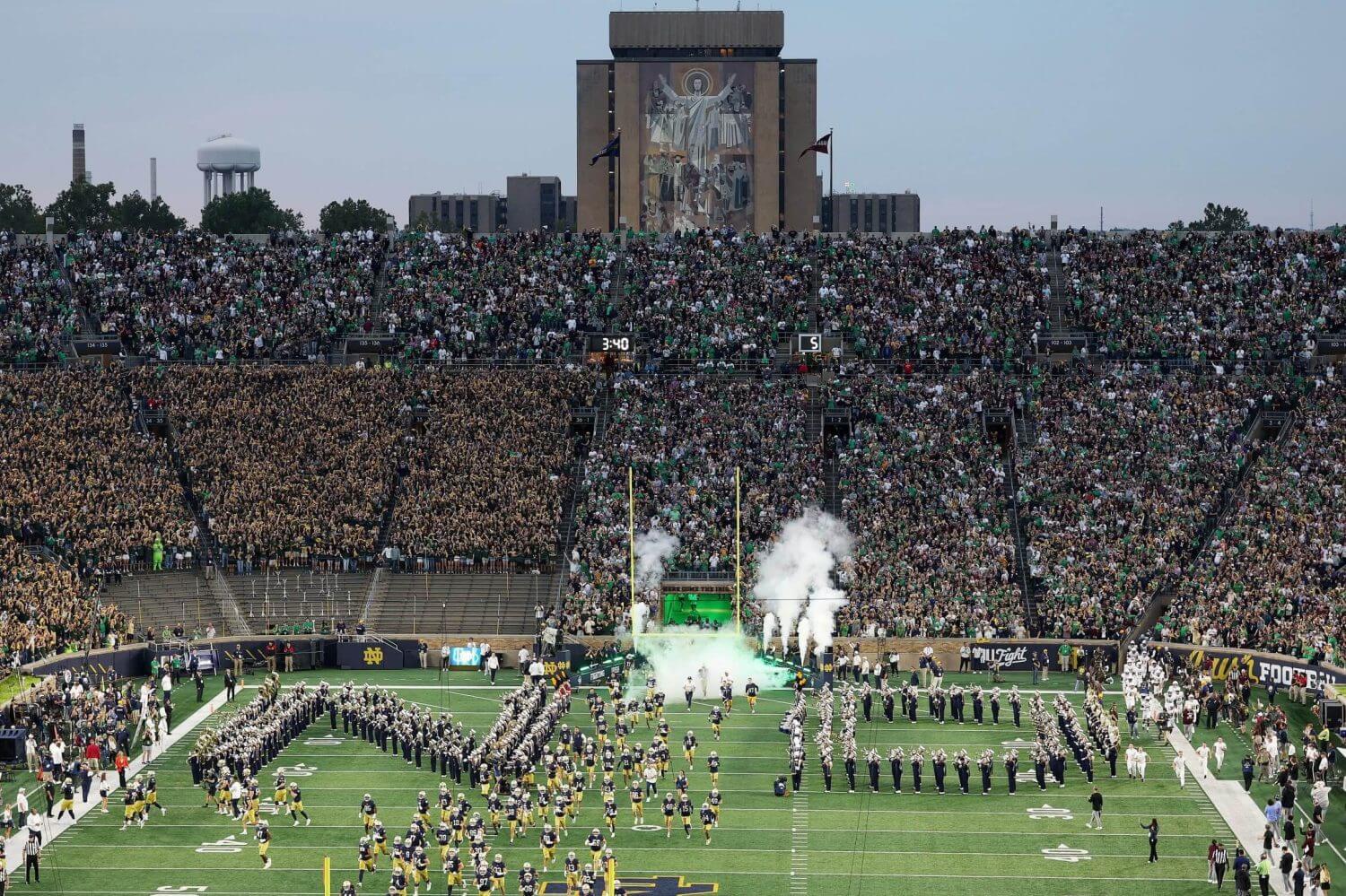
The Irish dropped from No. 9 to No. 11 over the final two sets of CFP rankings, one spot too far to play into late December. (Michael Reaves / Getty Images)
There are probably better places to stage a protest than the lobby of the Hammes Bookstore, located just off Notre Dame Avenue, en route to the Golden Dome. Yet it briefly became the center of public discourse the week after Notre Dame was bumped from the CFP bracket, when the bookstore nixed a book signing by renowned journalist Ivan Maisel, a first-year member of the CFP selection committee.
Maisel had already been to campus this year to promote his book “American Coach,” a biography of Notre Dame legend Frank Leahy that was released in September. Returning around the Christmas season made economic sense. The visit’s timing with the college football calendar, maybe less so. Maisel was partially recused from voting on Notre Dame’s CFP ranking because of the book, which included praise from head coach Marcus Freeman. That meant Maisel could listen to arguments within the committee about the Irish, but he couldn’t make them.
In the fever dream of Notre Dame’s exclusion, that distinction was lost.
Five days after the CFP’s final bracket and on the day of the signing, the bookstore pressed Maisel to cancel or postpone the event. Maisel assured everyone that he’d been yelled at before. Eventually the bookstore shelved the signing, which turned into a public spectacle that was news to the rest of campus. The athletic department interceded, everyone weathered the social media storm and the event was back on. Bevacqua called Maisel to apologize. Maisel told him no apology was necessary.
“It was a hell of a two hours there, I’ll tell you that,” Maisel said. “At the end of the day somebody was gonna be disappointed. And (Notre Dame fans) certainly are and they should be. We were trying to fit three feet into two shoes.”
Notre Dame dispatched two security officers to the event, including George Heeter, who can usually be spotted running security for Freeman on game day.
Everything went off without incident. Maisel signed more books than when he came to campus during the season. He fielded a few questions about the CFP process while signing, but the potential confrontations that worried the bookstore never happened. It was just an author signing in a bookstore lobby next to two soaring Christmas trees and tables of books.
Graduate student Paul Stoller bought three copies: one for himself, plus Christmas presents for his brother and his girlfriend’s parents. One semester away from completing his Master’s in Computer Science, Stoller had watched the bracket reveal in his apartment, assuming the Irish were comfortably in. He’d watched all of the conference championship games the day before, too, other than Duke’s upset of Virginia. Emphatic losses by BYU and Alabama seemed to have cleared the way for Notre Dame to remain on the right side of the bubble.
Last January, Stoller attended the national championship game in Atlanta against Ohio State. He wondered if he might be making another trip to see Notre Dame try to win its first title in 37 years.
“Getting snubbed, this hurt more than losing the national championship game, I can confidently say that,” Stoller said. “The vibe on campus, I’m with graduate students in engineering, so it’s not so football-crazy, but everyone was so sad. It’s almost turned me into a football conspiracy theorist.”
When Stoller approached Maisel to sign copies of the book, he slipped in a few comments about Notre Dame being left out, but he wasn’t there for a debate. Turns out, being mad online isn’t the same thing as being disappointed when you’re face-to-face.
“I just tried to make light of everything with, ‘Crazy week, right?’” Stoller said. “I just told him we appreciate your work, someone had to get left out and obviously we wished it wasn’t us. In a weird way, I just wanted to say thank you.”
Maisel is scheduled to return to the bookstore during spring practice.
Katie Bell watched the selection show during an early family Christmas get-together in Indianapolis, feeling good about Notre Dame’s chances. So good that she’d bought tickets to the Rose Bowl that morning, already looking beyond Notre Dame’s potential first-round win at Oklahoma to a CFP rematch with Indiana.
When Alabama showed up at No. 9, it felt like a punch in the stomach. When Miami flashed at No. 10, it sucked the air out of the room. An extended family member suggested Notre Dame missing the CFP didn’t need to ruin the day. Bell, who’s been going to every Notre Dame home game since she was 6, disagreed.
“Please do not say anything else to me,” Bell said. “I’m not trying to fight with anybody on Christmas.”
In protest, Bell decided she’d wear Notre Dame apparel every day until next season kicks off on Sept. 6 at Lambeau Field against Wisconsin. Then she wondered whether she should make T-shirts, an act of commiseration available in onesie to extra-large sizes. Playing off the “Catholics vs. Convicts” shirts from a game played before Bell was born, she brainstormed “Catholics vs. Committee” then made committee plural to lump in the ACC with the CFP voting group as key adversaries.
“I figured either I could sit some and cry, feeling sorry for myself like last January, or I could sell T-shirts,” Bell said. “At most, I thought I’d sell 50.”
As of last week, Bell had sold 780, with another 100 people on the wait list. Bell’s living room has turned into a shipping department, as if having 5-year-old twin daughters and a 3-year-old son isn’t chaotic enough around Christmas. The shirts sell for $15 and cost $10 to make. Bell plans to donate the profits to the Rockne Fund at Notre Dame, the athletic department’s fundraising arm. She wants the money to go to NIL.
“I’ve bought three shirts myself and with three kids I do laundry every day, so it’s on rotation,” Bell said. “I have this Notre Dame parka that I wear outside, then I’ve got a ‘Rudy’ jacket that I wear to football or basketball games. My kids’ teachers think I’m nuts.”
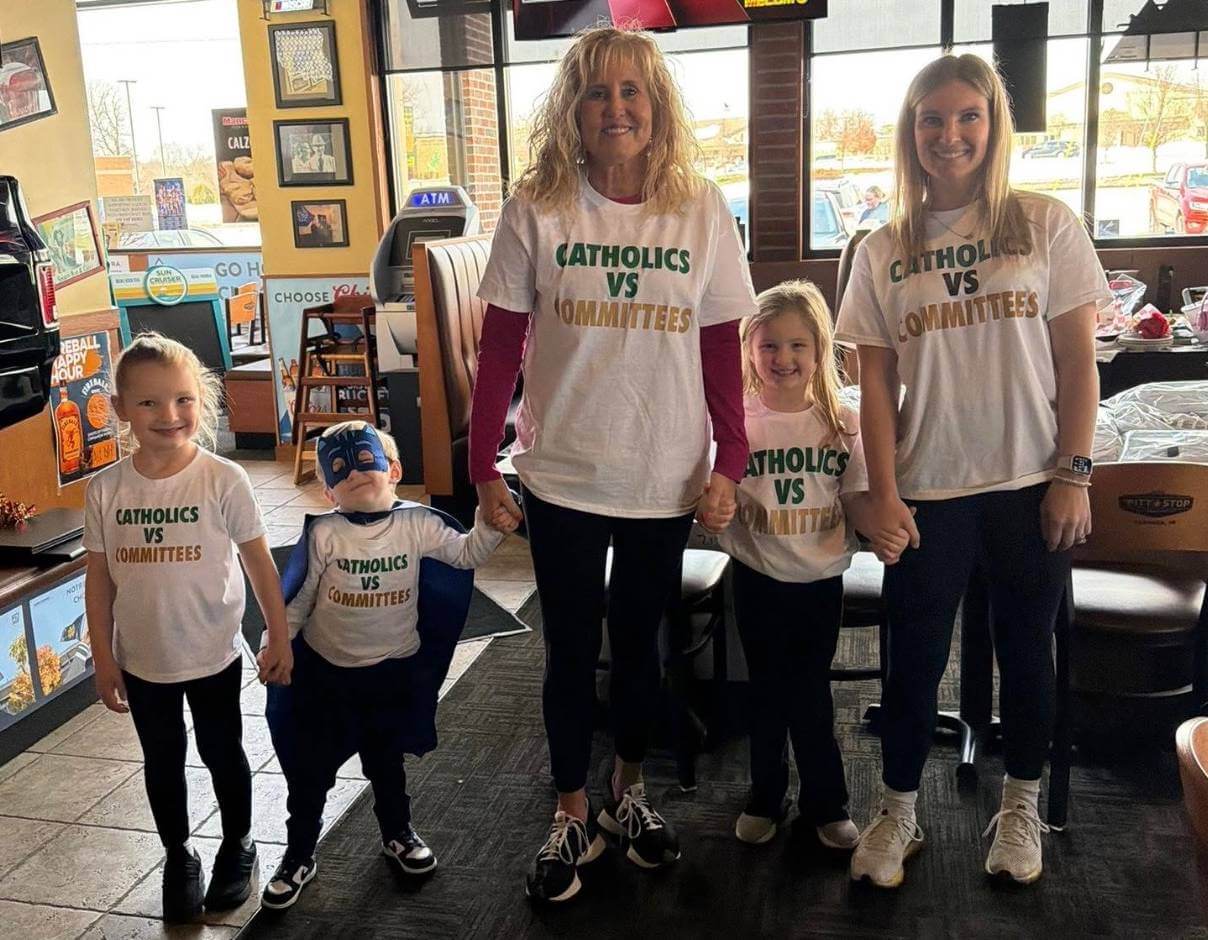
Bell, right, and her family model the anti-CFP committee shirts that are flying off the figurative shelves of their living room. (Courtesy of Katie Bell)
Bell said Notre Dame’s snub hurt more than the title game loss to Ohio State or even Northern Illinois’ shocking upset earlier that season. And she knows heartbreak at Notre Dame. As a 12-year-old, Bell attended the Bush Push game. She was so devastated that her mom let her stay home from school the following Monday.
Now Bell has an open family calendar, which had been intentionally blocked off from last weekend through the national championship game in Miami on Jan. 19. She still planned to watch the CFP, probably as background noise while she packages shirts to bring to the post office on Monday morning.
But Bell is opting out of her family Bowl Pick ‘Em pool this year.
“Solidarity with the team,” she said. “We didn’t have the opportunity to play. When you lose, you get sad. If you don’t get the players on the field, you just get angry.”
Just then, Bell’s doorbell rang. Someone was there to pick up their shirts.
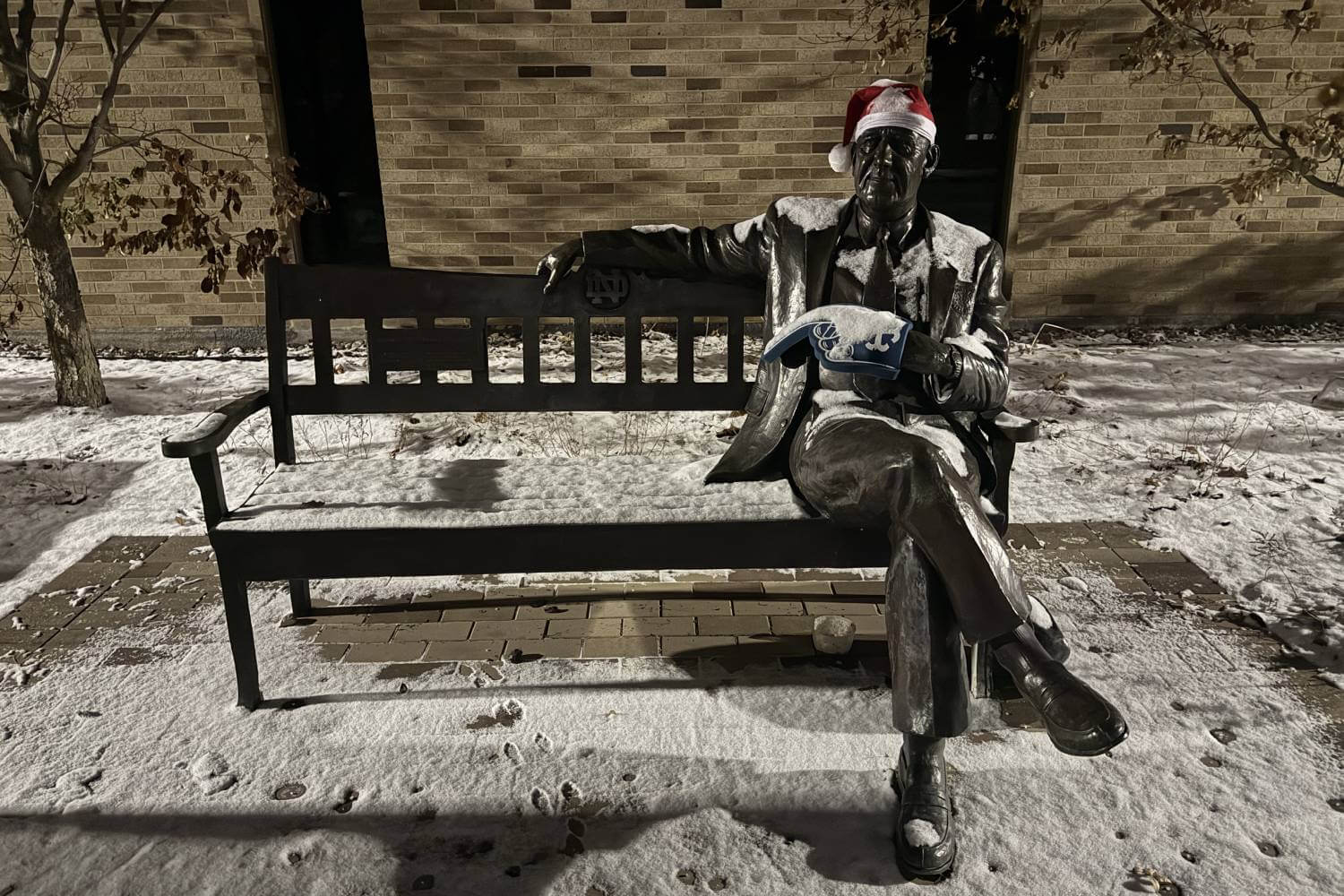
A lonely but festive statue of former Notre Dame All-American, coach and athletic director Ed “Moose” Krause on the first night of the 2025 College Football Playoff. (Courtesy of Pete Sampson)
As Alabama kicked off at Oklahoma, the Notre Dame campus had already gone into hibernation. Final exams complete. Dorms closing for winter break.
A year earlier, Notre Dame Stadium was a hivemind of blue, gold and green on this Friday night. The House That Rockne Built could barely keep its doors on the hinges. This year, there were almost as many people walking outside the stadium (three) as there were Grubhub delivery robots at work (two). The only cheer was of the Christmas variety, Santa hats draped on the statues of Knute Rockne, Ara Parseghian and Dan Devine.
Touchdown Jesus was still aglow, but the library quad was dark.
Two miles south of campus at Manny’s Sports Bar, a crowd settled in to watch the Crimson Tide rally past the Sooners, mostly indifferent about it all. The place was about three-quarters full at kickoff and half that when Alabama running back Daniel Hill scored to make it 34-24 midway through the fourth quarter. Somebody shouted, “It’s always Bama!” from across the bar, but most of the crowd watched blankly.
It’s hard to have your heart in it when it’s already broken. Miami’s 10-3 win at Texas A&M didn’t help, followed by Tulane and James Madison looking overmatched in slots Notre Dame could have filled under different formats.
When the Irish opted out of bowl season, it launched a thousand takes about Notre Dame taking its ball and going home or choosing easy when life got hard. Freeman hasn’t spoken about the snub since. Bevacqua may have spoken too much. The only commentary from inside the program came from Love at the Heisman Trophy presentation.
“We understand, if we took care of business throughout the whole season, that there would have been no doubt we would have been in the College Football Playoff,” Love said. “We felt like we had a very special group, and at the end of the season, we weren’t going to have the same team that we did going into the bowl game. So we wanted to make sure that we didn’t want to represent the team in any light that it wasn’t throughout the whole 2025 season.”
It’s hard to know how this team will be remembered, only that it will — for the way the season started, for the power of Love, for how it finished on its own terms after being dumped out of the College Football Playoff. The Irish were a trendy pick to win it all entering December, but their season had actually finished on Thanksgiving weekend in front of a half-full stadium at Stanford. It’s just that nobody knew that while it was happening.
“This is the biggest snub in College Football Playoff history, and it’s going to live in infamy for Notre Dame fans,” Cressy said. “We’re not gonna forget this.”
Cressy would have been in Norman on Friday night if Notre Dame had played Oklahoma, with tentative plans to attend the Rose Bowl on Jan. 1. He was already looking at a potential rematch with Ohio State in the national championship game at Hard Rock Stadium, a matchup and venue with cosmic significance to this modern era of Notre Dame football.
Instead, Cressy spent Friday night moving out of his room in Sorin Hall. He didn’t watch the CFP’s opening night. He said he’d skip Saturday, too.
“That’s partly because I packed up and moved home from my dorm room and am flying down to Florida with my family (on Saturday),” Cressy said. “But also definitely out of principle.”