
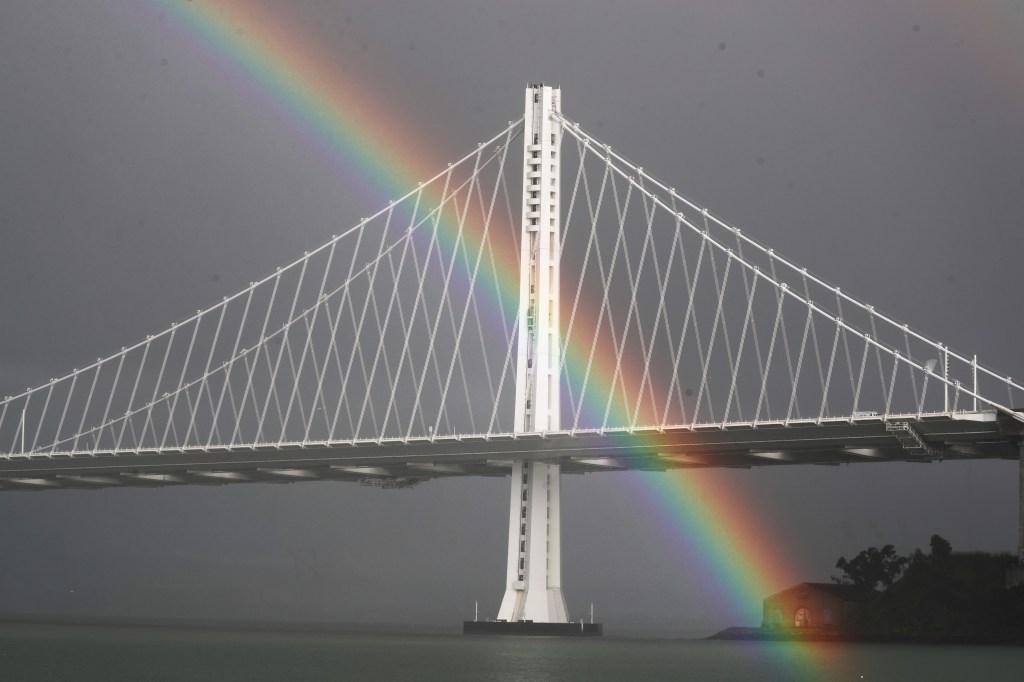
There’s a surreal serenity atop the world’s longest self-anchored, single-tower suspension bridge, crowned by a thick blanket of fog more than 500 feet above the rippling tides off Yerba Buena Island’s eastern shore.
From here, the nearly 300,000 daily commuters below who cross the newest, asymmetrical side of the Bay Bridge look like a frenetic ant highway, as 15 mph winds blow towards the perennial stack of vibrant shipping containers that frame the Port of Oakland. Barges lazily float under the 1.4-mile skyway, while Coast Guard patrols fade into the horizon past Treasure Island.
Once hotly debated as an experimental, costly pitch to restore the vulnerable eastern span in the wake of the 1989 Loma Prieta earthquake, the rebuilt Bay Bridge now has more than a decade under its belt serving one of the Bay Area’s most vital transportation arteries.
The iconic tower that boasts this panoramic view is home to one of the last remaining architectural secrets of the Bay Bridge: A last-minute final design touch was a case of life imitating art.
As revealed for the first time by Bart Ney, who quickly became one of the most prominent public faces of the bridge as the California Department of Transportation’s Bay Area spokesperson in the early 2000s, the creative team at Popular Mechanics magazine took a little extra creative license when putting the Bay Bridge on the cover of their June 2007 issue.
“They put parapet walls up there and a little inspector standing on the top of the bridge,” Ney said. While the roof was originally intended to be flat, he said there was still time and money in the budget for a moment of inspiration. “When our designers saw that, it was so compelling we redesigned the top of the bridge.”
Roughly 24 years and $6.5 billion in the making, when it reopened to Labor Day weekend traffic in 2013, the Bay Bridge was the most expensive public works project completed in California — a title it still holds, along with its place as the fourth most expensive such project in the nation and the widest suspension bridge in the world.
One of the biggest architectural challenges, Ney said, was physically bridging the design gap between structural longevity, functional use and artistic flare.
“This bridge was built out of fear — fear of an earthquake, fear of death,” Ney said. “The inspiration was to counteract that fear. When you look at this bridge, you’re supposed to feel better.”
They started with designs to fulfill “lifeline criteria” laid out within the highest seismic safety standards in the state. There were two basic rules: The new landmark had to be able to withstand the largest ground motions from an earthquake, but it also needed to be immediately accessible to emergency-service vehicles following violent tremors.
Of the roughly 100 other, self-anchored suspension bridges in existence, Ney said a majority only support pedestrians.
“To build one at this scale was rare, and then to build one that was record-setting was really rare,” he said, admitting that even he wondered at one point if the groundbreaking plans would ever break ground. “The Bay Bridge has proven itself, not just with the looks, but with its performance. The scale that this was done is herculean.”
As a vast team of architects, engineers and transportation officials started brainstorming a structure that could physically withstand extreme ground movement – jolts that are estimated to occur once every 1,500 years – local leaders and community advocates wrestled over a way to ensure that the new Bay Bridge was a “signature” design that represented and served the East Bay.
“Parts of the bridge had to be invented that didn’t exist before,” Ney said, explaining that even though the science behind the self-anchored suspension bridge wasn’t novel, no one had previously attempted to construct a structure that could safely span the Bay. “There were really difficult times when engineering solutions had to come almost out of the ether.”
The final result was a catenary arch – the signature curve formed by the single, 32-inch diameter cable holding the reconstructed bridge together – that refuses to swing, sway or strain while bearing 35,200 tons of steel, concrete and asphalt.
Ney said the Bay Bridge’s architectural genius could not have been built anywhere else – forged through a uniquely local mix of tragedy, community and ingenuity.
“We had to build a brand new bridge in the same footprint as an existing bridge that carried one of the busiest routes in the nation – all without closing the bridge,” Ney said, recalling the years of heated public debate and strict regulatory oversight that painstakingly slowed construction of the bridge, which spans 1,400 feet over the navigable waterway. “And then we had to make an icon.”
Part tour guide, part dream coach, Ney’s job was to explain how such a gargantuan feat was even possible, especially built on a strata of unstable mud near a hotbed of seismic activity.
“I was the guy that used to sit out in a boat, hand waving for politicians, engineers and anybody that would listen – over hundreds, maybe thousands of tours – explaining what we were planning to put in this big hole,” Ney said. “It was not easy to defend, but I definitely felt like I could throw my weight behind it.”
The secret to the Bay Bridge’s architectural sauce is hidden deep within its core, where a network of catwalks, staircases and access ways help protect from unnecessary damage, deterioration or disregard.
Mechanical hums rattle the skyway’s roughly mile-long interstitial space, married with a cacophony of tires thumping over the hundreds of omni-directional, accordion-style joints that are designed to absorb any displacement, rotation or seismic movement.
Ney proudly notes that the eastern span of the Bay Bridge is designed to last 150 years — twice the life of a standard bridge – and is outfitted with several components that architects and engineers anticipate will extend the structure’s life even further.
One inevitability, Ney said, is that the concrete will begin to sag. Secondary anchor points, however, are standing ready to secure new cables to pull the self-anchored suspension bridge taut for another century, or more.
Climate control systems within the belly of the bridge prevent the humid, salty air from compromising exposed portions of the Bay Bridge’s main cable, which consists of 17,400 individual, 5mm wires that each have the tensile strength to suspend a military grade Hummer. Compacted into 137 bundles, that steel had to be meticulously splayed out in order to successfully loop around the roadbed, just before the Yerba Buena Tunnel. Those steel wires were then repacked into the main cable, suspended back over the bridge and self-anchored in cement on the other side.
Twenty hinge-pipe beams were installed inside segments of the roadway, which allow the bridge deck to flex and slide back and forth as the temperature changes or ground shakes, but prevent lateral, side-to-side jolts that could jeopardize the bridge’s integrity.
Easily repairable, hollow stress points called “fuses” were designed to absorb the brunt of impact when overloaded – mitigating catastrophic structural damages, similar to a blown fuse at home. Miles of utility lines are funneled through channels and empty hinge pipe beams to protect essential services during an emergency.
“The idea is that the bridge will potentially live forever,” Ney said. “If the people that are alive then want to keep this bridge, we built this for them.”