

Last August, an Oakland high school student named Eric began gender-affirming care, at Kaiser Permanente. He’d never thought about needing it before he hit puberty. But once that happened, he said it quickly felt necessary, even urgent, to “make sure my body was going on the same track as my brain.”
Eric, 15, who asked to go by his middle name in this story, said the medical providers he worked with at Kaiser were very supportive. In fact, he said, it was conversations with a social worker there that allowed his parents to feel comfortable with him starting hormone replacement therapy. He calls that medical intervention his “daily stress relief.” Teenagers, he points out, care a lot about how people see them.
His mom, who asked to go by her initials, BP, also saw Kaiser as a great medical provider. “Honestly, it was really easy,” she said. “They have a terrific gender clinic. We went at a pace that was comfortable for us. They neither blocked us nor stalled us.” She said having access to compassionate care is part of why her family lives in the Bay Area.
“That is why we were in such shock that — just a few months after the inauguration — Kaiser, of all places, was rolling back care,” she said.
She’s talking about Kaiser’s decision to “pause” gender-affirming surgical care for patients under the age of 19. When news of this change broke in July, it was unclear exactly what it would mean for Eric’s future. It would certainly mean no chest surgery. Would it also mean no hormone implants, one of the most common ways young people receive HRT?
It wasn’t the first shoe to drop, and it wouldn’t be the last.
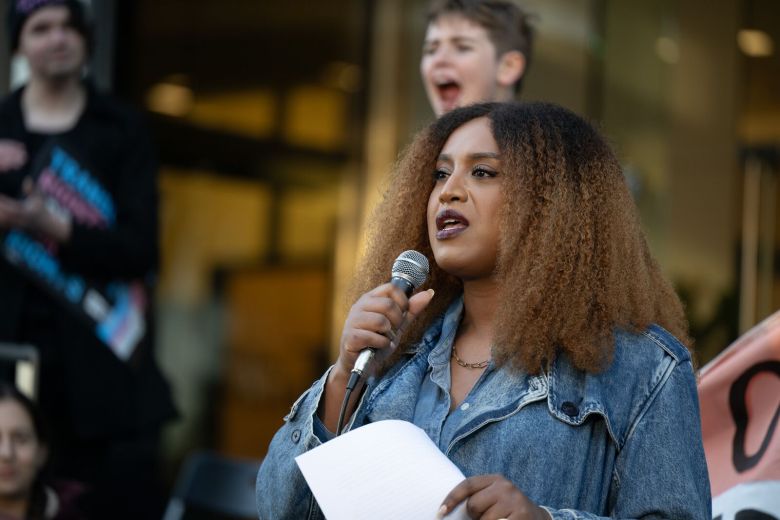 Honey Mahogany, the director of San Francisco’s office of transgender initiatives, reads statements from young people receiving gender-affirming care at Sutter Health at the protest on Dec. 8. Courtesy: Rainbow Families Action
In January, just months after Eric started getting care at Kaiser, President Donald Trump signed an executive order directing federal agencies to defund what he called “chemical and surgical mutilation” of transgender kids under the age of 19. After a federal court stayed that order, Trump wielded other forms of pressure. In early April, his Department of Health and Human Services sent a letter to states threatening review of any Medicaid spending on gender-affirming care.
A couple of weeks later, his Department of Justice sent a letter threatening criminal charges against anyone performing what the agency described as “genital mutilation.” By early June, the DOJ was issuing subpoenas to hospitals across the country that sought sensitive personal information about young people receiving gender-affirming care.
Perhaps most worrying for hospitals was the threat of defunding on an existential scale. In October, NPR obtained the draft text of a proposed rule that would block all Medicaid and Medicare reimbursement to hospitals that offered gender-affirming care to minors.
Hospital systems survive thanks in great part to Medicare and Medicaid funding. According to the American Hospital Association, 97% of all California hospitals get more than half of their inpatient care covered that way. Losing that reimbursement would be a catastrophic blow.
On Thursday, Health Secretary Robert F. Kennedy Jr. announced the publication of that draft rule, along with a slate of other initiatives designed to halt care for trans kids, what one of his deputies called “vile sex-rejecting procedures.”
“Trump said he was going to eradicate gender ideology and there was a slew of stuff that came out,” BP said. “It was ‘flood the zone.’”
First Stanford, then Kaiser, then Sutter
At 49, Calder Storm calls himself a “young elder,” part of the first generation with easy access to gender-affirming care. So when his trans teenager was ready to pursue care two years ago, Storm knew the ropes. It wasn’t hard to find clinics at UC San Francisco, and later Stanford Health Care, that felt right for his daughter. Then, early last summer, everything changed.
Storm got a call from his daughter’s clinic. “She has to be seen right now,” a staffer said, even though his daughter wasn’t due in for months. Storm later realized the clinician was hustling to get his daughter in before it was too late.
In late June, news reports surfaced in which Stanford confirmed that it had “paused” gender-affirming surgical care on June 2. Storm’s family, who live in San Francisco, were never formally notified of the change. “We were all sort of reeling,” he said.
Storm and his partner quickly began the process of moving their daughter to the widely respected clinic at Kaiser. Before they could, Kaiser had also halted surgical care. “The Stanford Kaiser one-two punch was really a gut punch,” he said. “We realized we really needed to get active on a local level.”
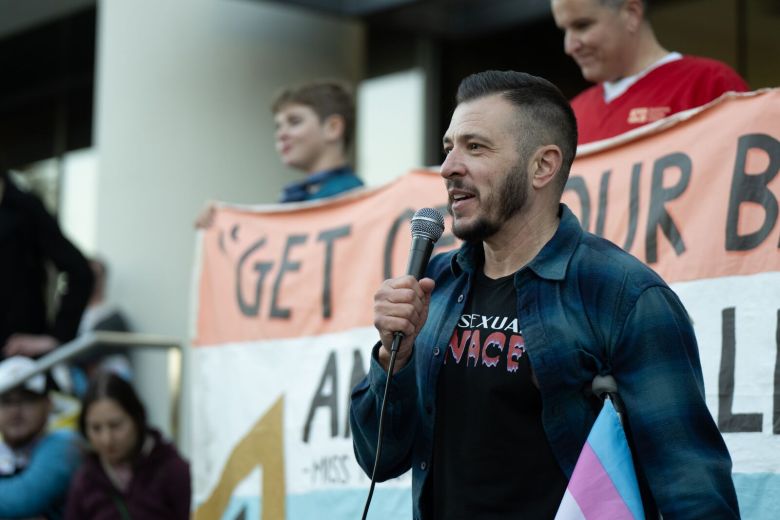 Calder Storm, whose daughter receives care at Stanford Health Care, at the Sutter protest on Dec. 8. Courtesy: Rainbow Families Action
Before all this happened, Storm had been focused on how to help other kids around the country get the kind of support his family took for granted. “I truly thought I’d be safe in California,” he said. “I was thinking, ‘How do we support trans kids in red states like Texas?’ And then there was a reckoning.”
That sense of reckoning has led many families like Storm’s to a small but rapidly growing group called Rainbow Families Action, which formed shortly after Trump’s reelection. Its roots are in a support group, Rainbow Families, that formed around 2014 as a place for families with transgender kids to find each other for playdates, camps, and tips on great local doctors, Arne Johnson, an early member, told me. Increasingly, it’s become a place to build political power, too.
BP, Eric’s mom, found her way to Rainbow Families Action right after Kaiser’s pause, when she met Johnson at a private meeting of Kaiser parents. She said finding the organization was “life-changing” after experiencing “such despair and rage in the face of all these hateful words and actions against my child.”
Calder Storm joined the group after what happened at Stanford. And Allison, an East Bay parent who asked to go by her middle name, made it to Rainbow Families and its action arm about a year and a half ago, when her daughter, now 14, first came out to her as trans. “My child is not out in our community, so I can’t be out about her,” Allison said. “Rainbow Families is so amazing in keeping us all connected.”
Crucially, Rainbow Families was a place where parents would share information about doctors. When Allison joined, her daughter had already started male puberty, she said, “and so we needed to act quickly to get her the care she needed.”
UCSF had a months-long waitlist at the time, but at Sutter Health, a clinician was able to fit her in right away and get her kid the puberty blockers she needed. For her daughter, she said, it was a great relief. Over time, Allison became extremely loyal to her daughter’s doctor there, whom she describes as deeply supportive, ready to explain all the details of any potential treatment to make sure her family is ready.
Then, on Nov. 21, just weeks after Allison’s daughter took the next step in her care and started gender-affirming hormones, Allison got a call. Sutter would no longer provide gender-affirming care to anyone under the age of 19, her child’s doctor said, with a tentative stop date in less than three weeks — Dec. 10.
The families had reached a breaking point. Rainbow Families Action had sent letters and held small protests over the treatment restrictions by Stanford and Kaiser. This time, they turned out in numbers at the Sutter facility on Powell Street in Emeryville. More than 100 parents, kids and supporters showed up on a cold afternoon on Dec. 8 with their signs, their banners and their stories.
 A youth member of Rainbow Families Action at the Dec. 8 protest. Courtesy: Rainbow Families Action
“I’m not a pawn,” Eric told the crowd, his first time speaking at a political protest. “I’m a teenager who wants to grow up in a body that feels like his.”
Within days, Sutter showed signs of backpedaling. Parents started getting word from doctors that Sutter might be postponing its decision to abandon gender-affirming care for minors. Appointments that had been mysteriously canceled were now back on the books.
Families would have, Allison said, “a bit of breathing room.”
What Kaiser, Stanford and Sutter say
Fighting all of these new restrictions can feel like fighting ghosts, with little direct communication from the hospitals that families had come to depend on. Appointments would simply be canceled, with no explanation. “The initial communication was very random,” said Johnson, one of the leaders of Rainbow Families Action. “The doctors were in chaos and the families were in agony.”
Nikki, the East Bay parent of a 14-year-old trans boy, read me the message her doctor sent her out of the blue one day in November — the day after Transgender Day of Remembrance, she recalls — through the Sutter patient portal. “I am just hearing about this, trying to get parents’ information to tell them personally because you may not have heard from Sutter,” she read aloud. “I’m upset but it pales in comparison to how upset you must be. I’m sorry.”
Then: “Please try not to panic. We … will do our best to help you.”
When Nikki, who asked that we use only her first name, finally reached the doctor, it got even scarier. She recalls the doctor saying, “There are no protocols. I don’t know if I’ll have to call back your prescription. Your visits are going to be coded differently. I may not be able to check hormone levels.”
Even now, it’s been difficult to get clarity on what exactly the “pauses” at Kaiser and Stanford mean, and what exactly the status quo is at Sutter or UCSF.
Kaiser Permanente’s statement was the most explicit, referencing a “significant focus by the federal government on gender-affirming care,” and naming Trump’s executive orders directing federal agencies to curtail access, hospital inquiries by the Centers for Medicare & Medicaid services, and the DOJ subpoenas sent to doctors and clinics.
“As the legal and regulatory environment for gender-affirming care continues to evolve, we must carefully consider the significant risks being created for health systems, clinicians, and patients under the age of 19 seeking this care,” Kaiser’s statement reads. “After significant deliberation and consultation with internal and external experts, including our physicians, we made the difficult decision to pause surgical treatment for patients under the age of 19 in our hospitals and surgical centers,” effective Aug. 29.
All other gender-affirming care remains on offer, Kaiser told us, including, pivotally, hormone implants. Many parents I heard from were worried that those would be seen as a surgical intervention and halted.
Stanford Medicine also responded to us with a statement, saying that its gender clinic remains open and would provide care “in compliance with federal laws and regulations.”
After reviewing “the latest actions and directives from the federal government,” Stanford had “paused providing certain gender-related surgical procedures for patients under the age of 19, effective June 2.”
“We took this step to protect both our providers and patients,” Stanford told us. “This was not a decision we made lightly, especially knowing how deeply this impacts the individuals and families who depend on our essential care and support.”
Sutter responded to us on Dec. 10, the day that its own doctors had been led to believe all care might cease.
“Like other health systems locally and across the country, we are working to ensure compliance with recent federal actions and other developments affecting the provision of gender-affirming care only for patients under 19,” a spokesperson wrote. “Sutter-aligned physicians are engaging directly with their patients to have open and thoughtful conversations and to determine individual care plans that will meet anticipated requirements. Gender-affirming surgeries for patients under 19 had previously ceased.”
UCSF’s press officer did not respond to multiple queries over several days, though the website of its adolescent clinic says it offers hormone medications, but not gender-affirming surgeries, to young people.
The federal Department of Health and Human Services did not respond to a query either.
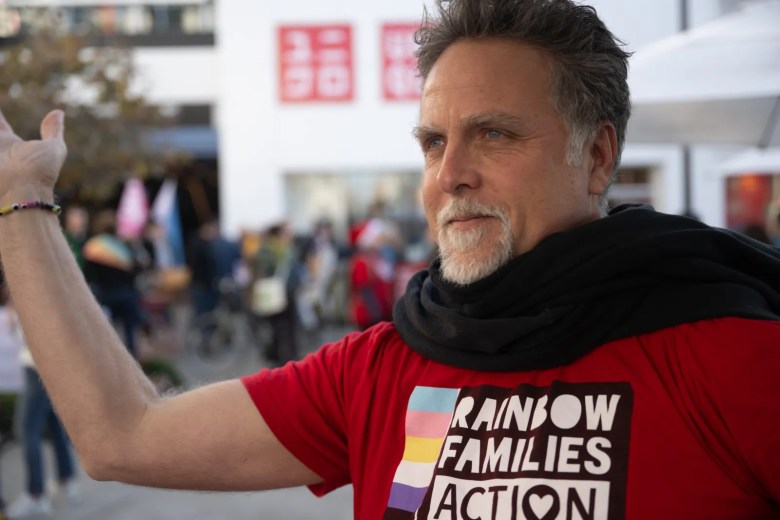 Arne Johnson, one of the early members of Rainbow Families, and one of the founders of Rainbow Families Action, its activist arm. Credit: Courtesy of Rainbow Families Action
“They’re complying in advance,” Allison said of the proposed HHS rule. “And complying in advance with it is just completely cruel.”
Allison and other parents I spoke with said they knew it wasn’t the doctors driving this change; that they have been put in a terrible position along with their patients. “I want to make really clear that the caregivers are heroic,” Johnson told me. “We know they’re fighting for us right now. Our goal is to support them and to support the executives to make the right decision.”
Meanwhile, the “pauses” in care can feel for many kids like pauses in life.
Eric told me about a friend who got surgery through Kaiser just weeks before surgeries got paused there last summer. It’s something he’d imagined for himself in the future, maybe, he said, when he turned 16 and a half. “I thought the battle was going to be convincing my parents,” he said. “We all got so angry when we realized we didn’t even get to have that argument in our family. We didn’t even get to choose.”
Frustration with California attorney general Rob Bonta
Rob Bonta, California’s attorney general, has fought openly against the federal government’s attack on trans rights. Starting in October, he filed a series of amicus briefs supporting lawsuits challenging federal subpoenas issued to gender clinics in Boston, Philadelphia and Colorado.
In November, he released guidance to medical providers that flouted Trump’s executive orders. “In California, you have the right to receive medically necessary gender-affirming care,” the statement read, “without discrimination.”
And Thursday, after the HHS draft rules were announced, his office swiftly pushed back, calling them cruel and unlawful. “It’s important to note these proposals are far from final,” Bonta said. “We stand ready to use every tool in our toolbox to prevent them from ever going into effect. Despite these proposals, medically necessary gender-affirming care remains protected by California law.”
But as Stanford, Kaiser, Sutter and other systems in the state have preemptively halted surgical care for trans — but not cisgender — youth, Bonta has so far declined to enforce the state’s anti-discrimination laws.
“It’s been a source of great frustration,” Johnson, the parent who helped found Rainbow Families Action, told me. “The law has been broken, wildly in the open, denying care to our kids. These are illegal actions in the state of California. This is the part that baffles us.”
When I reached out to the AG’s office to ask why, a spokesperson said only this: “The Trump Administration is threatening criminal charges and the jailing of doctors, as well as funding threats on hospitals that would place gender-affirming care nationwide at risk. We are focusing on removing these unlawful threats and root causes so that these providers can provide gender-affirming care.”
Bonta will battle Trump, in other words, but not California’s hospitals.
His hand may soon be forced. BP told me yesterday that Rainbow Families Action may file a civil rights complaint with the Department of Managed Healthcare, which oversees health equity in California. And they have spun up a legal committee to pursue “other legal avenues.”
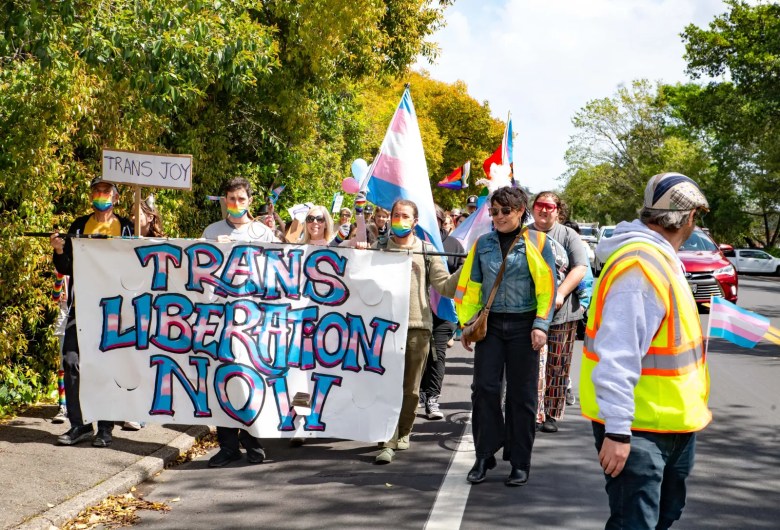 One of Rainbow Families Action’s earliest protests was a march to Gov. Gavin Newsom’s home on March 31, a few weeks after he called it “deeply unfair” for trans girls to compete on girls teams. Credit: Gabriel David Barkin
BP said she and other parents in Rainbow Families Action held a watch party of sorts yesterday as Kennedy; his head of Centers for Medicare & Medicaid Services, Mehmet Oz; and other officials claimed parents like them had been railroaded by “gender ideology” and announced a barrage of actions, including stripping “gender dysphoria” from legal definitions of disability and denying Medicare and Medicaid reimbursement to any hospital system that offers gender-affirming care to minors.
An hour after the press conference ended, I called BP, who sounded defiant.
“We’re actively campaigning with all of our health care providers to make clear there is no need to proactively pause,” she said, explaining that rulemaking is a process that takes months. Oz confirmed at the press conference that the proposed Medicaid and Medicare rules would undergo a 60- to 90-day comment period, followed by the incorporation of that feedback, before a final rule would be issued.
“We will flood the public comments,” BP told me. “We’ll be in touch with state legislators, where we have a lot of allies, and hopefully with the attorney general’s office. Despite what they may have said in that press conference, the doctors are on our side, the science is on our side, and, you know what? The moral justice is on our side.”
The ACLU, like Bonta’s office, has already threatened to sue. When I reached out to Lawrence Gostin, a distinguished university professor at Georgetown Law and an expert on health law, he noted that the federal Administrative Procedure Act means the government “can’t act arbitrarily.” And over the years, courts have interpreted the act’s prohibition on “arbitrary and capricious” rule-making expansively, to include, as one academic wrote, “poor analysis pushing an ideological agenda without regard to the facts.”
Navigating Bay Area gender care options now
Meanwhile, local parents continue to look out for their kids, who are worried, as BP’s son Eric said, that they’re going to have to keep putting their lives on hold.
Again and again, East Bay parents said, they’re trying to reassure their kids that no matter what, they’re going to be okay; that, in Allison’s words, “I’ll do whatever I can to make sure you have what you need.” The struggle, she said, is how to find new care options, “because doctors who offer this care are afraid to advertise that they offer this care.”
“It’s like seeking a back-alley abortion,” she said, “like, ‘I know a person who can help you.’”
Knight Ball is a community advocate at Our Space, a community center in Hayward that serves hundreds of queer and trans youth across Alameda County. “Gender affirming care historically has been difficult to access,” they said. “Access can fluctuate. Some agencies that were offering care are no longer. We’re trying to be as adaptive as possible. We have had some numbers go dead, some websites go dead.”
But Ball said case managers there can help kids and their families navigate the changing care environment, as can those at the Oakland LGBTQ Community Center.
For now, Ball said, they continue to recommend Planned Parenthood clinics, La Clinica’s network, and Dream Youth Clinic, all of which have locations in the East Bay, and case managers stand ready to sort out what will work for each young person’s insurance coverage and means.
For some kids, the rise in hate-filled rhetoric has made them retreat. When Nikki’s son first came out at age 7, she said, “he was vocal about it because it felt safe. Now he does a lot more to pass and fall under the radar.” Storm suspects that the care cuts are particularly devastating to young people because they were born into this access and didn’t realize how fragile it was.
And when kids don’t feel safe being out as trans, it can be tricky for their parents to engage in public advocacy, Johnson told me. “We’re very fortunate in the Bay Area,” he said, “where some of us are part of supportive communities, we have trans parents who are not afraid to say who they are, and so we have been able to move into the public sphere in a way that not many families can.” The hope, he said, is to keep California a sanctuary state for trans youth.
Just a few weeks ago, Rainbow Families Action formed a youth group, something so new it doesn’t yet have a name. Eric was one of the first to join. “There are a lot of kids,” he said, “interested in trying to secure their own future.”
“*” indicates required fields