
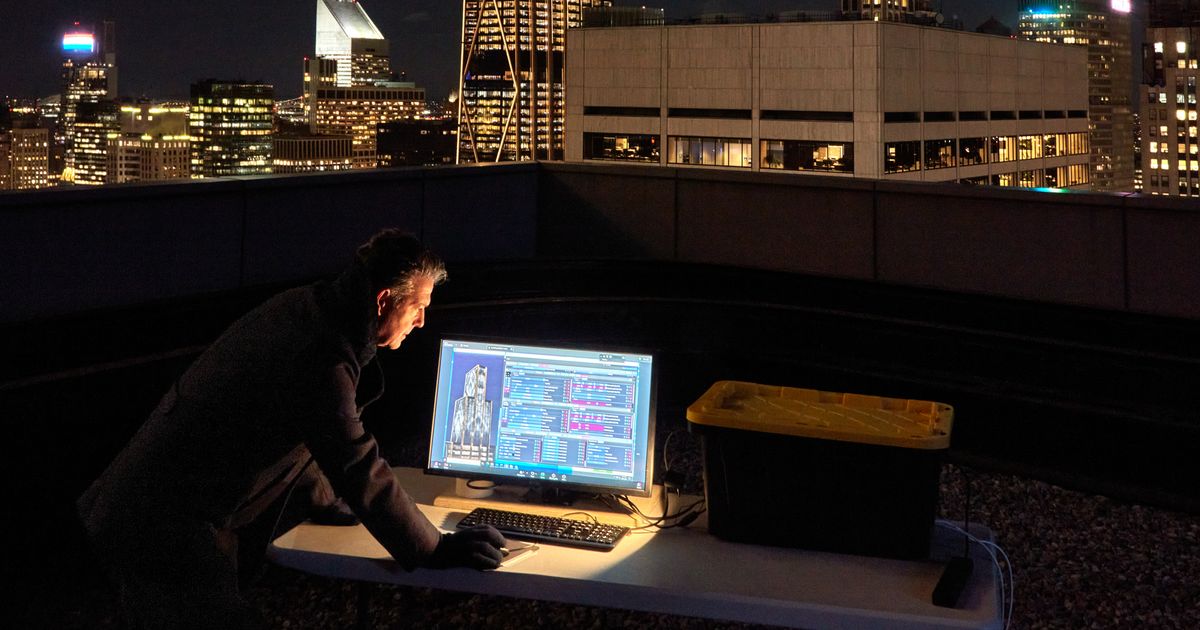
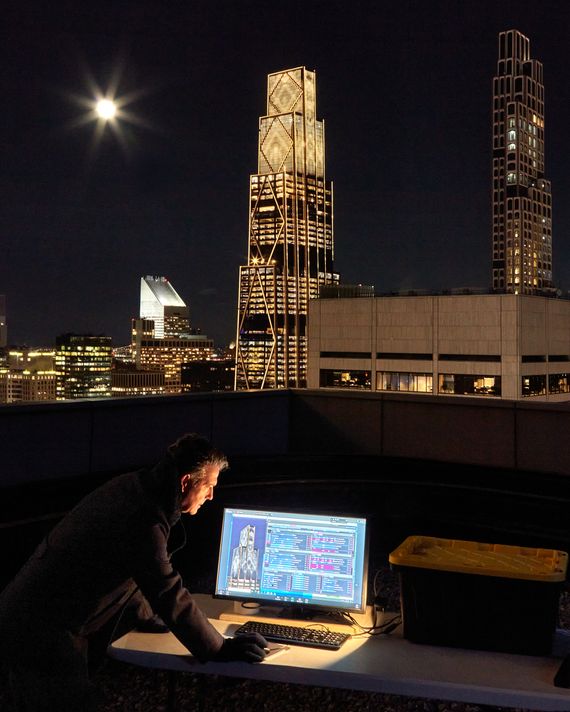
Leo Villareal’s Celestial Passage (2025) as seen from a building near Bryant Park.
Photo: Richard Barnes
Leo Villareal’s latest artwork is so big that, in order to step back from the metaphorical easel and take it all in, he needs to be ten blocks away and 42 stories up. Atop a tower near Bryant Park, reachable by two service-elevator rides and down a concrete hallway, his temporary workspace is, apart from his own presence, pretty artless. It’s just a computer and monitor on a plastic folding table and a couple of office chairs. A steel door, propped open, leads to the building’s gravel-surfaced roof. From this chilly vantage point, Villareal can see his monitor and also the top half of 270 Park Avenue, the new JPMorgan Chase tower. At dusk, he takes the controls.
Villareal works principally in the form of light installations, and for its new building, JPMorgan Chase commissioned an immense one. Celestial Passage is a swimming animated display on 181,200 small groups of LEDs, each functioning as an individually controllable one-by-six-inch pixel. They create patterns on the building’s surface that slowly drift and dissolve into one another. (Every one of those pixels contains eight little clumps of LEDs, a quarter-inch across, so Villareal has nearly a million and a half lights to play with.) Some of the sequences look like diffraction, interference, or watery moiré, others more like meteor showers. They completely blanket the top-two setback sections of the 60-story building, and elements of the artwork extend about 750 feet down from the crown to the 29th floor. (He calls those sections “pinstripes,” suited to a building full of bankers.) From his workspace, he can adjust the lights in real time with a mouse click or a keystroke.
Villareal has been testing and tweaking the array for a couple of months, and he will be doing so into the New Year. On his screen, there’s a 3-D representation of the building — he can spin it at will — and a dizzying-to-me array of sliders and controls: gamma, chroma, duration of transition. The software is all custom built. “We have a real-time visualization here, so we can see everything, down to the single-pixel level, represented,” he says. “Then this is connected live to the building. I have a lot of different layers. There’s this background layer, which — if I hit this button — ” He taps the mouse, and I am startled to see the top hunk of the building dim immediately.
“Sorry, did you just — ” I say.
“Yeah, I just soloed this,” Villareal says. “That” — he gestures out to the lights that are still on — “is just the background layer. I don’t know if you use any music software or Photoshop, but you can think of it as layers in Photoshop or channels in the sound mixer. And there are many other layers that are all being dynamically combined.” He taps again, and the foreground reilluminates and once again begins to move, as if the lead guitar and bass tracks have reappeared over the drums.
It’s hard to put into words exactly what it all looks like. Photographs don’t fully capture it either. Broadly, though, when Celestial Passage is running, all those diodes — which can display red, green, blue, and white and are tunable to any mix thereof — appear somewhere in the range of butterscotch. Most are mounted pointing outward, but a second set points back at the tower’s reflective exterior, adding depth to the display. The bankers within can’t see the light sources themselves, somehow.
Atop the tower, layered shapes slowly and continually dissolve into one another. Click to see it in action. (Video: Richard Barnes.)
The transitions between patterns are variable and somewhat stochastic. Showing me one background layer, Villareal says, “The minimum is 2.3 minutes, and the maximum is 4.6. It” — meaning the software — “picks some value, and it’ll stay on that for that amount of time.” Other patterns will cycle in front of that layer on their own separate periodicity. The slowness of the changing forms draws the eye in, both because you are inclined to look for repetitions and because the morphing shapes have the hypnotic quality of some of Yayoi Kusama’s work or James Turrell’s or (at a much smaller scale) even the forms inside a lava lamp. The pace is a lot of what he’s adjusting these days, Villareal says, as he controls “how it flows. It shouldn’t feel like it’s rushing through. But the motion needs to be fast enough that you can perceive that it is moving. If you slow it down too much, then it feels just static, and that’s not really what it’s about. But also we’re allowing for some outliers so that there are these moments of surprise.”
In some of those, the dissolves periodically give way to something that looks like a curtain of twinkling falling stars: “sparkle layers,” Villareal calls them, “and yet another layer that’s doing these larger big gestures that are meant to be seen from a distance.” Does it repeat? “It’s randomized.” He explains that they started with lots of computer-generated patterns and then, when he saw one he liked, they would grab it and give it a slot in the lineup.
Villareal, who studied sculpture at Yale and interactive communications at NYU, began making high-tech art in the early days of virtual-reality computing. “We had this Silicon Graphics computer, like a million-dollar computer” — extremely high-powered for the 1990s, which is to say it had less processing oomph than a fancy fridge does today. He made his first light-based work, a grid of 16 strobes and an itty-bitty circuit to drive them, at Burning Man in 1997. “It was just a beacon to get home to my camp at night. It had a language to it, and you could see it from miles away. And I realized that by going the other direction from virtual reality, which was all about more resolution and needed faster everything, I could do a lot with 16 pixels and zeros-off-ones-on.”
His profile rose dramatically in 2013, when he covered the San Francisco–Oakland Bay Bridge in LEDs that shimmered up and down and across the suspender cables. The Bay Lights was understatedly dramatic, especially as it delineated the pure structure of the bridge over the open water, and it had a ten-year life before the salt air and traffic vibrations wore it down. It’s being rebuilt now for a relaunch in the coming months with sturdier electronics and twice as many lights. “I want to respect the Bay Lights everyone knows and loves,” says Villareal, “but I’ve learned a lot over the past 12 years.” More recent commissions have come from London, Santa Fe, and Tokyo. New Yorkers have also experienced his work firsthand when transferring from the 6 to the F at Bleecker Street: The MTA installed Villareal’s illuminated hex grid, Hive, in the station in 2012.
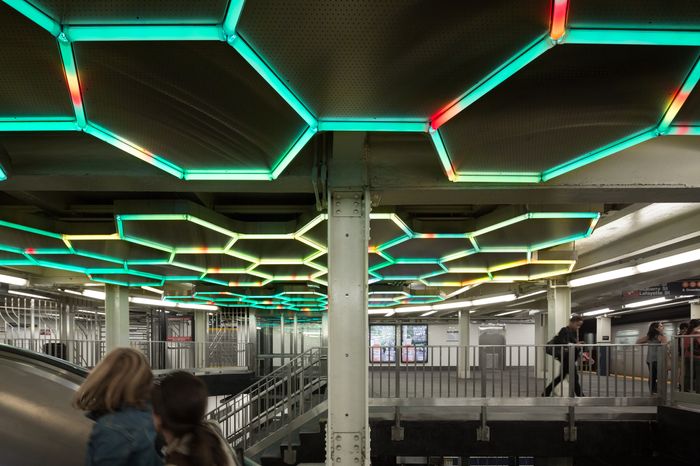
Villareal’s Hive (2012), inside the Bleecker Street station.
Photo: James Ewing/JBSA
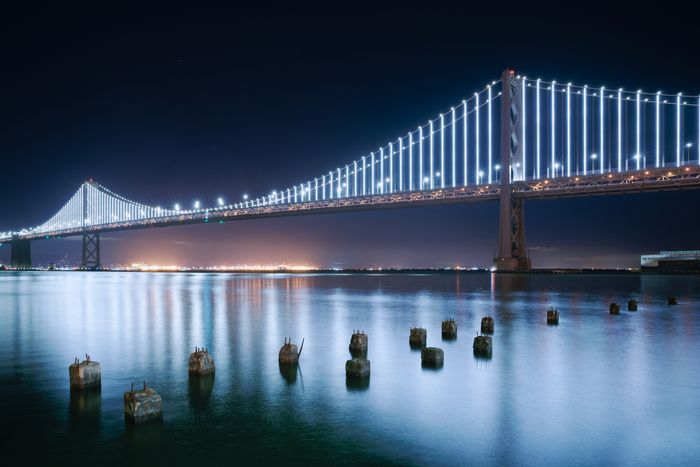
The Bay Lights (2013) on the Bay Bridge in San Francisco.
Photo: Shutterstock
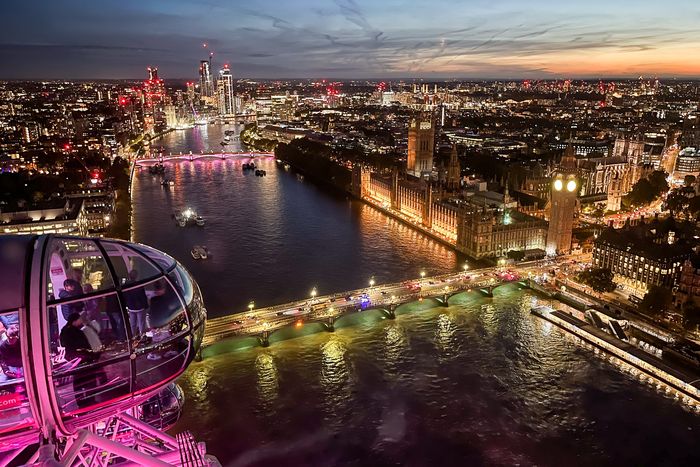
Illuminated River (2019–21) on the Thames in London.
Photo: an Woitas/picture alliance via Getty Images
I confess that when I heard a preliminary description of Celestial Passage, it made me uneasy. A hard blue-white LED glow is increasingly the look of midtown, partly because those diodes can be so bright in a tightly delineated band of the color spectrum, partly because this century’s new buildings, from One Vanderbilt to the dual towers at Manhattan West, are intensely lit on top. Although eye-frying light seems urbanistically correct in Times Square — the sky’s the limit there, it seems to me — the rest of Manhattan is another matter, and expanding that level of razzle-dazzle 20 blocks east and north and south would be transformatively garish. The Empire State Building has been fitted with highly programmable LEDs as well, and some nights it crosses the line into blinky pinball jitteriness. This JPMorgan Chase project, I thought, might aim to make itself seen through the visual cacophony, and I feared that we were in an illumination arms race — that we would end up with a Third Avenue weed shop at skyscraper scale.
Instead, Villareal went the opposite way. On most nights, the glow is remarkably restrained. For holidays and other special events, JPMorgan Chase will take over the building’s crown, and on those evenings, it’ll all be saturated colors and bright visuals: a giant image of a waving American flag capped the tower this past Fourth of July, for example, and a Union Jack appeared later in the year to welcome some British visitors. (A JPMorgan Chase representative told me that the schedule for running these other displays in lieu of the artwork was still being worked out. The holiday weeks include a lot of Hanukkah-Christmas–New Year’s color.) But when Villareal’s work is up there, it’s nuanced and comparatively unflashy in large part because the LEDs aren’t cranked up all the way. He tells me that, at their peak brightness, they’re running at a quarter of their maximum output.
In its evenness and responsiveness to the software, the light has an unexpectedly old-fashioned vibe. The warm color temperatures — “I didn’t know you could make brown light,” Villareal says — suggest Edisonian incandescence instead of diodes. He’s been working on a separate commission lately in which LEDs are embedded in slats of white oak, and maybe it’s no accident that the projects are in the same tonal family. “I’ve talked about my work as being these digital campfires you gather around,” he says, “the same way people did around my first piece at Burning Man.”
By the time he says this, we’ve been talking quietly for nearly an hour at his computer setup, and I notice something. The pauses in our conversation are getting longer, and that’s not because either of us is bored or has checked out. It’s because the lights are within view, right outside the door, and as much as I am interested in what he’s saying about this project, I can’t stop looking at it. I remark on this to explain why I’ve drifted away from asking him questions, and he says he’s encountered this phenomenon before. “The security guy who works here came up one night and was very official, but he started looking at it and talking about it, saying, ‘This makes me feel like I’m a kid and I’ve seen fireworks for the first time.’ ” I nod, then don’t say much more as my gaze once again drifts toward the tower. So does his, as he continues his edit. Click. Click.
Thank you for subscribing and supporting our journalism.
If you prefer to read in print, you can also find this article in the December 29, 2025, issue of
New York Magazine.
Want more stories like this one? Subscribe now
to support our journalism and get unlimited access to our coverage.
If you prefer to read in print, you can also find this article in the December 29, 2025, issue of
New York Magazine.
Related