
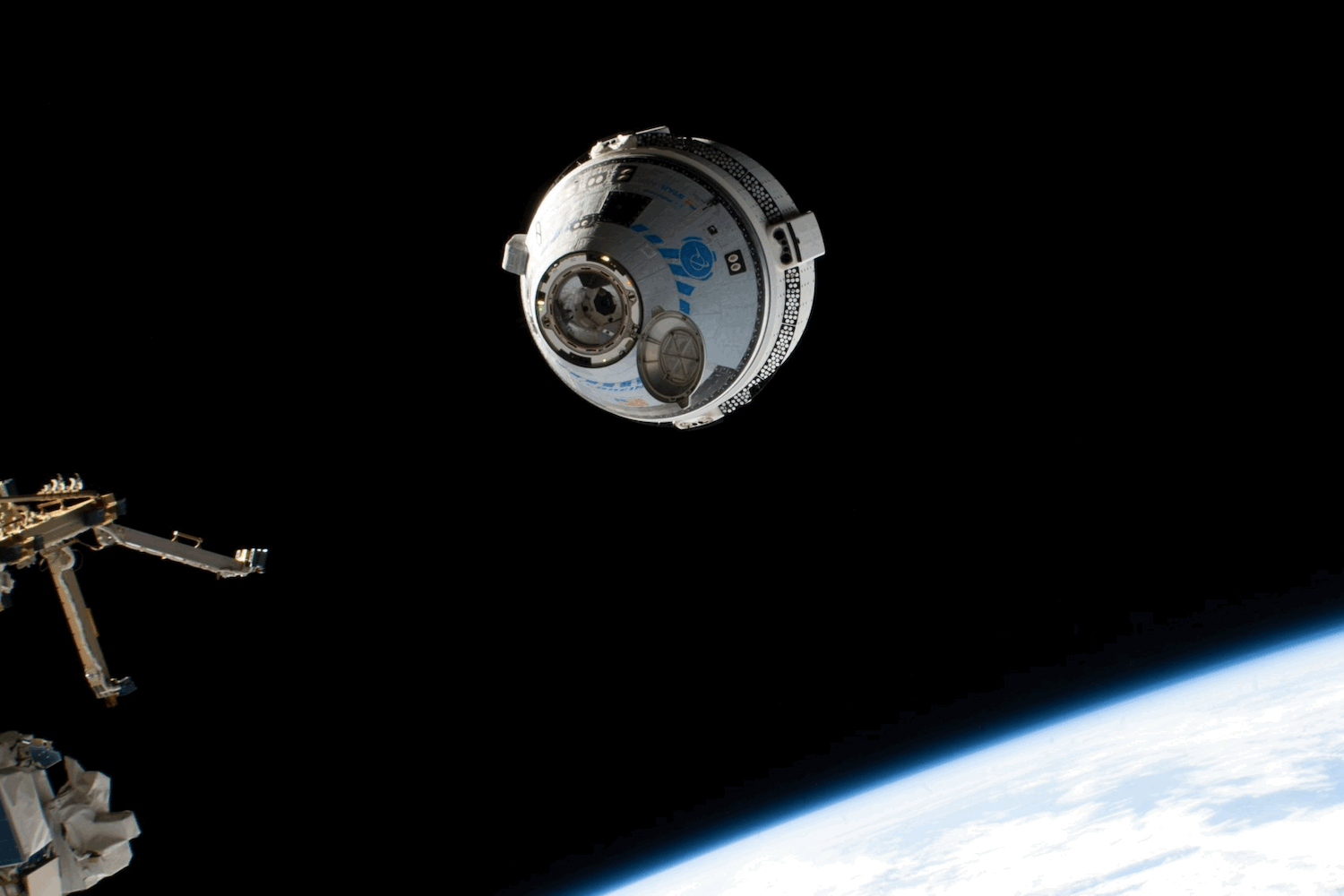
A NASA safety panel has criticized space agency officials for how they handled the busted Starliner mission that left two astronauts stranded on board the International Space Station (ISS). A new report highlights a wave of uncertainty that lurked behind Boeing’s unfortunate saga, casting doubt over whether NASA can properly address safety concerns with future missions like Artemis.
For months, NASA and Boeing officials reassured the press that astronauts Butch Wilmore and Suni Williams could depart the ISS on board the faulty Boeing spacecraft. Given the severity of the situation, however, NASA should have immediately declared the incident as a mishap to prompt an investigation with the agency’s safety office, according to a new report by NASA’s Aerospace Safety Advisory Panel (ASAP).
“The ASAP finding is the lack of a declared in-flight mishap or high visibility close call contributed to an extensive, excessive … period of time where risk ownership and the decision-making authority were unclear,” Charlie Precourt, a former space shuttle commander and member of ASAP, told Ars Technica.
Safety first
Boeing’s Starliner capsule launched atop United Launch Alliance’s Atlas V rocket on June 5 for its first crewed test flight. The spacecraft had a hard time docking at the space station after five of the spacecraft’s thrusters failed during its approach. Starliner also developed five helium leaks, one of which had been identified prior to its launch.
The mission was originally scheduled for eight days, but the crew’s return was delayed several times as ground teams conducted tests on the vehicle and collected data before giving the green light for the astronauts to return to Earth. NASA eventually deemed the spacecraft unfit to carry the astronauts back home and returned the crew on board SpaceX’s Dragon spacecraft instead.
Astronauts Wilmore and Williams ended up spending nearly nine months on the ISS while officials downplayed the thruster glitch and deliberated whether or not to return the astronauts on board Starliner. On September 6, 2024, Boeing’s Starliner undocked from the ISS and returned to Earth without a crew on board.
NASA’s procedural requirements stipulated that the agency should declare a mishap in the event of a mission failure. The agency had made that official declaration following Starliner’s first uncrewed mission to the ISS in 2019, when the spacecraft failed to reach the space station. Declaring a mishap initiates an internal process within NASA’s safety office to launch an investigation and document lessons learned for future missions.
“Procedurally, investigation reports are tied to anomaly declaration, so they gain an official status in NASA records,” Precourt is quoted as saying. “Certainly, this particular anomaly deserves to be right up front and center for quite some time.”
Wave of confusion
In failing to officially declare the Starliner mission as a mishap, NASA created a wave of confusion within the agency, delaying the launch of an investigation. For months, NASA weighed whether to return the crew aboard Starliner or opt to have them board SpaceX’s capsule instead. The agency was keen on sending a message to the press that the crew was not stranded in space and that Starliner is capable of returning the crew to Earth.
“There’s a significant difference, philosophically, between we will work toward proving the Starliner is safe for crew return, versus a philosophy of Starliner is no-go for return..until we learn how to ensure the on-orbit failures won’t recur on entry with the Starliner,” Precourt told Ars Technica. “The latter would have been the more appropriate direction. However, there were many stakeholders that believed the direction was the former approach. This ambiguity continued throughout the summer month.”
In its report, the safety panel recommended that NASA remove this ambiguity in the event of a mishap in the future that may jeopardize the safety of its crew.
Despite the Starliner mishap, NASA is not giving up on Boeing’s spacecraft just yet. In late November, the space agency announced that it is revising its commercial crew contract with Boeing and reducing the number of Starliner missions to four instead of six. Starliner’s next mission to the ISS is scheduled for no earlier than April 2026, although the spacecraft will fly with no crew on board this time.