
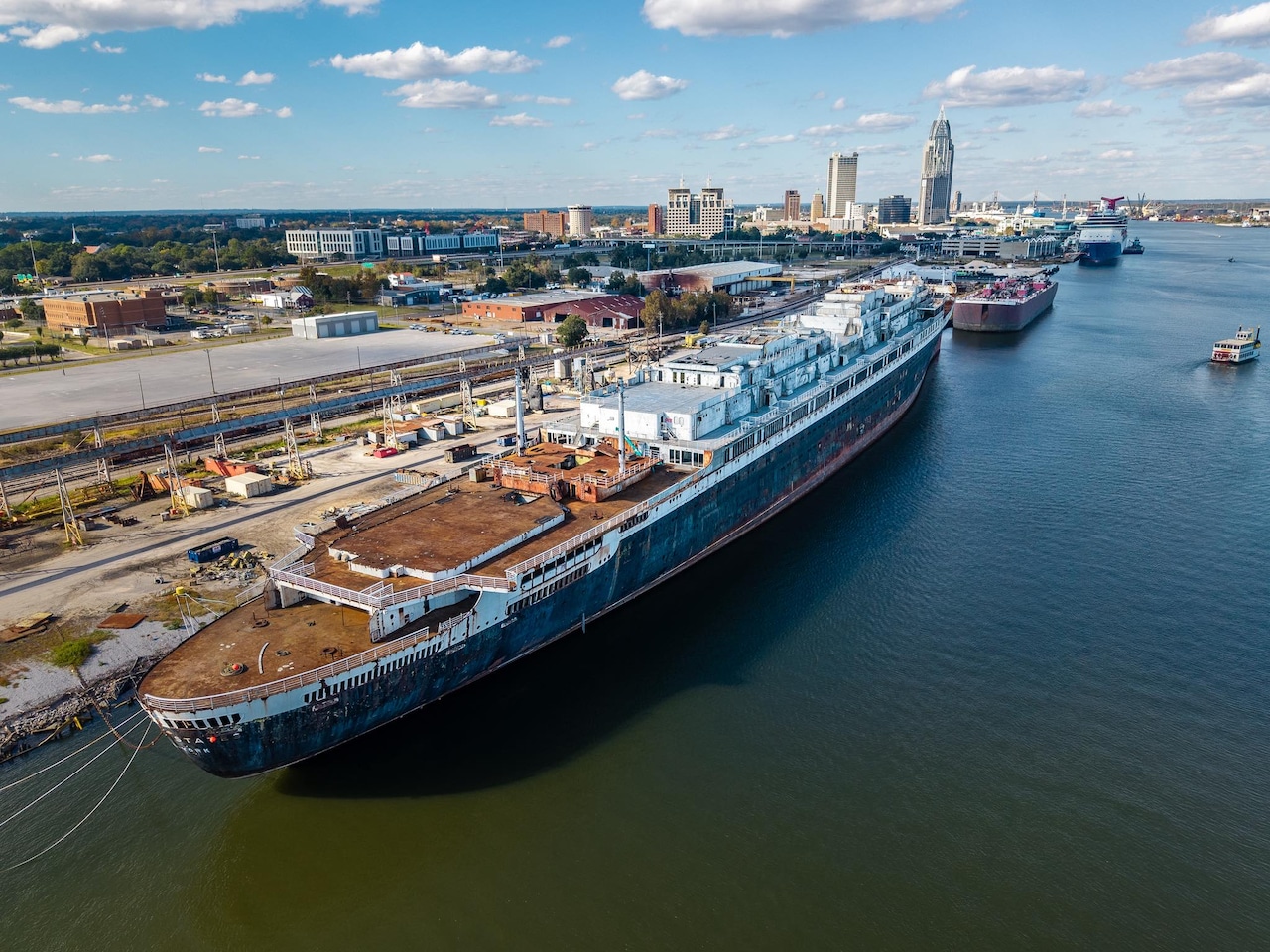
The SS United States is preparing to leave Mobile early next year for its final voyage, but the research tied to the historic vessel is only just beginning.
At least one Alabama institution will continue working on the vessel after it meets its final resting place at the bottom of the Gulf.
Researchers with the Dauphin Island Sea Lab will be investigating how a collection of sounds associated with SS United States might affect humans and animals once it becomes the world’s largest artificial reef.
The 990-foot former cruiser that has been docked in Mobile since March will deploy to the Florida Panhandle sometime in late February or in the month of March 2026, where it will be sunk and transformed into a tourist attraction for scuba divers.
“The data collected can be used to analyze many parameters such as what species are present, how sound travels through the habitat, and even human activity around the dive site,” said Sierra Robertson, a doctoral student at the University of South Alabama who is conducting the research in the Martin Lab at Dauphin Island Sea Lab.
The research work was first announced earlier this month by Alex Fogg, the natural resources chief for Okaloosa County, during an update on the ship’s deployment and sinking before the Okaloosa County Commission, which purchased the ship last year.
Soundscape research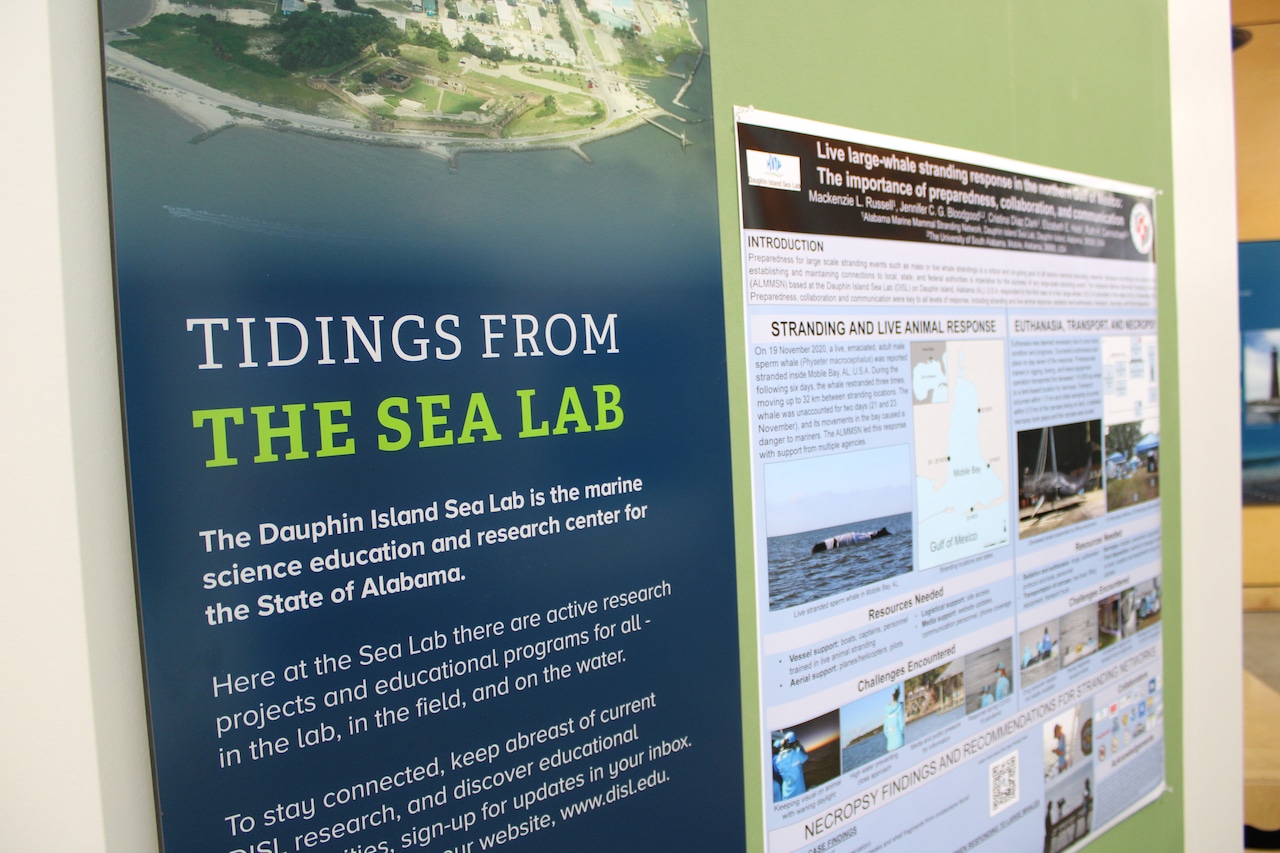 A display at the Alabama Aquarium highlights the research of the Dauphin Island Sea Lab.Lawrence Specker | LSpecker@AL.com
Robertson, in an email to AL.com, said the research focuses on the term, “soundscape,” which is a collection of all sounds, including human, animal, wind, waves, within an area.
Researchers have already deployed an underwater device to record sounds at the proposed location of where the ship will be transformed into an artificial reef. Called a “SoundTrap Recorder,” it was put into place in October at the site approximately 32 nautical miles southeast of Pensacola.
The recording currently taking place is a continuous process, with one minute recorded every 10 minutes to serve as a “before” treatment, Robertson said.
Once the ship is sunk, researchers will redeploy the SoundTrap and record potential changes in the soundscape as the ship is colonized by invertebrates, smaller organisms, and larger animals, Roberston said.
The recording will last for one full year after the ship is sunk. However, Robertson said there may be a need to increase the timeline.
“It is not very common in ecological research to get a true before and after experiment so this is very exciting to observe,” Robertson said.
Timing questions
When the ship will be sunk is the looming question that is capturing national interest, and pushback in New York City.
Officials are saying that at the earliest, the ship will be deployed to its final destination by March 2026. At the earliest, and depending on the weather, the ship could be moved in late February.
In New York City, officials are hopeful to generate enough attention that either President Donald Trump or members of Congress will intervene to thwart the Florida sinking. The New York City Council, last Thursday, voted on a resolution calling for federal support to have the ship relocated to New York where it would remain above-water and serve as a tourist destination.
“I’m not going to sugar-coat anything, but I’d love to see that ship not become a coral reef,” New York City Councilwoman Gale Brewer told The New York Post in a story posted Dec. 15, ahead of the council’s vote. “Letting this iconic vessel slip away would mean losing a huge opportunity to create a great new public space and maritime museum that could educate and inspire New Yorkers about our maritime history for generations.”
In response, an Okaloosa County spokesperson said there are no plans to change directions with the county’s project that involves transforming the ship into what they hope is a major scuba diving tourist attraction with a land-based museum.
“Okaloosa County is the owner of the ship, and we fully intend to deploy her as the World’s Largest Artificial Reef,” said county spokesperson Nick Tomacek.
There is no sendoff event planned in Mobile.
Attraction and exit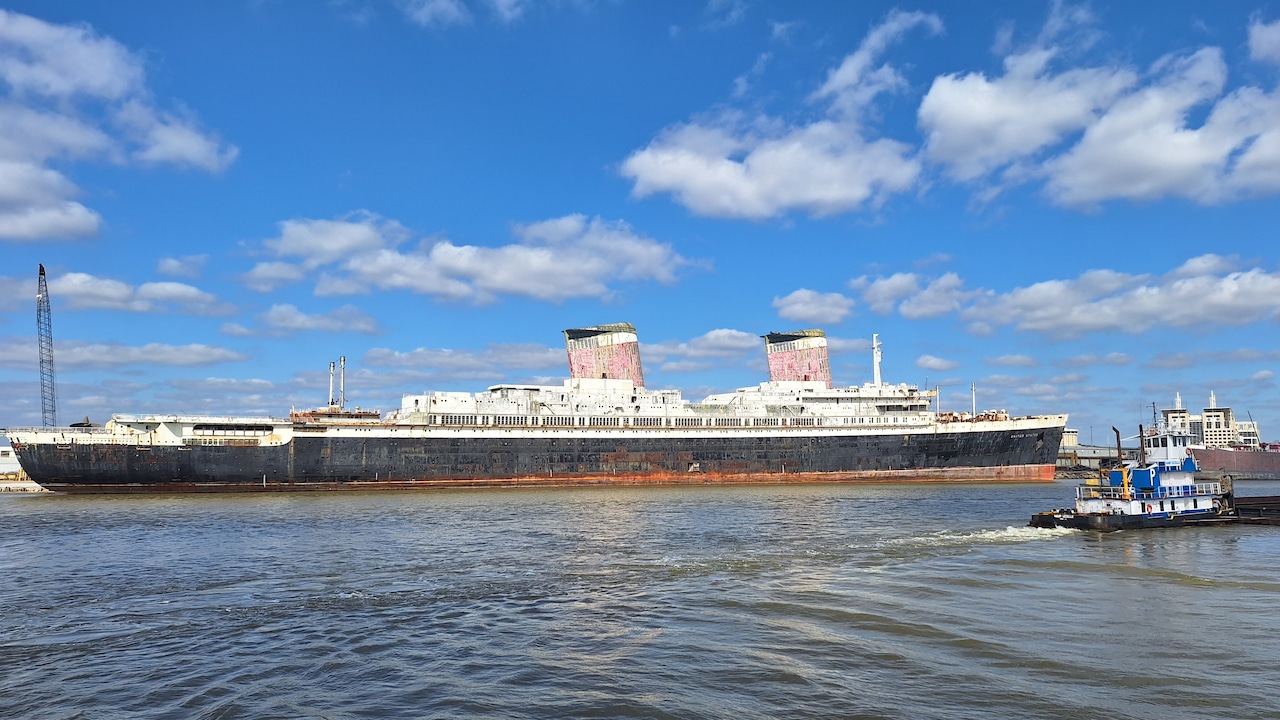
1/23
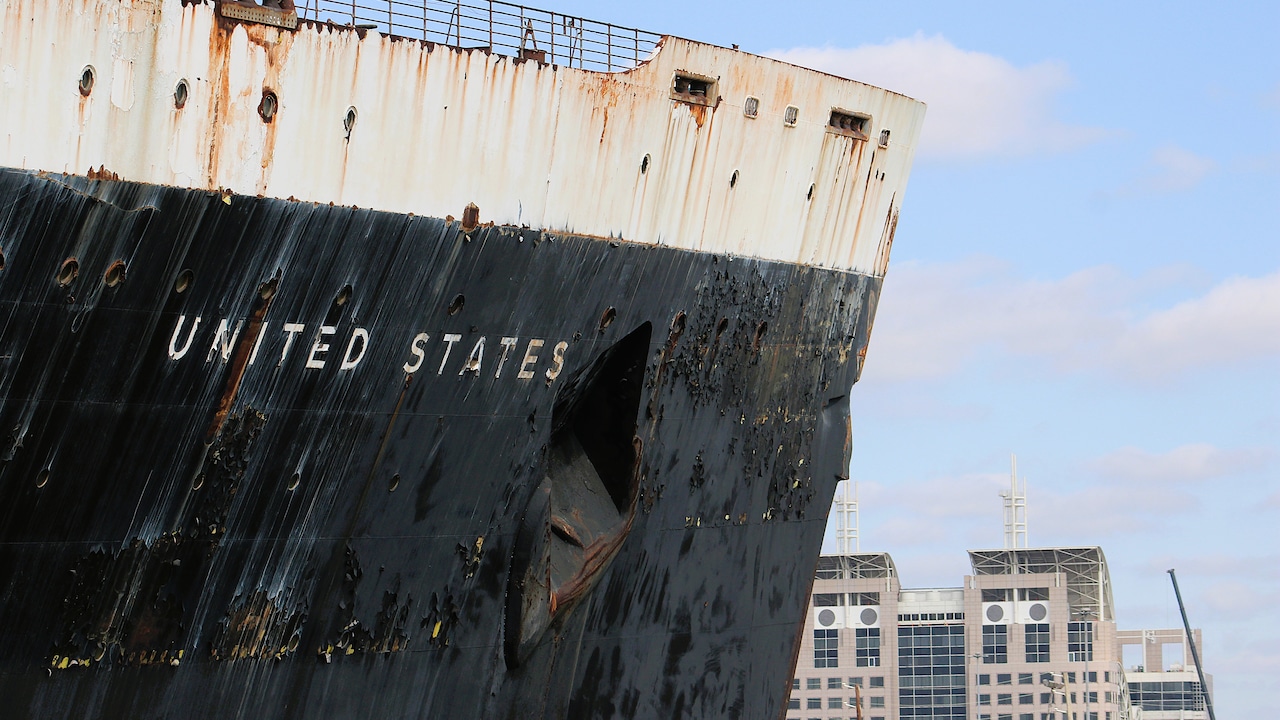
SS United States in Mobile
The ship has been a tourist attraction within the Port of Mobile since its arrival on Lundi Gras, in early March where it’s been docked at the Modern American Recycling and Repair Service (MARRS) facility south of downtown Mobile. There, the ship has been dismantled and prepared for its future deployment into the Gulf as part of a tourism project benefiting Northwest Florida.
For several months, the ship served as a tourist attraction with riverboat companies offering water-based excursions to the vessel. Guides aboard some of the tours, including the Perdido Queen and Delta Explorer, shared stories about the ship’s past as a glamorous ocean liner sailed by celebrities of the 1950s and 60s. It was built in 1951 and was once the largest and fastest ocean liner built in the United States.
“It was a big boon for about a good six months,” said David Clark, president & CEO with Visit Mobile. “The boats were full a few times a week for many months.”
Florida Panhandle officials believe the ship will provide healthy economic return on its investment.
According to the Florida Fish and Wildlife Conservation Commission, for every dollar spent on artificial reefs in the Florida Panhandle, the conservative overall economic benefit of the artificial reef system over its life span is $138, or a 13,800% return on investment. This includes job creation in the construction and maintenance of reefs and increased economic activity in related sectors such as retail.
The ship’s eventual exit from Mobile will be a three-day process, Fogg told the Okaloosa County Commission earlier this month. He said that once the ship leaves Mobile, it will be located into the Gulf where it will slowly sink.
He said that holes are being carved into the vessel to prepare for its sinking. He said explosives are not permitted, which is why the “we are cutting so many holes” into the vessel.
“We have to have water into the ship quickly,” Fogg said.
He said that pinning down an exact timetable for the deployment is tricky and is weather-dependent.
“It’s hard to set a date,” he told commissioners. “We have to plan on safety and security, weather. The best-case scenario is the last week of February. If the weather does not cooperate, the deployment is pushed another 30 days.”
Purchase and remediation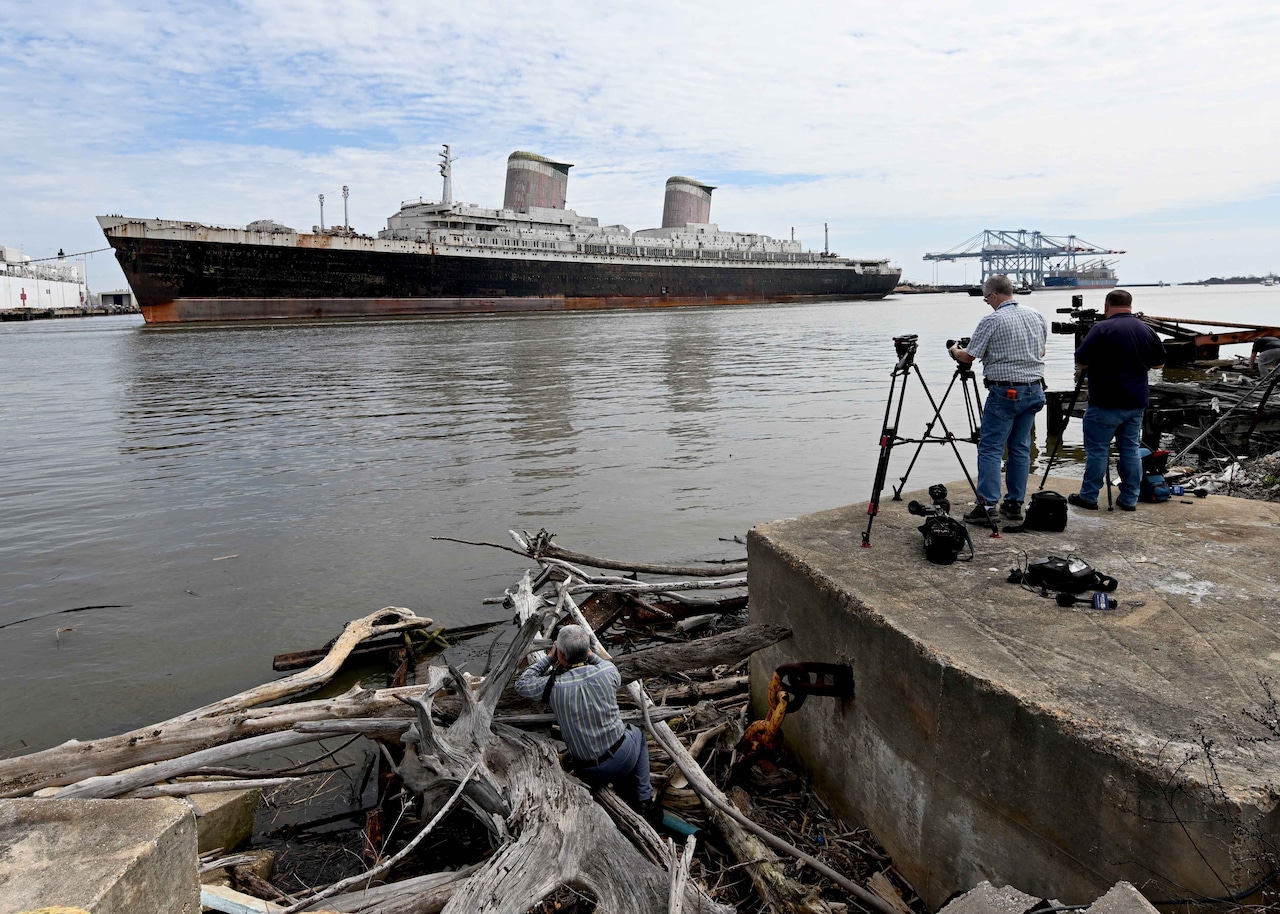 The SS United States arrives at its new, temporary dock in Mobile, Alabama, on Monday, March 3, 2025.Okaloosa County, Florida, provided
Okaloosa County purchased the ship for $1 million last year and allocated $10 million to have it moved from Philadelphia to Mobile, and then eventually into the Gulf where it will be sunk.
Okaloosa County commissioners, during their meeting this month, authorized spending $2.9 million on additional costs associated with moving the ship. Most of those costs were related to the difficulty of maneuvering the ship out of Philadelphia.
While in Mobile, the ship has undergone a massive remediation and cleaning in preparation for it sinking, while adhering to U.S. Environmental Protection Agency standards. According to Fogg, 120 fuel tanks scattered throughout the ship have been emptied and cleaned. 99% of PCB chemicals found on the ship’s decking have been remediated, paints have been scraped off, and windows removed.
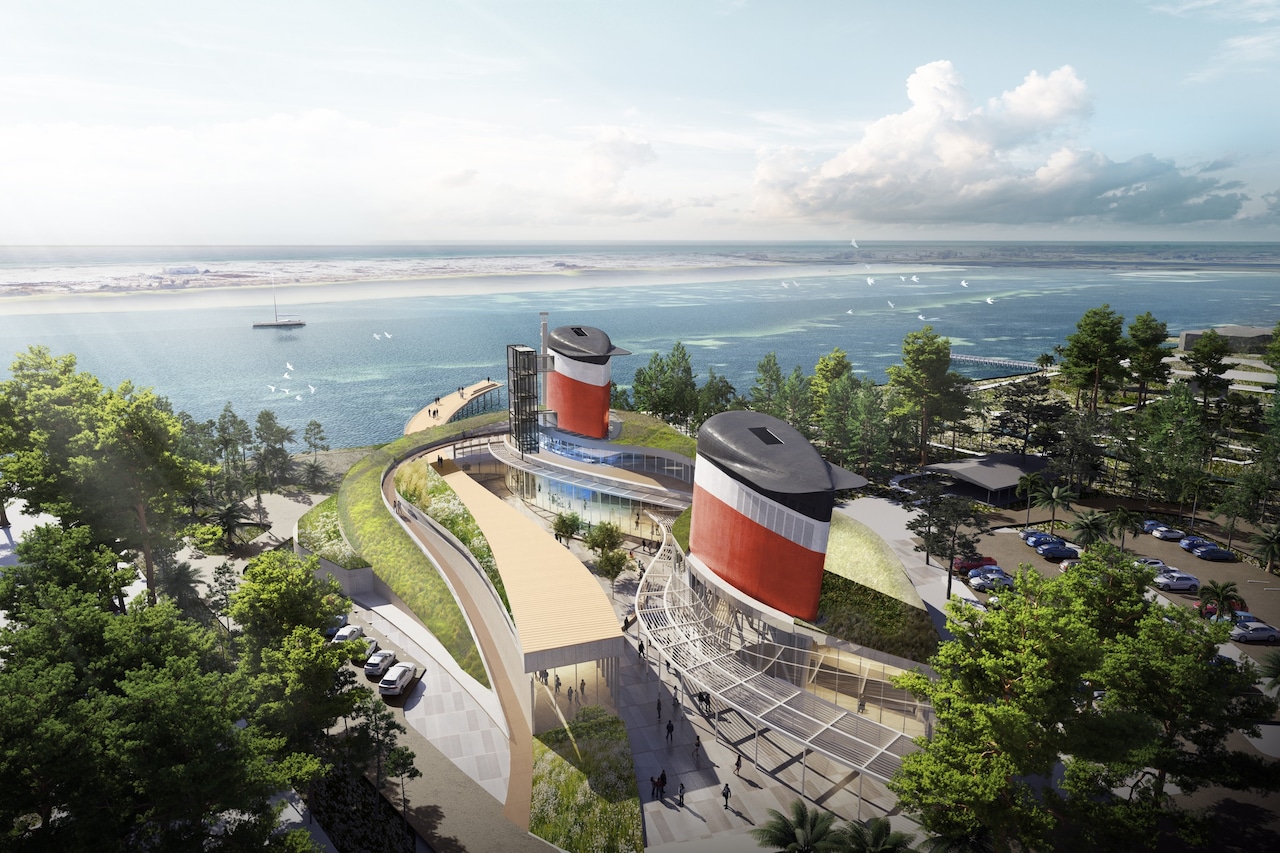 Renderings of the future SS United States Museum and Visitor Experience in the Florida Panhandle.Rendering courtesy of Thinc | LMN Architects | Buro Happold.
The most notable effort involved removing the two iconic smoke stacks in August. They are currently in storage where they will be repurposed and featured in a land-based museum and immersive exhibit dedicated to the ship’s robust history.
“It’s got an incredible history, and we look forward to continuing with it,” Fogg said.
As for Mobile, Clark said he anticipates another tourism bump from a second high-profile remediation project when the USS Enterprise, the world’s first nuclear-powered aircraft carrier, arrives into the Port of Mobile and is dismantled in a location just south of where the SS United States is currently docked.
The USS Enterprise is a much larger vessel than the SS United States, and is likely to be an even more visible attraction to Mobile’s downtown skyline, and one that will last a longer period of time. The USS Enterprise dismantling is expected to last until 2029.
“The SS United States was about leisure, a cruise ship with presidents and stars and celebrities on board,” Clark said. “The next ship is about those who served our country and has a lot of military heritage associated with it. We’re expecting a whole lot of interest for a whole lot longer of a time.”