
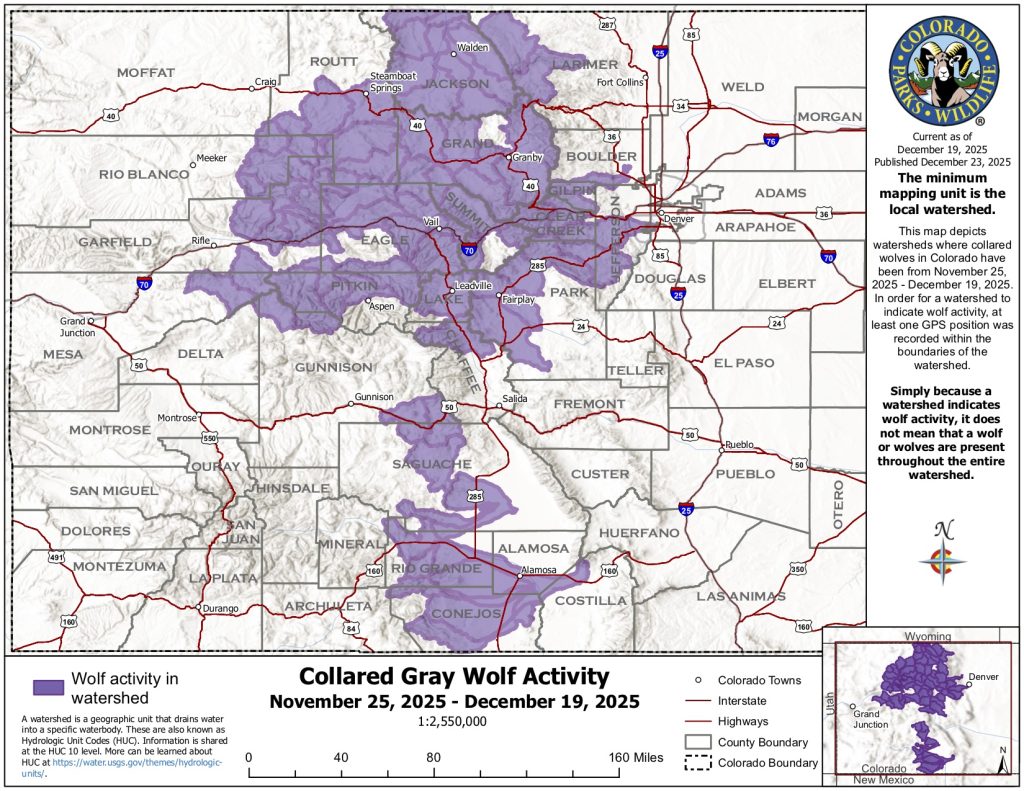
 The December wolf activity map shows where Colorado’s collared wolves have traveled in recent weeks.
Colorado Parks and Wildlife/Courtesy Photo
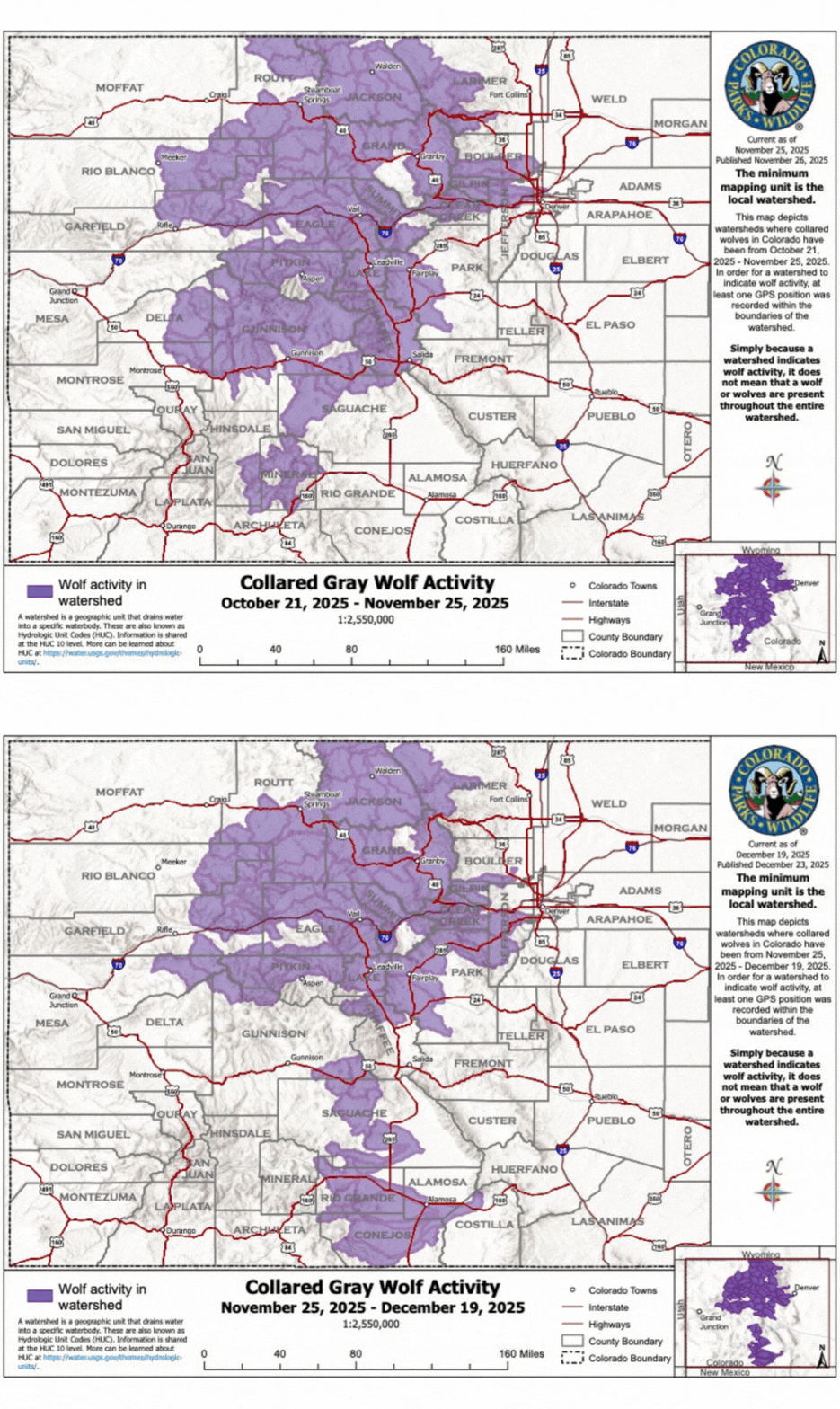 The December wolf map is compared to the November wolf map to show where Colorado’s collared wolves have traveled. Colorado Parks and Wildlife/Courtesy Photos
While some of the wolves are part of Colorado’s four packs establishing territories in Pitkin, Jackson, Routt and Rio Blanco counties, others continue to search the landscape for mates and suitable food sources and habitat.
Largely, however, wolf exploration of Colorado remains within similar northern counties in December, according to the latest wolf activity map shared by Colorado Parks and Wildlife on Dec. 23.
The map — which shows the watersheds where the state’s collared gray wolves were located between Nov. 25 and Dec. 19 — shows that wolves continue to be most active in the northwest, while also pushing into watersheds to the south and east.
While the map continues to show activity in some Front Range area watersheds within Larimer, Denver, Boulder and Jefferson counties, the agency reported that “no wolves have crossed I-25 or spent time near urban centers.”
If a watershed is highlighted, it means that at least one GPS point from one wolf was recorded in that watershed during the 30 days. GPS points are recorded every four hours or so. The latest map also shows activity in Routt, Rio Blanco, Eagle, Jackson, Larimer, Grand, Summit, Gilpin, Clear Creek, Park, Lake, Chaffee, Gunnison, Garfield, Saguache, Rio Grande and Conejos counties.
While wolves have been exploring southern watersheds for months, Colorado saw its first wolf enter New Mexico and be returned by the southwestern state’s wildlife agency in December. Colorado has an agreement with Utah, New Mexico and Arizona in which any gray wolves from Colorado that enter these three states can be captured and returned to Parks and Wildlife.
The December wolf activity map shows where Colorado’s collared wolves have traveled in recent weeks. Colorado Parks and Wildlife/Courtesy Photo
According to Parks and Wildlife, the male gray wolf was among those born to the Copper Creek pack in 2024 and dispersed from the pack in the fall. Dispersal is common for young wolves as they leave their birth pack, attempt to make it on their own and search for a mate. The animal was released in Grand County — a decision that sparked concerns from state and local elected officials as well as some wildlife advocates — in a location reportedly distanced from livestock and near to an unpaired female wolf as well as prey populations.
The watershed map shows that there was wolf activity in Conejos County along the New Mexico state border. It also shows wolf activity brushing up against the Wyoming border. Parks and Wildlife does not have an agreement with its northern neighbor. Instead, wolves that enter Wyoming lose their protections as an endangered species and can be hunted in the vast majority of the state. Three of Colorado’s reintroduced wolves have died after going north.
Colorado is nearly two years into its reintroduction of gray wolves, releasing a total of 25 wolves. Four packs had pups this year, but Parks and Wildlife has not released minimum counts of new wolf pups for all the packs. It says it will release the count in its annual wolf report, released each spring. Eleven wolf deaths have been confirmed.
While the agency was looking to conduct its third year of wolf releases in the southwest this winter, Parks and Wildlife has yet to secure a source of wolves. The agency had planned to return to British Columbia; however, the federal government, under a new director, said it could no longer import the wolves from outside the country.