
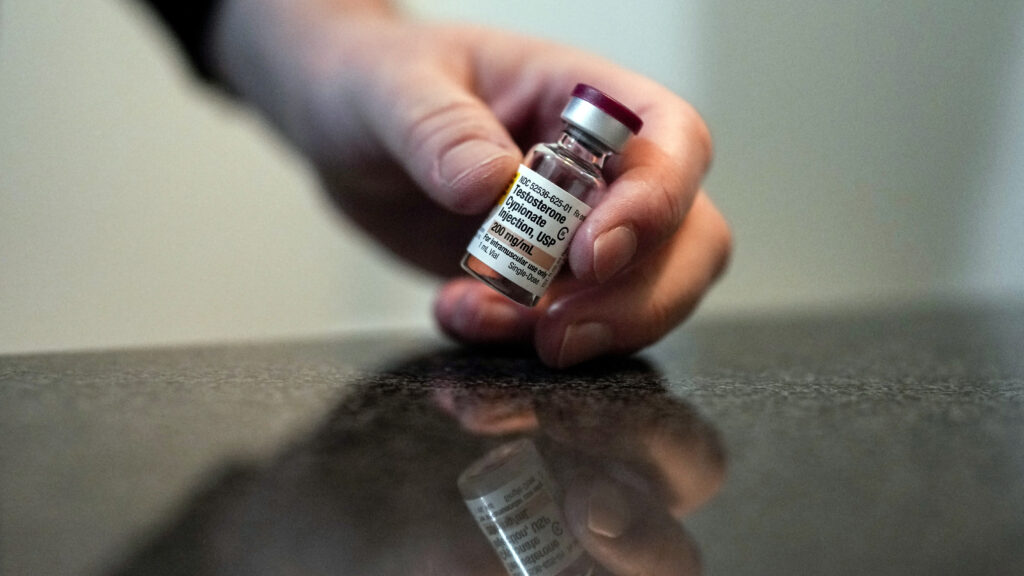
The first thing Abraham Morgentaler learned about testosterone is that it’s a brain hormone. It was in a lab at Harvard, while an undergraduate in the late 1970s, where he had this realization: A castrated male lizard put in a cage with a female would not perform its mating ritual and would be uninterested in the female; but the same lizard, dosed with testosterone in the areas of the brain sensitive to testosterone, would — its dewlap coming out, head bobbing.
That is what he thought about when, about a decade later and a newly minted urologist, he began dosing men with testosterone. The patients were miserable, complaining of a lack of sex drive so severe it was ruining their relationships and lives. They were often coming for a second, third, even fourth opinion, after other specialists had been unable to help.
Could they be like the lizards? Could testosterone help them? But there was a problem. “In my training residency, I was taught that if a healthy man got an injection of testosterone today, he would come back in one month with prostate cancer,” he said.
At the time, testosterone treatment was limited to a few rare cases of severe hypogonadism, and no one — or no one that Morgentaler knew of — was even considering dosing men who had gone through puberty with the hormone. But his patients were so desperate that even as he discussed the risk of prostate cancer and demanded they get a biopsy to make sure they didn’t already have any cancer (an invasive, painful procedure at a time when anesthetizing the prostate was challenging), they were willing to take the risk.
So was he.
He started measuring patients’ testosterone levels, which he had never done in his training, and by trial and error landed on dosage and protocols that worked for them. He monitored their progress, and took note of the benefits they were reporting, which often included improved mood or better stamina. “I have to tell you, it was scary,” said Morgentaler, now a Blavatnik faculty fellow in health and longevity at Harvard Medical School.
Why men are flocking to dubious online clinics for testosterone therapy
“The benefits were obvious to me and I felt like I had this magic sauce that nobody else had. It didn’t feel right: I was too young a guy, not established well,” he said. “I worried that I was making a deal with the devil that the men were getting benefits now, but maybe I was putting them at risk, and they would get prostate cancer later on.”
Except, his patients weren’t getting sick. Not after a month, or many months. “The first indication I had there was something wrong with the story was my guys were doing well. I was monitoring them like crazy,” he said, noting that urologists “see themselves as protectors of the prostate,” so putting this particular organ at risk was especially concerning to him.
It took four decades, but the medical consensus now aligns with his clinical evidence: testosterone therapy in men with hypogonadism does not increase their risk of prostate cancer.
In a recent conversation with STAT, Morgentaler discussed what led to decades of shunning of testosterone treatment, as well as why this hormone continues to be “medically politicized” even as study after study confirms its safety and benefit for men with low levels of testosterone.
This interview has been edited and condensed for clarity.
When you started practicing in the late 1980s, testosterone therapy had been all but nonexistent in the U.S. for decades — why so?
Because of the universal belief that testosterone causes prostate cancer. The teaching was that eunuchs — men who had lost their testicles — never got prostate cancer. Today, I can tell you that there’s no basis for that, but that was universally believed and taught.
What propelled me into national awareness around testosterone was that right away I found prostate cancer in these men who should have never had prostate cancer because they had low testosterone. The belief was if you had low testosterone, you should be protected for life — but we didn’t just find some cancers, we found a lot.
But there was a time when testosterone was widely used?
There was a golden period for testosterone use in the late 1930s up to 1940, after the identification and the synthesis of testosterone by three Nobel Prize winner groups in 1935.

Testosterone made me feel 30 again — until it nearly broke my heart
In 1940, in a New England Journal of Medicine article, Dr. Joseph Aub talks about it as one of the most potent medications in the doctor’s armamentarium. He describes many of the things we recognize today: people were using testosterone for angina, with excellent results; they used it for vascular lesions that were not healing — excellent results.
In 1941, that golden era ended.
What happened?
The fellow named Charles Huggins published a paper with his co-author, Clarence Hodges.
He wrote that in men with metastatic prostate cancer, when he removed the testicles or gave estrogen to lower testosterone, the acid phosphatase [an enzyme that is elevated in cases in patients with prostate cancer] came down, and in every case in which he gave testosterone, the acid phosphatase rose. He concluded that testosterone activated prostate cancer.
But you eventually found out it wasn’t so.
I’d heard of this on the first day of urology training. Huggins, he went on to win the Nobel Prize, he’s the most important figure in urology ever, he’s like a god in urology.
I didn’t have access to anybody’s library that had articles going back to 1941, so I had to go to the medical library at Harvard: you go down the basement and they’ve got the archives, they’ve got the journals. I found the dusty thing — I’m blowing dust off of this thick volume — and I read the article. And I got so nervous because there’s Huggins, in black and white, saying “every patient I gave testosterone to his acid phosphatase went up.”
The last sentence of the article says testosterone injections activate prostate cancer.
And I’m thinking: “I’ve got 100s of patients now on testosterone, my guys are gonna get cancer, Huggins says so.”
But I forced myself to reread the article as if I needed to present it, and asked basic questions: How many patients did he treat? How many patients that he had castrated?
And it turned out that he only gave testosterone injections to three men. Of the three, he only gave results for two of them. One of those men had already been castrated. In the end, there’s really just one man previously untreated who got testosterone, and his blood test results are all over the place. It’s uninterpretable.
The whole thing was based on one patient treated for 18 days. That was the basis for the next 60 years of physicians being unwilling to treat men with testosterone.
It’s an unbelievable thing.
The review you published in 2004 showing there was no compelling scientific evidence that testosterone treatment leads to prostate cancer marked the beginning of a new era for testosterone. More studies since have confirmed its safety profile, yet a kind of ambivalence toward testosterone therapy still lingers. Why?
Even the best scientists are very susceptible to narratives.
Testosterone has been medically politicized, and you have these camps that are too polarized. You have the, let’s call them “establishment” academic medical people. They have opinions about testosterone that are not based on clinical experience. They have a pre-formed idea that it has limited value, that there are very few real candidates, and since they don’t treat patients, they get no feedback from them. And then you have the people who think that it’s the answer to everything. And of course that leaves a lot of room in between.
This is what the field has to fight: an a priori belief that people already know what testosterone is, and its reputation is actually dismal. And it’s not just the medical community that has this, it’s that everybody in the world has heard the word testosterone and everybody seems to have an opinion about it, as a stand-in for what people think male energy or masculinity is about.
It’s not so long since testosterone has been rehabilitated in medicine.
The fact that it’s such a recent phenomenon, if you will, shows up in a couple of different ways. First of all, it’s not taught in medical school, as a rule. Unless the medical school education involves almost exclusively a urologist who practices sexual medicine, it won’t be taught at all.
If you’re an educator in medicine, there’s a good chance that your training occurred before the introduction of so much testosterone and testosterone research. For many of us, once we leave medical school and residency, our attitudes are often formed and set, and our beliefs about certain things are well established.
We’re really only one generation removed, and so I think it’ll take time.
This shows some parallels with what happened with the Women’s Health Initiative: It took two decades to remove the “black label” warning for estrogen therapy for menopause.
I wrote a paper once with some colleagues about hormonophobia, and I think the common thing is about sex. It’s not that they’re hormones, like nobody has this feeling about thyroid hormone; it’s sexual hormones. It’s about a certain level of repression and discomfort around sexuality.
You often talk about how testosterone highlights some of medicine’s weak spots as a discipline more broadly, too.
One of the things that’s lost in the discussion of testosterone is what the impact is on an individual and how they experience life.
[When I started prescribing testosterone], I didn’t know what was supposed to happen because it wasn’t taught, it wasn’t in the textbooks. So I asked my patients what they noticed, and the responses were fascinating, and I didn’t quite know what to do with all of it.
My hope was that the sexual symptoms would get better and for most of these guys, they did improve. That was great, but they said other things outside of sex that I didn’t have any way to anticipate. I heard things like, “I wake up in the morning with a sense of optimism. I haven’t felt that way in many years”; “my wife likes me again … she thinks I am nicer to her.” Men would say, “I have confidence, I’d forgotten how I used to feel that way.” One guy said, “now that I’m on testosterone, what I see is that before I was seeing the world in black and white, and now I see it in color.”
Testosterone is a brain hormone and it has a lot of functions. One of the things that the research has shown, and our patients tell us regularly, is that their mood has improved. But it’s difficult in medicine to come up with instruments that necessarily capture the range of human experience. And one of the problems in what I call the evidence-based era is two things that have been almost completely dismissed: One is clinical experience, and the other is patient symptoms and experience. I was taught to not pay attention to what patients say because it’s not reliable.
I think that medicine has lost its humanity in that way.
STAT’s coverage of health challenges facing men and boys is supported by Rise Together, a donor advised fund sponsored and administered by National Philanthropic Trust and established by Richard Reeves, founding president of the American Institute for Boys and Men; and by the Boston Foundation. Our financial supporters are not involved in any decisions about our journalism.