
Hospitals across the country are implementing renewed Covid-like visitor restrictions amid concerning spikes in flu, Covid and other respiratory infections.
St. Joseph’s/Candler in Georgia is restricting visitors due to flu. Visitors without a flu shot or with symptoms must wear a mask, and no one under 18 is allowed unless they are a patient’s primary caretaker.
Hospitals in the Dayton, Ohio region will begin temporary visitor restrictions on Friday, December 26 in response to high patient volumes from respiratory illnesses. Visitors with any symptoms or those who are under 14 years old are prohibited.
Hospitals in Marion County, Indiana are imposing temporary visitor restrictions due to rising flu and RSV cases. Starting the week of December 22, visitors with any illness symptoms, such as fever, cough or sore throat, will not be permitted. Additionally, no visitors under the age of 18 will be allowed.
Mask mandates are also making a comeback. Major hospital systems in New Jersey, including Hackensack Meridian Health and RWJ Barnabas Health, have reinstated mask mandates for staff, patients, and visitors in response to rising cases of Covid, flu and RSV.
New York State has also mandated masks for unvaccinated healthcare workers in patient areas, as statewide flu cases and related hospitalizations have more than doubled in recent weeks. Health officials urge vaccination and preventive measures to curb the surge during the holiday season.
Flu hospitalizations have been climbing since early October but began to spike in mid-November. So far this season, the CDC estimates that at least 4.6 million flu illnesses have occurred. The agency estimates that there have been 49,000 hospitalizations and 1,900 deaths from the flu.
Covid, meanwhile, is regaining ground. Currently, nearly four percent of tests are coming back positive, up from three percent in early November.

Flu hospitalizations have been climbing since October and spiked in mid-November. So far this season, the CDC estimates at least 4.6 million illnesses, 49,000 hospitalizations and 1,900 deaths (stock)
Your browser does not support iframes.
The current flu crisis sweeping across several states is caused by the H3N2 subtype of influenza A, which has mutated so many times that the immune system does not recognize it.
Professor Andrew Pekosz with John Hopkins Bloomberg School of Public Health, told Fox News: ‘We think this subclade K virus is evading population immunity, meaning more people are susceptible to infection.
‘It has mutations that may allow it to evade some but not all of the influenza vaccine-induced protection.’
A total of 927 influenza viruses were reported by public health laboratories last week, the highest level of positive cases so far this season. This is likely an undercount, as most people don’t. get tested for flu.
Of those, 911 were influenza A and 16 were influenza B.
Of the 706 influenza A viruses that were subtyped, nearly 90 percent were influenza A H3N2.
Trevor Bedford, who also studies viral evolution at the Fred Hutchinson Cancer Center, told CBS News that H3N2 tends to evolve faster than other influenza strains.
Bedford said: ‘I expect more H3 incidence than the typical year and poorer vaccine effectiveness.’
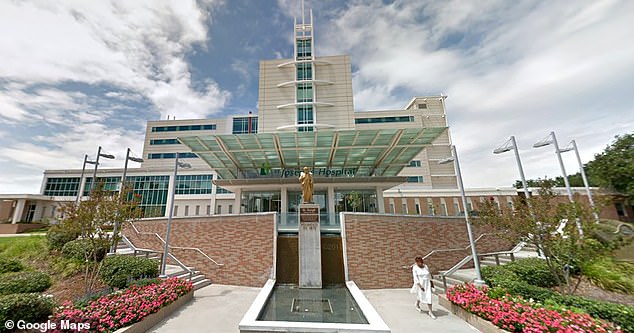
St. Joseph’s/Candler in Georgia is restricting visitors due to flu. Visitors without a flu shot or with symptoms must wear a mask, and no one under 18 is allowed unless they are a patient’s primary caretaker

Major hospital systems in New Jersey, including Hackensack Meridian Health and RWJ Barnabas Health, have reinstated mask mandates for staff, patients, and visitors in response to rising cases of Covid, flu and RSV
These large ‘jumps’ in how the virus appears to our immune system usually occur every three to four years, he said.
The virus has ravaged parts of Europe, the UK and Japan this year. Hospital admissions for flu are at a record for this time of year in England.
High or very high activity is now being reported in at least 27 of the 38 countries being monitored by the WHO European Region.
Japan’s health authorities have declared an influenza epidemic, with thousands of people infected with the respiratory virus.
The number of infections is unusual for this time of year, researchers say, and could seed outbreaks in countries that are heading into winter in Asia and Europe.
Scientists warn this year’s flu shot may offer reduced protection, as early data shows a mismatch between the vaccine strain and the dominant circulating virus, H3N2 subclade K.
The possibility of a mismatch between the vaccine and the circulating H3N2 strain is a major concern for flu experts. They are now watching carefully as flu activity begins to increase in earnest across North America.
Your browser does not support iframes.
Your browser does not support iframes.
However, health officials argue that getting a flu shot is still worthwhile because a mismatched vaccine is often still highly effective at preventing the worst outcomes.
It may not stop someone from getting a mild case of the flu, but it significantly reduces the risk of severe illness, hospitalization and death by priming the immune system to fight the general virus family.
Dr Scott Hensley, a microbiologist and influenza vaccine scientist at the University of Pennsylvania, told Stat: ‘If there’s ever a year to get a flu vaccine, this is the year.’
Florian Krammer, a flu virologist at Mount Sinai’s Icahn School of Medicine in New York, added: ‘Here we had a very strong H3N2 season last year. And of course the virus changed, but there might be some protection from that H3N2 season.’