
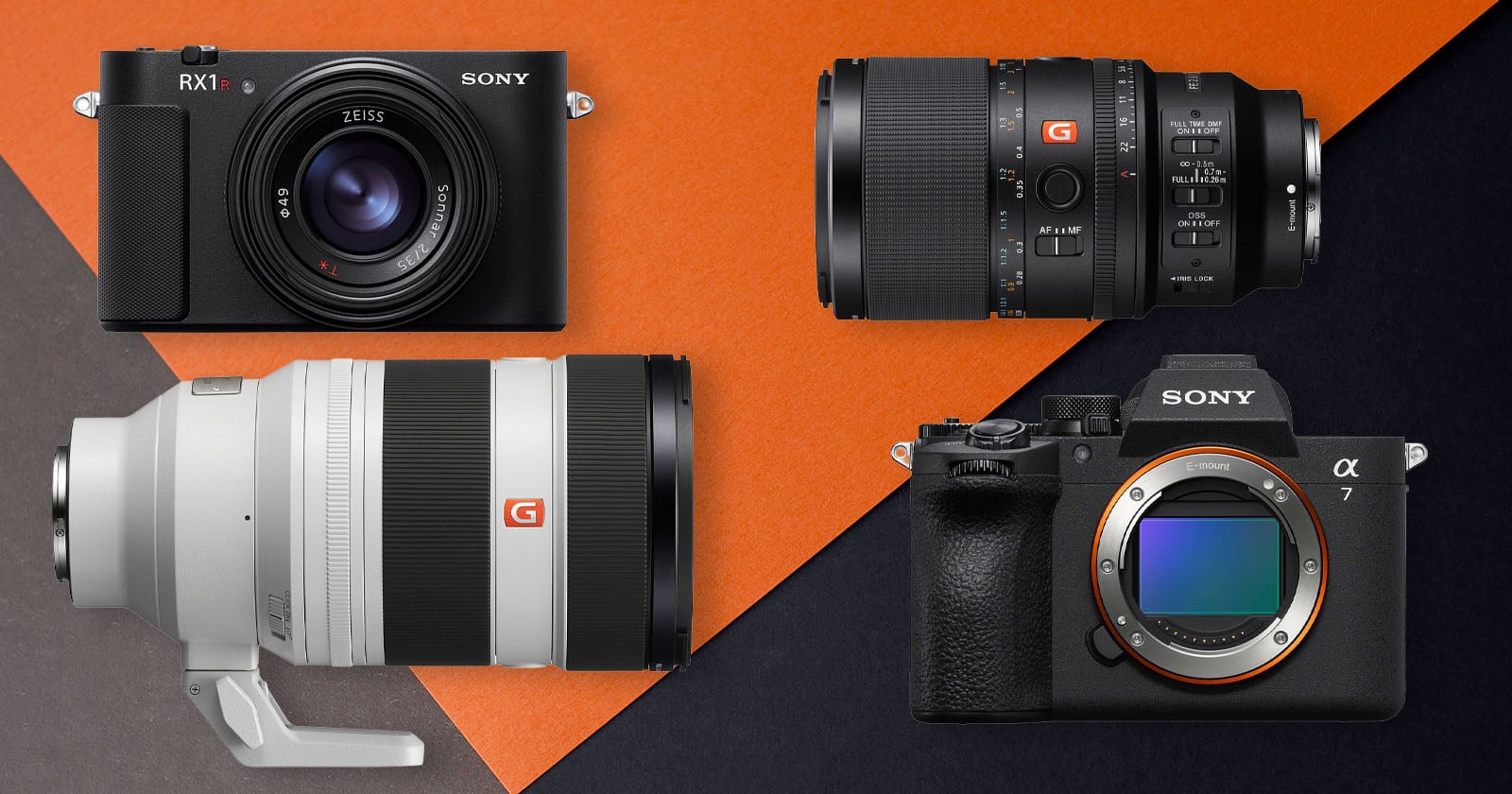
Sony has long been the top dog in the full-frame mirrorless camera space, but the gap has closed dramatically in recent years. Did Sony do enough to stave off the competition in 2025?
As a quick recap, last year Sony released two cameras, the flagship a1 II and the vlogging-centric ZV-E10 II. The company was much busier when it came to glass, launching five lenses, four for full-frame cameras. The Sony FE 24-50mm f/2.8 G, FE 16-25mm f/2.8 G, E 16-50mm f/3.5-5.6 PZ OSS II, FE 85mm f/1.4 GM II, and FE 28-70mm f/2 GM are all great for different reasons. Sony won both the Prime Lens of the Year and Zoom Lens of the Year categories in the 2024 PetaPixel Awards for the 85mm f/1.4 GM II and 28-70mm f/2 GM. For its efforts, I gave Sony a well-deserved A-. As we’ll soon see, I think Sony somehow did even better this year.
Three Very Different Cameras
Sony’s three cameras in 2025 all serve wildly different audiences. The Sony FX2 was the first Sony camera of the year, and the most video-centric of the bunch. For my money, the FX2 is also the worst of the trio.
Although the FX2 aims to be more than an a7 IV with better video features or an FX3 junior, it ultimately falls short. The camera’s sensor, borrowed from the a7 IV, is not very good for video, and it holds the FX2 back considerably>.
While the FX2 has a nice design, a nifty tilting EVF, strong autofocus, and delivers decent features, it ultimately fails to separate itself from the competition. The a7 V’s arrival later this year with a much better 33-megapixel sensor only makes the FX2 a tougher sell.
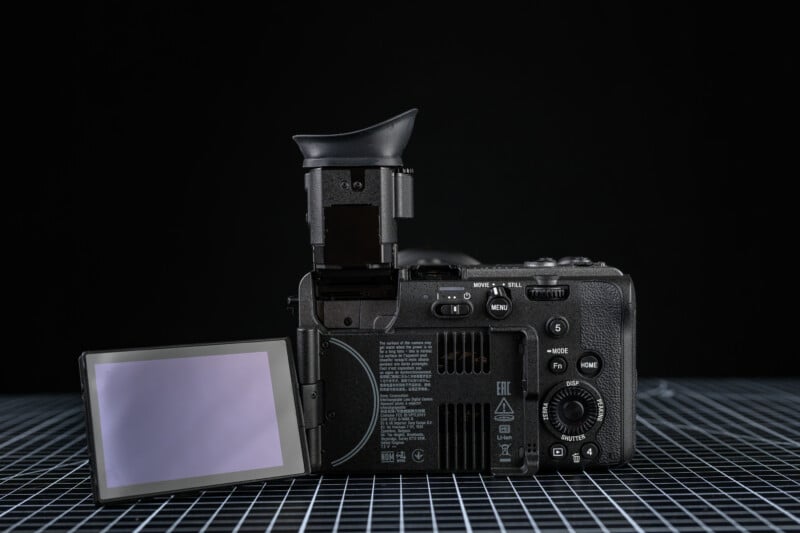 The Sony FX2 has a really nice design, but its outdated image sensor holds its performance back. | Photo by Erin Thomson for PetaPixel
We hope to see the FX2’s strong design carry forward to future FX-series cameras that feature a better image sensor for video.
Sony’s second camera of the year, the RX1R III, was a very long time coming. The last camera in the series, the RX1R II, was released way back in 2015. Nearly 10 years is an awful long time between models in a series. Was it worth the wait?
As it turns out, yes. Mostly. The Sony RX1R III packs a wide range of new features, including most notably a refined design and the move to the 61-megapixel sensor that debuted in the a7R IV in 2019. While not a particularly new imaging system in 2025, it remains capable of capturing incredible photos.
 Photo by Chris Niccolls
However, not everything of significance has changed in the past 10 years. The built-in Zeiss Sonnar T* 35 mm f/2 lens, which traces its roots back to 2012, is unchanged. As it turns out, this doesn’t really need updating. The lens remains as beautiful now as it was then, and is a real strength of the RX1R III.
Nonetheless, a decade is a long time to wait for a new model in a beloved camera series, and we do wish Sony had changed a bit more with the RX1R III. The RX1R II’s strengths remain mostly intact, but the new model has also inherited its predecessor’s shortcomings, including its relatively high price tag.
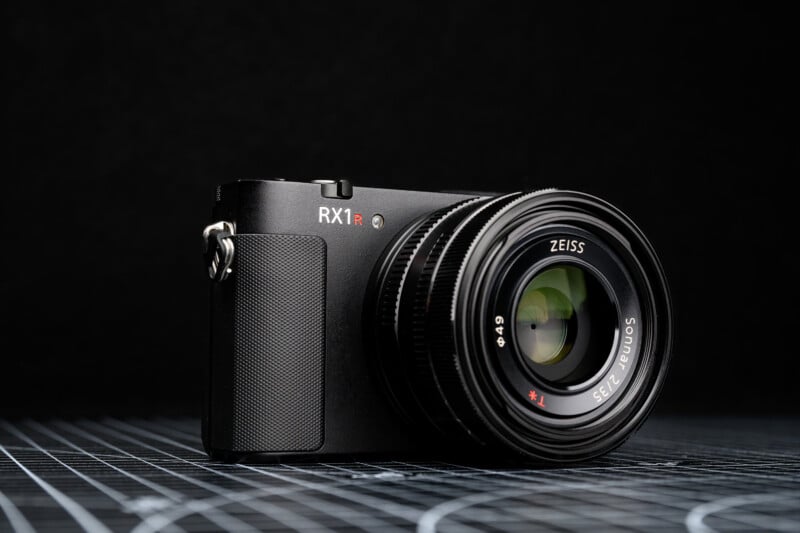 Photo by Erin Thomson for PetaPixel
“There is no denying that it is a fun and handy camera to carry around, with the power to take some great images. This camera doesn’t fall far from the 2016 camera bag, and whether you will justify the $5,100 cost depends on how much you really pined for that RX1R II experience back in the day and how much more resolution really means to you,” Chris Niccolls concludes.
Like the RX1R III, Sony’s third and final camera of the year was a long-awaited, much-hyped addition to a beloved series. The Sony a7 V is an incredible camera. It very narrowly lost to the Canon R6 III to be PetaPixel‘s Camera of the Year, settling for an Official Selection instead. But make no mistake, while not our Camera of the Year, the Sony a7 V is fantastic.
When the a7 IV launched in late 2021, it arrived with the promise of great hybrid performance with a then-class-leading 33-megapixel sensor. However, this sensor is pretty slow, as evidenced by the FX2 above. The 33-megapixel sensor had plenty of resolution but lacked the speed to deliver the performance people expected from an a7-series model. The a7 V and its exceptionally good new partially stacked 33MP sensor addresses all the a7 IV’s shortcomings. It is a much faster camera with significantly improved autofocus, excellent 4K video recording, and high-end features.
 Photo by Chris Niccolls
However, as great as the a7 V is, it has faced pretty venomous online criticism. To some extent, I get it. The a7 V lacks open gate recording, internal RAW, and other features that competing models like the R6 III offer. It is certainly not the perfect camera for everyone, but I think the a7 V is a genuinely impressive successor to a rather disappointing a7 IV and puts the a7 series back on the right track. The a7 V is in the conversation for the best mid-range camera on the market, especially for photo-first users. Admittedly, the a7 V is not the hybrid powerhouse some people desire, but I find it refreshing that a company like Sony has dedicated so much effort to making a fantastic photo-oriented camera in 2025. Besides, the a7 V still records great video, but I digress.
Sony Released Incredible Lenses in 2025
I know that for many photographers, announcing new cameras is by far the most exciting thing a company can do. I get it. However, for me, lenses are where it’s at. I love new lenses, and I especially love it when a company breaks new ground with its optical designs. Companies can go years between truly novel lenses, but Sony somehow released three fascinating optics in 2025. Plus a couple of other good lenses, for what it’s worth.
In February, Sony announced the compact and lightweight FE 16mm f/1.8 G prime and the FE 400-800mm f/6.3-8 G OSS.
Looking first at the 16mm ultra-wide prime, it’s a really nice lens. While it may not have G Master branding and the optical quality that comes with the “GM” badge, the 16mm f/1.8 is a really good lens for those who need an ultra-wide field of view.
The teeny-tiny lens is great for travel photography and vlogging, even if it has some optical weaknesses for certain applications. Nonetheless, it’s a great value and a welcome addition to Sony’s lineup.
The other lens announced in February could hardly be more different. Not small at all, the FE 400-800mm f/6.3-8 G OSS telephoto zoom is a bulky, heavy lens that complements Sony’s popular 200-600mm f/5.6-6.3 G OSS zoom. For those who can withstand the weight and need the reach, though, the 400-800mm is excellent. It’s an incredible wildlife lens, and one I gladly added to my kit.



The Sony 400-800mm f/6.3-8 G OSS is not the perfect lens, and it is quite expensive, but it offers more reach and better performance than the 200-600mm lens it replaced in my bag. Thanks to its 800mm reach and improved autofocus, it enabled me to capture better wildlife shots, all else equal, and what more can I really ask for? I really love this lens.
In April, Sony debuted another zoom lens, the FE 50-150mm f/2 GM. As much as I love the 400-800mm f/6.3-8 G OSS for what I like to shoot, there is no question whatsoever which of the two zoom lenses Sony released this year is the more impressive technical achievement. The 50-150mm f/2 GM is a remarkable lens, and among the very best fast zooms ever released.
This lens breaks new ground as the very first of its kind. Sony took what made last year’s FE 28-70mm f/2 GM so special, and gave it a mid-telephoto range. As I wrote in my review, the 50-150mm f/2 GM is extremely exciting in theory, and somehow even better in practice.
 Photo by Chris Niccolls
“The Sony FE 50-150mm f/2 G Master lens delivers exceptional optical performance, swift and reliable autofocus performance, professional build quality, and, most importantly, an altogether novel photographic experience in an age where getting something new and unique is quite rare,” I concluded in our review. What an utterly spectacular lens.
Sony was not done knocking my socks off, though. Sony shooters have long clamored for a G Master macro lens, and after years of hoping, it finally arrived in 2025. The long wait, which at times felt like it would never end, was undeniably worth it. The Sony FE 100mm f/2.8 Macro GM is not just Sony’s best and most impressive macro lens ever, but arguably the best macro lens ever made.
Now that is a bold claim, I know, but the Sony 100mm f/2.8 Macro GM is about as close to perfection as any lens can get. As a standard 1:1 macro lens, the 100mm f/2.8 Macro GM is fantastic. It is exceptionally sharp, delivers impressively swift autofocus, and has lovely bokeh to boot.
 The option to use up to a 2X telelconverter is a huge benefit to getting closer. | Photo by Chris Niccolls
“The bottom line is that the 100mm gives you the versatility of a sharp portrait lens with beautiful bokeh and fast focusing, as well as a macro lens capable of pushing well beyond the classic 1:1 macro range. Given its ability to use teleconverters, this lens could be excellent for some wedding and event work as well, where the occasional close-up shot can be appealing to tell more of the story,” Chris Niccolls wrote.
The Sony FE 100mm f/2.8 Macro GM earned an Official Selection in this year’s PetaPixel Awards.
Sony’s fifth and final lens of the year, the FE 28-70mm f/3.5-5.6 OSS II is just a slightly upgraded version of the original 28-70mm f/3.5-5.6 OSS released in 2013. The optics are unchanged, but the autofocus system can now keep up with the a9 III at 120 frames per second. It’s a fine update to a classic compact zoom lens.
Grading Sony in 2025
Last year, Sony earned an A-, thanks in large part to the Sony a1 II and the FE 28-70mm f/2 GM. I’m not saying the a7 V is as good a camera as the a1 II, but it is perhaps even more impressive from a performance-for-the-money perspective. On the glass side, Sony did even better this year than last. The 50-150mm f/2 GM is arguably even better than the 28-70mm f/2 GM and certainly more novel. The 100mm f/2.8 Macro GM tells a similarly impressive story, and I personally love the 400-800mm f/6.3-8, minor shortcomings and all.
Then there’s the other side of the coin. The FX2 is a letdown, frankly, and as much as I love that the RX1R III exists, it feels like it has a lot of untapped potential. If Sony wants to be the kind of company that makes fixed-lens cameras photographers want to spend over $5,000 on, it needs to be a bit cooler and really invest time and energy into channeling the special kind of photographic experience a camera like the RX1R III could deliver.
Nonetheless, 2025 was a very good year for Sony, at least in the full-frame space (APS-C withered on the vine, disappointingly). Given the overarching ambivalence many seem to feel toward Sony these days, I fully expected to give the company a lower grade than I’m about to. But when you actually look at all the products Sony launched this year, what you find is a healthy smattering of incredible achievements and a couple of good but flawed cameras.
For the first time ever, I think Sony is facing very serious competition across the board, from entry-level to professional, from photo-first to hybrid. I think Sony did enough to maintain its position as the top dog in 2025, but time will tell what 2026 has in store. Sony demonstrated its engineering excellence this year with the a7 V’s fantastic sensor and a couple of remarkable G Master lenses. Sony will need every bit of that excellence moving forward, because the long-time stalwarts Canon and Nikon have caught up. There is no more time or space for Sony to rest on its laurels, and photographers are poised to be the primary beneficiaries of the increasingly tight competition.
Grade: A
Image credits: Featured image created using an asset licensed via Depositphotos.