
New research from the Woods Hole Oceanographic Institution finds sea level rise is accelerating across the contiguous United States, contradicting a federal report from July that downplayed the risks from climate change.
The WHOI study found the average rate of sea level rise along the U.S. coast has more than doubled in the past 125 years, from less than 2 millimeters per year in 1900 to more than 4 millimeters per year in 2024. Present rates of rise are well above the historical average, the research shows.
Christopher Piecuch, a physical oceanographer at WHOI and author of the study, said the report from the U.S. Department of Energy released this summer referenced only a select few tidal gauge locations in its analysis, which may not properly represent nationwide sea level rise. The DOE report found “no obvious acceleration in sea level rise.”
In contrast, Piecuch said his study included all available long-term records from U.S. tidal gauges, 70 in all.
“You can’t really just look at a record here and a record there, and expect to have representative results for the entire U.S.,” he said. “ There’s a very large disconnect between the data that they show and the conclusions that they draw.”
Piecuch said he decided to do his own analysis after he read the DOE report and “didn’t really believe it.”
“Forty percent of the people in the U.S. — almost 130 million people — live in coastal counties,” he said. “So this has direct bearing on how we live and work near the sea.”
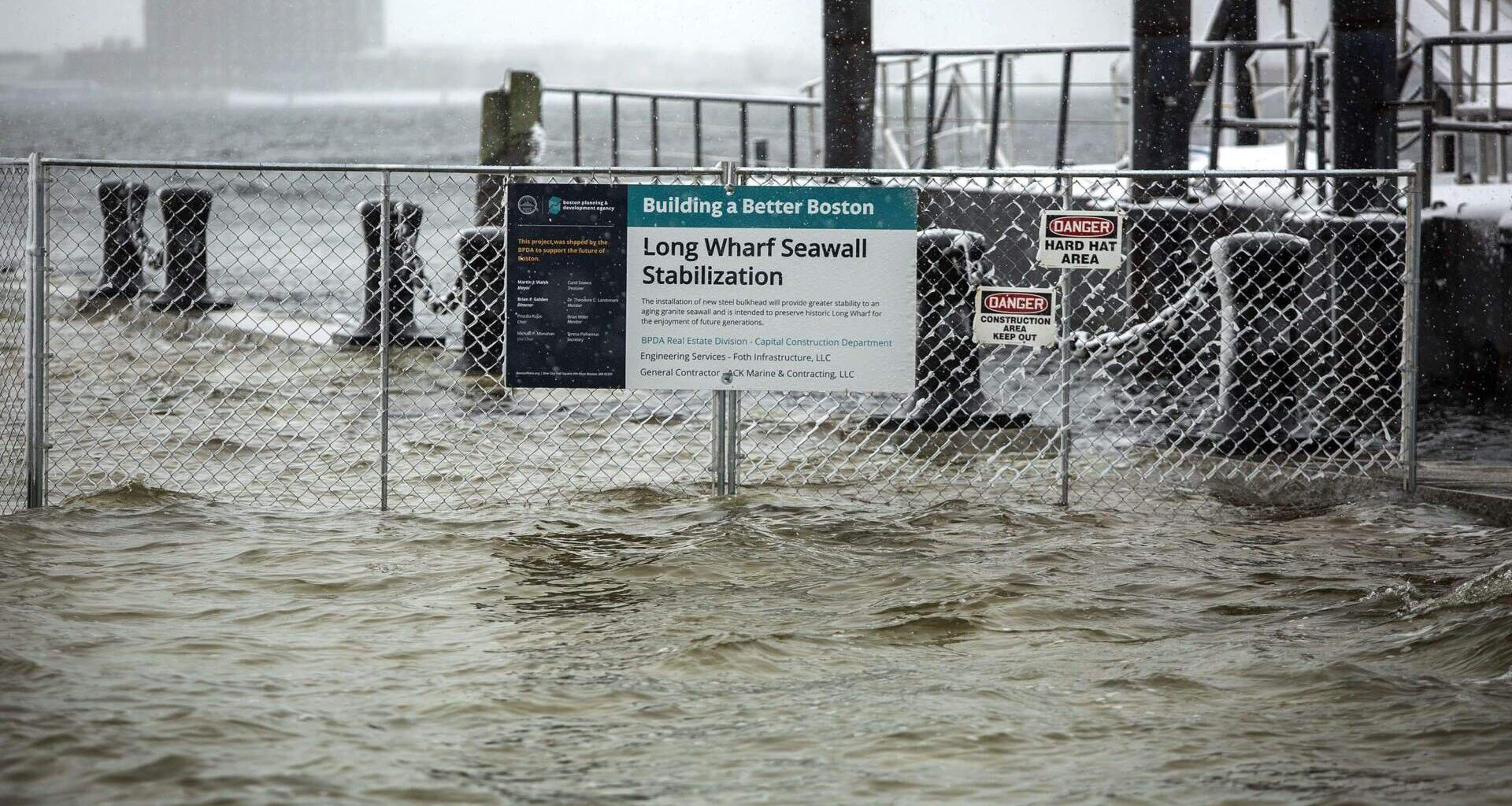
 Cafe tables are half submerged as seawater floods Long Wharf in Boston during the storm on Dec. 23, 2022. (Robin Lubbock/WBUR)
Andrew Kemp, a professor of earth and climate sciences at Tufts University who was not part of the research, called the new analysis “robust” and “sound.”
“The Piecuch study is repeatable, supported by other evidence, and reflects the understanding of the overwhelming majority of sea-level scientists,” said Kemp, in an email. “It was written to address the DOE report that is not robust, lacks sound reasoning, is contradicted by an abundance of other evidence that was ignored, and represents fringe science.”
The Department of Energy did not respond to a request for comment.
In an email Friday, Judith Curry, one of the authors of the federal government’s report, questioned some of Piechuch’s analysis methods. She said she and her co-authors plans to release more information defending their research, but did not offer a timeline.
While rising sea levels are a global phenomenon, there are striking differences by location, according to the National Oceanic and Atmospheric Administration. Extracting groundwater can make land sink, for instance, accelerating the local rate of sea level rise. In other areas, where land is still rebounding after ice age glaciers melted, local sea levels are falling.
The sea level around Boston has risen about a foot in the last 100 years, according to NOAA, while the sea level around Portland, Maine, has only risen about 0.65 feet.
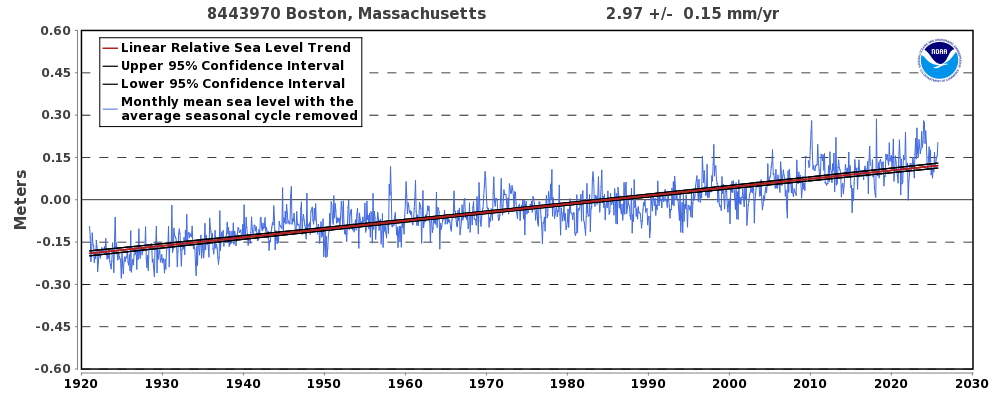 Sea-level trend in Boston. (Courtesy of NOAA)
The federal report released in July acknowledged global sea level rise “is arguably the most important climate impact driver that is unambiguously associated with increasing temperatures.” However, it called predictions of future sea level rise into question, noting that U.S. tidal gauge measurements “in aggregate show no obvious acceleration in sea level rise beyond the historical average rate.”
The report drew criticism from climate scientists and environmental advocacy groups when it was released, with more than 85 scientists issuing a rebuttal that called many of the report’s assertions “misleading or fundamentally incorrect.”
Baylor Fox-Kemper, a professor of Earth, Environmental and Planetary Sciences at Brown University, noted that the wide-ranging DOE report was compiled by only five authors in a matter of months. The most recent National Climate Assessment, by comparison, took hundreds of scientists years to produce.
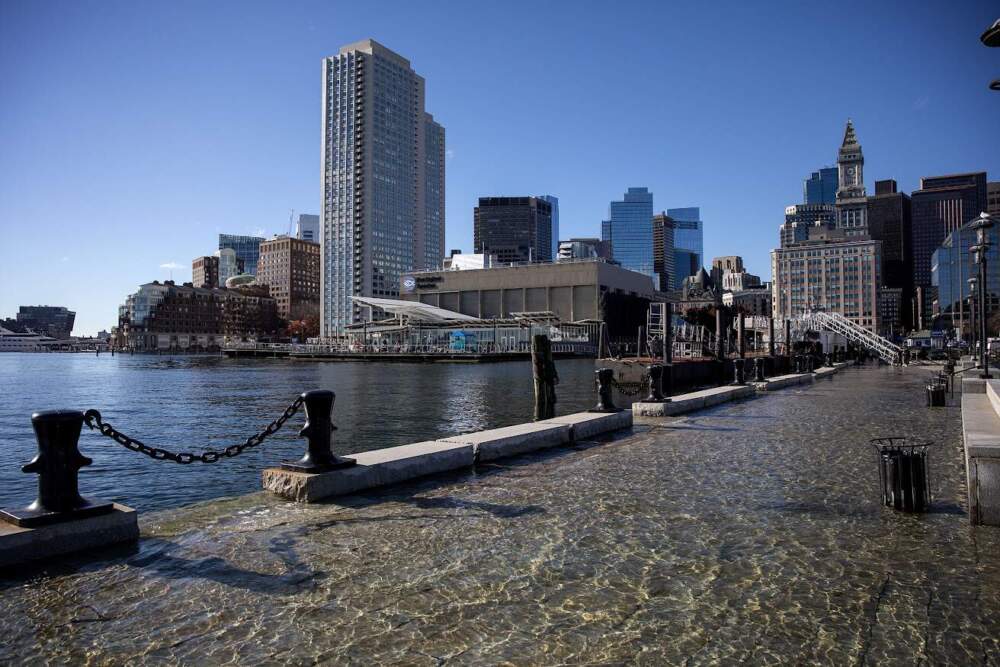 Sea water washes across parts of Long Wharf during a king tide last November. (Robin Lubbock/WBUR)
“I personally pay attention to how many scientists are involved and for how long, before I decide how seriously to take a project,” said Fox-Kemper.
The sections of the DOE report on sea level rise, he added, were “very opinionated and did not bring a whole lot of data into the conversation.”
Fox-Kemper said the new analysis by Piecuch aligns with similar studies in other regions of the world, as well as measurements showing the global mean sea level rose faster during the 20th century than in any other century in the past 3,000 years.
“In general, an acceleration is exactly what we expect because we’ve seen an acceleration in the loss of glaciers, in the loss of ice sheets and in the rate of ocean warming,” he said. “So sea level is just catching up.”
Clarification: The WHOI study looked at the contiguous United States, excluding Alaska and Hawaii.