
Staring at her golf gear in her garage in Destrehan three years ago, Diane Roussel couldn’t understand why she couldn’t find a pair of gloves.
She rifled through her golf bag. There were no right-hand gloves. How could she have a dozen left-hand gloves and not a single pair? Her husband found her there, searching.
“You never had pairs,” he told her, gently. “Golfers wear one glove.”
Of course, Roussel knew that. She had been a golfer for decades.
Later that year, her whole extended family celebrated Christmas and her birthday. It was the biggest gathering they’d had as a family to celebrate, “just an amazing day,” Roussel said.
Three days later, a friend texted. “How was your Christmas?”

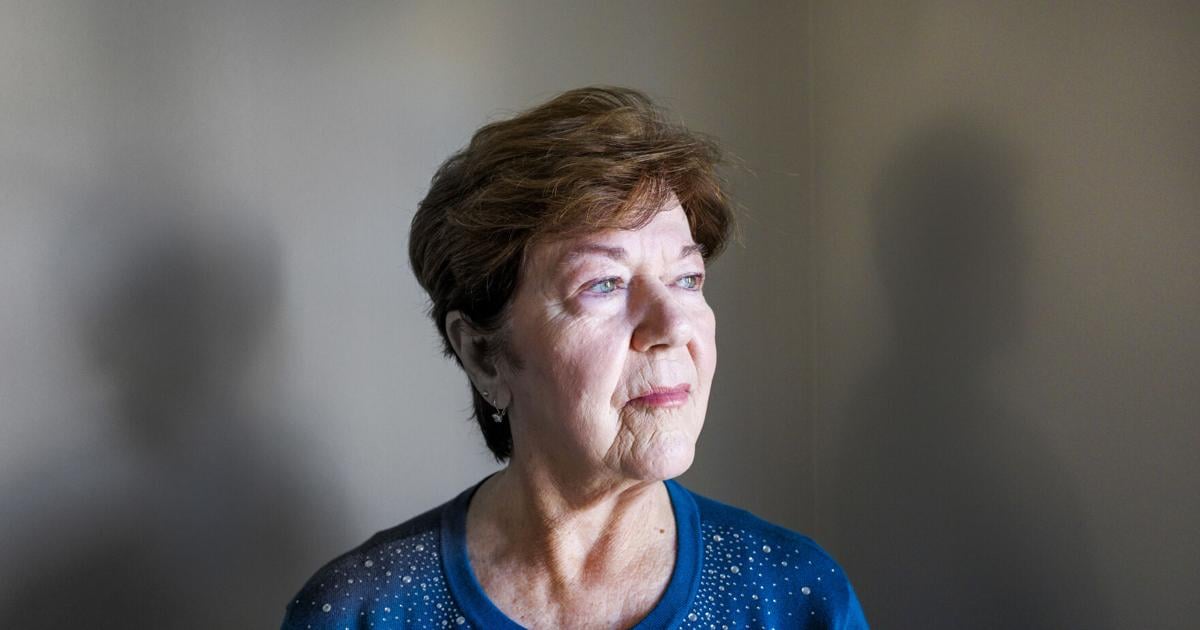
Diane Roussell and her husband, Black, at home in Destrehan on Monday, December 15, 2025. After seeking care for escalating memory lapses, Diane Roussel received a devastating Alzheimer’s diagnosis. She began infusions of Lecanemab, a newly approved drug for Alzheimer’s disease. Thirty-six infusions later, she has seen her biomarkers return to healthy ranges and her cognitive function improve. Her doctor calls it a remission from Alzheimer’s and is previously unheard of. (Photo by Chris Granger, The Times-Picayune)
PHOTO BY CHRIS GRANGER
Roussel couldn’t remember. There “was just a hole” where the memory should have been. She sought out a doctor to understand what might be wrong. After cognitive testing and a spinal tap, Roussel, then 66, learned she had biological signs of early Alzheimer’s disease.
She pleaded with God for it to be something else. “I’d rather you give me every kind of cancer you have in the book than this,” Roussel said. “I don’t want to lose who I am.”
But there was a sliver of hope. She qualified for a newly approved drug, lecanemab, that was shown to slow down the progression of the disease.
Eighteen months later, Roussel had a follow-up brain scan. The biomarkers that typically indicate Alzheimer’s had normalized. She felt a brain fog lift and hasn’t had any more dramatic losses in memory. In a conversation with her doctor, Dr. James Rini at Ochsner Health, she heard a word rarely associated with the irreversible disease, which for decades has had no treatment shown to alter its course.
“Remission,” she said.
Remission and Alzheimer’s
Rini described Roussel as an uncommon but instructive case in the transforming fight against Alzheimer’s disease.
Since it was first identified more than a century ago, Alzheimer’s was viewed as a one-way decline, treated with medications that eased symptoms but did not change its course until the recent approval of anti-amyloid drugs in 2023 and 2024.
Roussel is one of a small number of patients treated early enough that both imaging and biomarker evidence of Alzheimer’s pathology have receded to undetectable levels.
“From all objective ways that we have to measure this disease right now — our serum biomarkers or PET scans or MRIs or cognitive testing — there is no evidence that it’s there,” Rini said. “If she came to my clinic right now, I’d say, ‘You don’t have this.’”
At the same time, he knows that Roussel did have it. So he borrowed language from oncology, calling it a partial remission, like you might for stage 4 cancer.
Rini said this example is not a promise of what is typical for patients, but a glimpse of what may be possible when Alzheimer’s is caught and treated at exactly the right moment, in exactly the right patient.
Diane Roussell and her medical appointment note book on Monday, December 15, 2025. One of the last entries says PET “scan negative” and “remission.” After seeking care for escalating memory lapses, Diane Roussel received a devastating Alzheimer’s diagnosis. She began infusions of Lecanemab, a newly approved drug for Alzheimer’s disease. Thirty-six infusions later, she has seen her biomarkers return to healthy ranges and her cognitive function improve. Her doctor calls it a remission from Alzheimer’s and is previously unheard of. (Photo by Chris Granger, The Times-Picayune)
PHOTO BY CHRIS GRANGER
The promise and limits of Alzheimer’s drugs
Alzheimer’s is caused by a buildup of abnormal proteins, known as amyloid and tau, that slowly disrupt and kill brain cells, breaking the communication networks needed for memory, thinking and daily function.
Dr. Demetrius Maraganore, a neurologist at Tulane University and LCMC Health, explains it to patients by comparing it to the roots of oak trees and the cement used to patch New Orleans sidewalks.
Brain cells are shaped like trees, with branching extensions that allow them to communicate. In Alzheimer’s, amyloid accumulates between brain cells, as if cement was poured around the roots of trees to fix sidewalk cracks. If cement is poured at the base of the tree, it weakens the tree, interfering with its ability to receive nutrients.
As amyloid causes brain cells to weaken, another protein, tau, tangles inside the cells themselves, accelerating their decline. Once those brain cells die, they cannot be replaced.
Now, two new drugs, lecanemab, and donanemab, which were approved by the FDA in 2023 and 2024, can remove amyloid. They aim to interrupt the chain reaction that leads to cell injury and the spread of tau tangles, which are more closely tied to cognitive decline.
Lecanemab, sold as Leqembi, is made by Eisai and Biogen. Donanemab, sold as Kisunla, is made by Eli Lilly. The drugs alone cost about $26,000 to $32,000 a year. Medicare covers them for patients with early Alzheimer’s who meet strict criteria, though access can be limited by the need for frequent scans, infusions and specialist care.
In clinical trials, both drugs slowed cognitive and functional decline in people with very early Alzheimer’s disease. They do not cure Alzheimer’s, do not rebuild damaged brain cells and do not work for everyone.
There is an extensive screening process for who qualifies for the drug, so only about 5% of those who go through the screening process qualify, said Maraganore. Even in those people, sometimes the drugs simply don’t work. In others, they might barely slow the progression of symptoms.
Dr. Ronald Petersen, a Mayo Clinic neurologist who directs an Alzheimer’s disease treatment clinic, said it is important for patients to understand that the drugs typically do not end the memory and thinking problems that accompany Alzheimer’s. When they talk to patients about the drugs, they do so with caution.
“One, these drugs don’t stop the disease,” Petersen said. Two, they don’t make you better, but we do think they slow down the rate of progression.”
But there could be exceptional cases.
“If you get to somebody who has modest amount of amyloid and maybe just a nickel’s worth of tau, that might be the perfect sweet spot,” he said.
The drugs are the only ones proven to alter the underlying biology of the disease. For decades, Alzheimer’s drugs were targeted at symptoms. And despite debate in the field over the root cause of Alzheimer’s, “the data speak for themselves” for the modest effectiveness of these drugs, Maraganore said.
‘There’s hope’
Roussel describes a before-and-after when it comes to the drug treatment: mid-conversation blankness that used to startle her, and a lifting of brain fog. The potential side effects of the drugs — brain swelling and microbleeds — were worth it for her.
“I live life big,” said the retired IT manager. She’s got holiday lunches with friends on her schedule, and she’s babysitting her “granddog” this week for her grandson while he’s out of town. She cares for her husband, who had a cascade of health issues around the time she was diagnosed.
Holy Water and a picture of Diane Roussell and her husband, Black, on a shelf in their home on Monday, December 15, 2025 in Destrehan. After seeking care for escalating memory lapses, Diane Roussel received a devastating Alzheimer’s diagnosis. She began infusions of Lecanemab, a newly approved drug for Alzheimer’s disease. Thirty-six infusions later, she has seen her biomarkers return to healthy ranges and her cognitive function improve. Her doctor calls it a remission from Alzheimer’s and is previously unheard of. (Photo by Chris Granger, The Times-Picayune)
PHOTO BY CHRIS GRANGER
In addition to the drug, Roussel also changed her lifestyle. She went to a sleep clinic, changed sleep medications and got a CPAP machine, since sleep is shown to be when the brain repairs itself. She shifted her eating toward a Mediterranean-inspired MIND diet, which emphasizes vegetables, whole grains, fish and olive oil. She also changed her cholesterol medication to one less associated with cognitive side effects.
Under medical supervision, she began taking several supplements. She had always golfed, but added regular walking, aiming for at least 30 minutes of exercise five days a week.
She credits her faith with getting her through treatment and keeping her optimistic. Unlike decades of failed Alzheimer’s drugs, this one arrived at exactly the right moment, just as she received her diagnosis. It gave her hope.
“That was a little seed I had from the very beginning,” Roussel said. “And it just grew and grew.”
About 12% of Louisiana’s 65-plus population has Alzheimer’s disease, amounting to almost 100,000 people. A lot of them don’t talk about it because of the stigma of the disease. But Roussel sees her experience as carrying a purpose.
“I was meant to have Alzheimer’s so I could talk about it,” she said. “So I could tell people they need to get tested, and that real progress is being made.”
‘A matter of time’
Roussel, now 69, will transition to a lower-dose maintenance injection designed to prevent amyloid from reaccumulating.
Long-term answers remain limited.
“We don’t know if it’s going to come back,” Rini said. “We monitor closely, because this is essentially ongoing clinical research in real time.”
But the future is bright for a field that just a few years ago had almost nothing to offer patients. Lecanemab and donanemab have been shown to slow the progression of the disease 27% to 35%.
“There’s a place for these drugs,” Maraganore said. “But I also know that better things are going to come.”
Maraganore pointed to an oral drug in development, taken once daily, that he said has shown 50% to 75% slowing of disease progression at one year in clinical trials and is now being reviewed by regulators in Europe.
“Right now we’re peddling in Kitty Hawk trying to fly across the ocean, but soon we’re going to be sitting in first class in jumbo jets,” he said. “It’s just a matter of time.”