
Baa Baa Black Sheep
On Tuesday, September 21, 1976, the pilot episode “Flying Misfits” of the series that became Baa Baa Black Sheep, premiered on NBC at 9pm. President of Universal Television Frank Price had obtained the rights to legendary World War Two hero Gregory “Pappy” Boyington’s memoirs, and tasked up-and-coming writer Stephen Cannell to write a script for the two-hour pilot action thriller. Test audiences liked what they saw, and with the studio behind it, the first series was commissioned.
Even before it aired, however, the series seemed doomed to failure. Unsure where to place it in the television listings, the series provoked outrage for its storylines and visual content, which appeared to promote bad language, drinking, and womanising in an era that hadn’t yet defined the parameters of acceptable viewing. Its target audience, however, loved it for the unrivalled and dramatic sequences that featured thrilling and dynamic aerial footage of World War Two aircraft in action.
F4U-7 Corsair BuNo. 133693 “Blue Max”
As already explained in fact, considering that the warbird movement was still in its adolescence in 1976, it is incredible to note that a total of 44 aircraft was used throughout the entire series. Of these, eight were Corsairs of various models that constituted nearly 66 percent of the world’s airworthy Corsair population at that time.
As told by Stephen Chapis in his book Poor Little Lambs: The Baa Baa Black Sheep Story, over the decades, there have been a number of “experts” who have claimed that Robert Guilford’s (1933-2005) F4U-7 BuNo. 133693 nicknamed “Blue Max” appeared only in the pilot episode and never in any of the series episodes, and that when you see a -7 on-screen it’s John Schafhausen’s aircraft, but that was not the case. Careful examination of period photographs revealed that the -7s were nearly identical, but there was one subtle difference – the propeller hubs. The hub on ‘693 was black, and ‘710 was silver. Once that difference was identified, the author was able to determine that 133693 appeared in a total of 21 episodes – 14 in season one and seven in season two. All of the footage was shot in March and August 1976.
Catastrophic engine failure
Steve Rosenberg was tasked with flying Guilford’s Corsair. It is entirely possible that he and ‘693 could have continued flying on the series, but after he flew just three filming sorties on August 12, 13, and 19, the television careers of Rosenberg and BLUE MAX were cut short by a catastrophic engine failure.
In 2011, Rosenberg described the flight chat took place on August 19, 1976: “I took off for a short flight out of Van Nuys pulled into a loop and simultaneously noticed a light inside the cockpit and smoke coming down the left side of the fuselage. I rolled the aircraft upright, checked my gauges. The oil pressure was down to 25psi, and the temperature was rising through 128°C. The prop was freewheeling, but I had no power. Luckily, I was at about 7,000ft, which was enough for me to make a straight-in approach to Van Nuys’ 16R. I wheeled it on and coasted off one of the high-speed turn-offs just as the R-2800 seized.” Although this seems like a dramatic incident, Rosenberg’s logbook entry for this flight simply reads, “VAN NUYS LOCAL 0.6HRS-ENGINE FAILURE.”
The engine change that followed turned into a full-fledged restoration from which the Corsair did not emerge until 1979 – a year after Black Sheep Squadron was canceled.
Poor Little Lambs: The Baa Baa Black Sheep Story is published by Key Publishing and is available to order here.
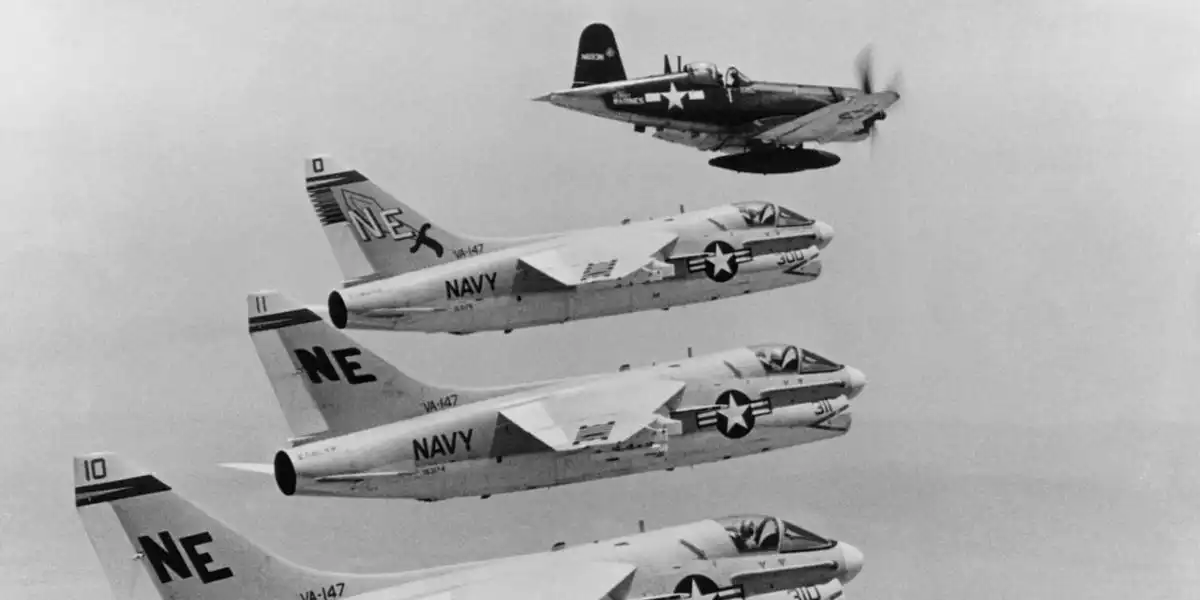
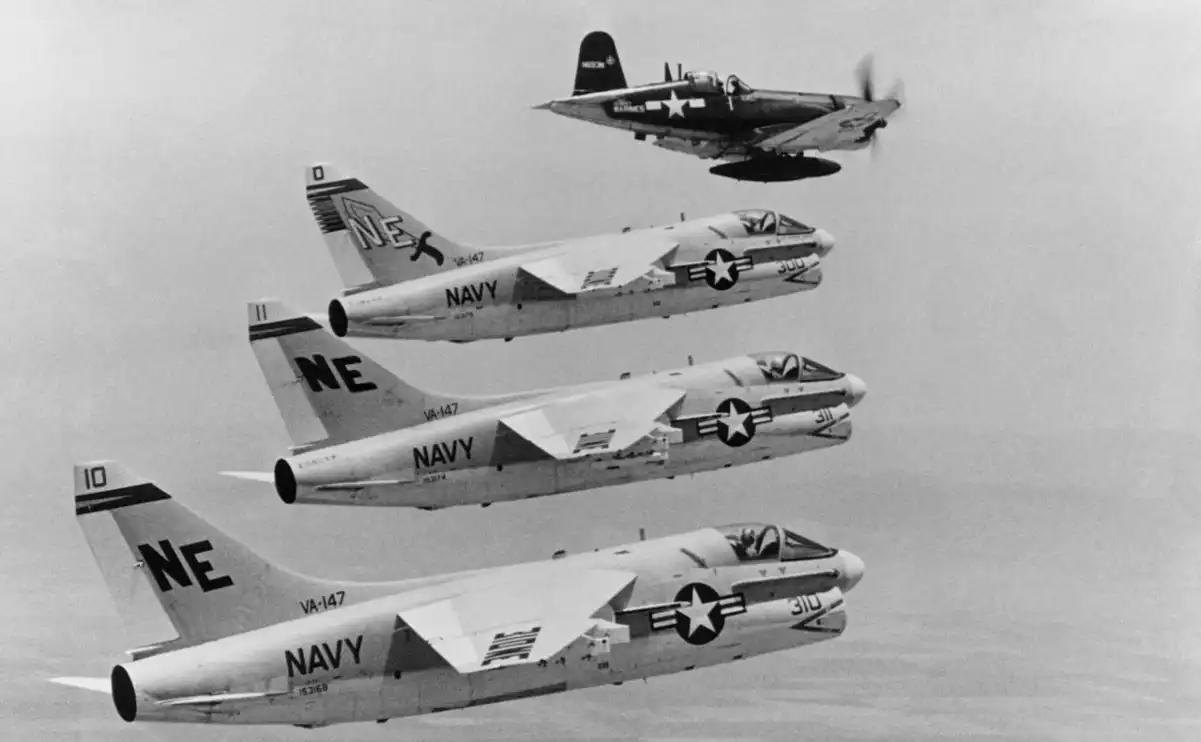 F4U-7 Corsair (BuNo 133693) leading LTV A-7A-4a-CV Corsair II fighters (BuNo 153168, 153174, 153175) of US Navy Attack Squadron VA-147 Argonauts over Naval Air Station Lemoore, California (USA), on 7 July 1967 before their first deployment to Vietnam aboard the aircraft carrier USS Ranger (CVA-61).
Photo credit: U.S. Navy