
Across Louisiana, 2025 was a banner year for economic development, with announcements promising billions of dollars in investments and thousands of new jobs.
Meta’s massive artificial intelligence data center planned for Richland Parish got underway early in the year. Hyundai unveiled plans for a new steel mill in Ascension Parish, the first domestic plant of its kind in decades. And throughout the year, LNG export facilities planned along coast of Louisiana continued moving forward, including Woodside Energy’s $17.5 billion project and Venture Global’s $28 billion CP2 LNG.
And that’s just some of the larger deals announced over the past 12 months.
The staggering investment sums trumpeted in press releases — $61 billion in planned capital investments and 9,300 new jobs — don’t always pan out, and there are costs and complications as well. But the totals have offered some momentum to Gov. Jeff Landry and state economic development officials, who are trying to bring jobs and investment to the state even as the insurance crisis, tariff uncertainty, rising costs, a tourism downturn and questions about the impact of AI pose big questions for the coming year.
Here’s a look at some of the investments, opportunities and challenges that Louisiana’s economy is likely to face in 2026.
AI investments and more big projects
Since Facebook and Instagram parent company Meta broke ground on its multibillion-dollar AI data center in rural Richland Parish, economic development officials have touted the spinoff effects from the deal. And the once-sleepy corner of northeast Louisiana has become a boomtown, with speculators driving up land prices and local subcontractors racing to get a piece of the action.

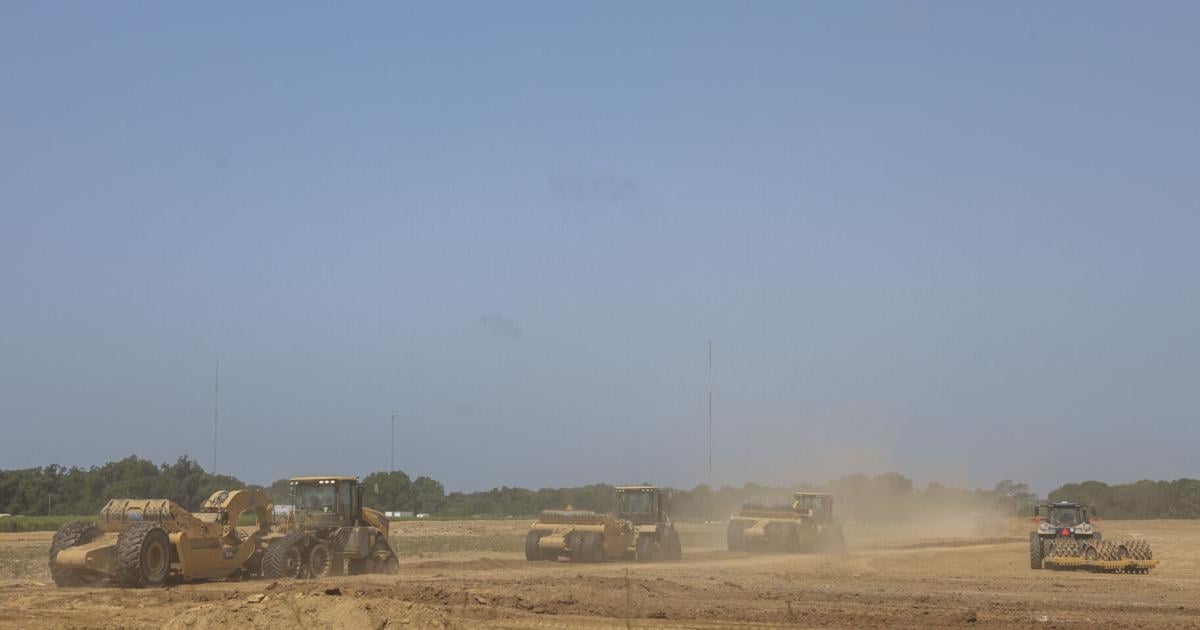
Construction begins on the future Meta AI data center in Holly Ridge, La., Friday, July 11, 2025. (Photo by Sophia Germer, The Times-Picayune)
STAFF PHOTO BY SOPHIA GERMER
There is reason to believe more is to come. Last summer, Meta CEO Mark Zuckerberg said Meta was just getting started in Louisiana and that Hyperion would eventually be the size of Manhattan. In October, when the company announced its plans to finance the deal — a joint venture with a private credit firm that will ultimately have an 80% stake in the project, giving Meta some protection should it ever walk away — company officials said they would share more details about their expansion plans in the future.
In recent months, brokers working for Meta have quietly been optioning thousands of acres of farmland adjacent to the 2,600-acre site, setting the stage for that expansion to move forward. Though it’s too soon to say whether the buildout will ever rival the size of a New York City borough, it’s likely that 2026 will bring greater clarity about the future of the Hyperion project.
A big data center announcement is also likely in the near future in northwest Louisiana near Shreveport, where city planners recently approved plans for a $2.8 billion data center at an industrial park. Though the name of the end user— likely another big tech company — is not yet public, an announcement is likely in 2026.
Ports and the Louisiana International Terminal
While AI data centers represent a new industry for Louisiana, the state is playing catch up in the maritime industry, one of its longtime legacy sectors, and 2026 could be a make-or-break year for whether things turn around.
Over the past decade, New Orleans has steadily lost container market share to Gulf rivals, particularly Mobile, Alabama, as containerized shipping has come to dominate global trade. Reversing that trend hinges on a single project: the long-planned Louisiana International Terminal in St. Bernard Parish.
The proposed $1.5 billion Louisiana International Terminal for St. Bernard Parish will look similar to the Port of New Orleans, photographed on Thursday, October 27, 2022, along Tchoupitoulas Street. (Photo by Chris Granger | The Times-Picayune) ORG XMIT: BAT2210271721140095
STAFF PHOTO BY CHRIS GRANGER
The multibillion-dollar terminal was expected to break ground in 2025 but remains stalled while awaiting a key permit from the U.S. Army Corps of Engineers. Port officials now expect the Corps to issue its findings by the end of the first quarter of 2026, a decision that will determine whether construction can finally begin or face further delays.
In the meantime, costs have climbed, timelines have slipped and opposition in St. Bernard Parish remains fierce, with many residents worried about truck traffic, environmental impacts and quality-of-life disruptions.
“We are continuing to work closely with the Army Corps of Engineers and all regulatory agencies, and we remain confident in the process,” Port NOLA CEO Beth Branch said.
To navigate that political terrain, Branch will be relying heavily on Michael Hecht, the longtime CEO of regional economic development agency GNO Inc., who was tapped by Gov. Jeff Landry to help shepherd the project. Hecht’s task will be to persuade skeptical parish leaders and residents that the economic benefits — jobs, investment, and regional competitiveness —will outweigh the disruption that comes with a project of that scale.
The stakes extend well beyond New Orleans. Late in the year, Julia Fisher-Cormier was named executive director of the Port of South Louisiana, a move that put women at the helm of the two largest port authorities in the United States. Fisher-Cormier played a central role in reshaping Louisiana’s port strategy in 2025, helping broker an agreement that put the Port of South Louisiana in charge of building and operating a new deepwater dock to support Hyundai’s $5.8 billion manufacturing complex in Ascension Parish.
The $25.5 million dock project — enabled by a new statewide ports commission designed to reduce parochial infighting — marked a rare moment of coordination among Louisiana’s often-competing ports.
Uncertainty around energy
For the state’s energy and petrochemical sectors, the outlook for 2026 is mixed due to continued uncertainty around tariffs.
While drilling activity in the Gulf and crude oil production have increased under President Donald Trump, fluctuating tariff rates and threats of further actions are making it difficult for businesses to determine if they should invest in oil and gas projects, said Tyler Gray, director of energy innovation at the LSU Energy Institute.
Crews build Venture Global LNG plant structures at the Port of Morgan City on Tuesday, June 10, 2025.
Chris Granger
The “wild pendulum swings” between the lax regulation and high tariffs supported by Trump and the Obama and Biden administrations, which sought to reduce dependance on fossil fuels and promote renewable energy, also has made it hard for businesses to do long-term planning, he said.
Compounding the regulatory uncertainty is the global glut of crude oil. The International Energy Agency said the amount of crude oil produced could exceed consumption by nearly 2.8 million barrels a day in the upcoming year. That would be a record, according to Bloomberg news.
Thanks to activity in West Texas, U.S. crude oil production is on track to hit a record of 13.9 million barrels a day in the fourth quarter and the U.S. Energy Information Administration projects it will remain at 13.5 million barrels a day in the upcoming year.
Forecasts call for crude oil prices to be below $60 a barrel in 2026, about the same as the current price.
“Hopefully, we won’t have another supply glut,” Gray said. The abundant supply of cheap crude oil, along with a drop in global demand is squeezing refineries, he said.
Louisiana has two advantages in navigating changes in the oil and gas sector during the upcoming year. The first is that the state is at the “front door” of the Gulf Coast for energy exports.
The second is massive gas deposits in the Haynesville Shale, which means natural gas can be produced in the northern part of the state, transported by pipeline to the LNG facilities on the coast, liquified, then shipped overseas by tanker.
“That’s a tremendous advantage,” Gray said.
Is this the year for big New Orleans developments?
Few things have frustrated New Orleans city leaders and residents more than the hulking shells of major buildings that have sat vacant since Hurricane Katrina or earlier, their unrealized potential looming over neighborhoods that have otherwise rebounded.
The sections of the lower floors of the Plaza Tower are being covered by signage for Super Bowl week. This display is from the Greater New Orleans Foundation, Inc. Monday, Feb. 3, 2025. (Staff photo by John McCusker, The Times-Picayune | NOLA.com)
STAFF PHOTO BY JOHN MCCUSKER
The familiar list includes Charity Hospital, Plaza Tower, the former Lindy Boggs Medical Center in Mid-City and the River District along the Ernest N. Morial Convention Center’s riverfront land. Together, they represent billions of dollars in potential investment and a chance to reshape large swaths of the city.
In 2025, there were signs that at least some of those long-stalled projects may finally be inching forward — aided by political intervention, new financing structures and a growing willingness by public officials to put substantial public money behind developments deemed too important to fail.
In 2026, that progress is expected to continue.
One reason for the optimism is Mayor-elect Helena Moreno, who pledged during her campaign to place real estate development at the center of her economic development strategy.
Another reason for hope are recent signs of progress. One recent breakthrough came earlier this month, when a roughly $300 million plan to redevelop the former Navy base in the Bywater finally closed on its full financing package. The project, which has been pitched as a mix of “luxury affordable” housing, technology space and community amenities, is scheduled to begin construction in January.
Graffiti photographed on the exterior at the former Lindy Boggs Medical Center in New Orleans, Thursday, Nov. 13, 2025. (Photo by Sophia Germer, The Times-Picayune)
STAFF PHOTO BY SOPHIA GERMER
Another turning point came in November, when voters approved a sweeping bond package that unlocked funding critical to the future of the former Lindy Boggs Medical Center. The bond vote clears the way for the city to finance the demolition of the crumbling buildings and construct a large underground stormwater retention facility on the site — infrastructure that city officials say will significantly reduce flooding in surrounding Mid-City neighborhoods.
Graffiti photographed on the exterior at the former Lindy Boggs Medical Center in New Orleans, Thursday, Nov. 13, 2025. (Photo by Sophia Germer, The Times-Picayune)
STAFF PHOTO BY SOPHIA GERMER
Once that work is complete, site owners plan to pursue a $100 million mixed-use development.
New Orleans’ Charity Hospital was severely damaged by the floodwaters and strong winds of Hurricane Katrina in 2005. Emergency responders like Ross Judice who were based in New Orleans used Charity as a go-to for emergencies as the hospital took care of mental patients, mothers birthing children and more. It was closed after the storm. Artist-photographers Chandra McCormick and Keith Calhoun documented what happened to Charity after the storm. 2020
Artist-photographers Chandra McCormick and Keith Calhoun
Charity Hospital remains the city’s most symbolically charged redevelopment effort — and its most expensive. Once envisioned as a $300 million conversion, the project’s price tag has since ballooned to at least $600 million, reflecting both rising construction costs and the scale of work required to adapt the 20-story building into a modern research, education and mixed-use complex.
Hecht at GNO Inc. has described the Charity project as “too big to fail,” arguing that leaving one of the city’s most prominent post-Katrina scars untouched is no longer acceptable. And people familiar with the project say Tulane University’s commitment to take a major equity stake in the deal provides it with the kind of backing it needs to get over the finish line or at least, finally get to the starting line, in 2026.
An aerial view of the proposed Rivana Apartments, the first phase of the River District’s residential units. They will mostly consist of units aimed at low-income renters.
Courtesy River District Neighborhood Investors
Less certain is the future of the River District, a multibillion-dollar plan to transform 47 acres of Convention Center-owned land along the Mississippi River into a dense, mixed-use neighborhood. First awarded to River District Neighborhood Investors in 2021, the project has struggled under the weight of rising costs, financing challenges and repeated renegotiations with its public-sector partner, the Convention Center.
A solution to the insurance crisis?
While the industrial and tech sectors have announced mega projects promising staggering investments and tens of thousands of new jobs, the state’s real estate sector has been hammered by a persistent insurance crisis that is affecting affordability in housing, office and retail.
Interest rates and inflation also have had a hand in chilling the housing market and preventing new projects from getting off the ground. But insurance remains the key issue, according to brokers and other market watchers.
There isn’t likely to be any wholesale solution in 2026 to the problem of rising rates and fewer carriers willing to write policies in an era of climate uncertainty, experts say.
To be sure, 2025 brought some relief to the double-digit rate hikes homeowners have experienced in recent years. For the first 11 months of 2025, insurance premiums rose less than 5% on average across the state, down from 6.6% in 2024, 14% in 2023 and more than 16% in 2022.
Still, insurance costs continue to rise. And there is little sign that they will decrease unless Louisiana puts fortified roofs on a massive number of homes or the federal government steps in. Economic development leaders are quietly lobbying Congress for a federal intervention similar to flood insurance, though it seems years away.
The issue is expected to dominate a lot of conversations this spring when lawmakers convene. Gov. Jeff Landry has already set the tone for the upcoming debates, swinging toward a pro-consumer position. Insurance lobbyists worry that more regulations are coming.
Even if lawmakers make major changes to the insurance landscape in Louisiana, which is unlikely, it would be likely months before they take effect and longer still before property owners and investors — both in the residential and commercial sectors — feel any impacts.
A hospitality sector on edge
One sector of the real estate market where the stakes are particularly high is in the hospitality sector. In recent months, a growing number of hotels have come up for sale. The most closely watched is the Virgin Hotel in the Warehouse District, a 4-year-old property expected to trade well below what it would cost to build today. Brokers say the looming sale is likely to reset expectations for the market value of other properties, which have been quietly marketed recently.
Kevin Davis, CEO of Hotels & Hospitality at JLL, a national real estate investment and management company, said the market appears to be at or near its low point.
“I think it’s fair to make the argument that the market has hit the trough and that there’s a lot of upside from here,” Davis said. “You can absolutely buy hotels in New Orleans for less than replacement cost. … If you can buy for less than replacement cost, then why build a new one?”
That logic helps explain why investors are circling properties even as performance remains choppy.
Looking ahead, industry leaders see reasons for hope. Convention bookings at the Convention Center are strengthening. At the same time, tougher enforcement against illegal short-term rentals has reduced competition in key neighborhoods, gradually pushing demand back toward hotels.
A rendering of the re-designed Omni Hotel on Convention Center Boulevard, which will have just over 1,000 rooms and serve as a new “headquarters hotel” for the Ernest N. Morial convention center. It is scheduled to be completed in 2030.
Courtesy of Rule Joy Trammell + Rubio, architects
All of that sets the stage for the long-awaited Omni “headquarters” hotel next to the Convention Center, a $600 million, 1,000-room project now redesigned and approved by the center’s board, with an opening targeted for 2030. Davis said the project will play a pivotal role in attracting larger, higher-spending group business.
“The Omni will be incredibly good for the city,” he said.