
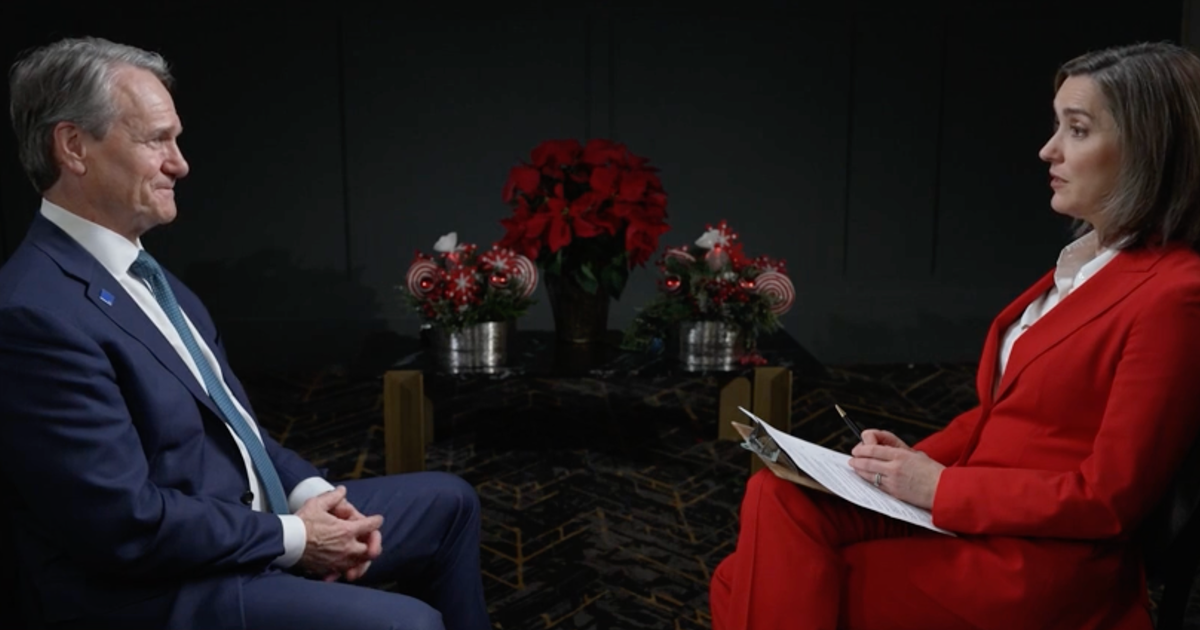
The following is the transcript of the interview with Bank of America Chairman and CEO Brian Moynihan that aired on “Face the Nation with Margaret Brennan” on Dec. 21, 2025. Editor’s note: This interview was filmed on Dec. 17, 2025.
MARGARET BRENNAN: Well, thank you for making time.
BANK OF AMERICA CEO BRIAN MOYNIHAN: It’s great to be here. Good to see you again.
MARGARET BRENNAN: I want to talk to you about the state of the economy, because our CBS polling is showing that the most Americans asked this question say their holiday items are hard to afford.
MOYNIHAN: Yeah.
BRENNAN: They’re pulling back because incomes are not keeping up with inflation. But it’s a very different story. When you look at the upper income brackets, I know you see data of actual transactions. Are people doing what they tell us they’re doing?
MOYNIHAN: So- so we not only see it in the aggregate, we also see it in pieces. And so if you look in the aggregate, the amount spent through the Thanksgiving weekend, on you know, Black Friday and Cyber Monday through all the month of November and the first part of December, it’s- it’s up four- four and a quarter, four and a half percent versus last year’s November. And so it’s growing. And then if you look by terciles, three buckets of income levels, it’s clear the people in the bottom income level, at lower income levels are spending a little faster growth rate, but still growing and in the middle and upper faster. So, you know, what they’re telling you is, what they feel, what they’re actually seeing, is spending is really solid, reasonably solid heading into the end of the year, and it’s been kind of going along like that all of December. Now, wages have grown, but inflation bothers people. Jobs are you know, the unemployment rate’s very low, but it’s been rising. So there’s a lot of discussion in there. At the end of day, people are spending they have good credit quality. They are employed, and wait- we can see wages growing in as people’s paychecks come in at a 3% clip. So it’s a- it’s pretty solid right now.
BRENNAN: Is that still, though stilted towards the upper income brackets? Is it that K shaped economy some people talk about–
MOYNIHAN Our team puts the- looks at this. Yes, it the growth rate difference is higher, but all of- all the third, a third, a third, all three thirds are growing.
BRENNAN: And you think that will continue?
MOYNIHAN: That’s been continuous. And so that’s the question. They grow at different rates, but they’re all growing, which all means they’re putting more money in the economy than they did this time last year.
BRENNAN: Why do you think people have sentiment that’s low but spending that’s higher?
MOYNIHAN: It’s- you hear about it, you’ve talked about it. It’s this question of affordability and prices and trying to figure out how that- because we had a very, a very strange process from 20 through now, we had COVID lockdown, then we had all the stimulus, and we had high inflation, and then we had wages caught up to it. And if you draw a line and say, Here’s wages and here’s spending and here’s price growth, it’s- they stay in sync across a long period of time, but they went at different times, and so they saw the inflation and 20 and 23 and 24 that that was on their minds, and they want to see it subsist, and it’ll take a little while to subsist. But as you go into 26 having come through 25 the incremental hit of that would be lower. And even when the Fed looks at they think inflation keeps working its way down. But it’s- it’s what people feel, and you can’t discount that. And it’s also at certain job categories and stuff, there’s been more dislocation, and that’s due to some of the government downsizing and some of the other things going on. But, but it’s, it’s not widespread at four, you know, 4.6% unemployment in the last number they publish, that’s still in the- in our business careers, is actually a very low unemployment rate, frankly,
BRENNAN: And what do you see then as the biggest risk to the economy?
MOYNIHAN Well, when you look out ahead, it’s, it’s it’s the question wars is another thing that could really shake up the markets. But the real question is- is- will the consumer keep spending in the US? We have the US economy growing about 2.4% next year. We have in- but that’s dependent upon a consumer that stays engaged. If the consumer becomes less engaged as we move into 20- from 25 into 26 and slows down their spending. That’s going to slow down the economy. So that’s a risk. You just don’t see it anywhere now. The second risk is wars and other things that could go on that could create shocks to the market. And you know, then there’s the usual things, cyber events and things like that. But the real risk is, will the Americans, if the companies of America employ people and pay them a little bit more, they will spend an economy in the US will be fine, and then you have these investments in the stimulus from the uh, the tax act, you have the stimulus from some of the investments coming in that are keep kicking in. And that’s why our team went from one and a half percent, probably four months ago, to two and a half percent, 2.4% for 26 now, yeah.
BRENNAN: Okay, so in the past year, trade and tariffs, there were a lot of shocks to the system. It was a big concern, but Bank of America now projects President Trump’s strategy is one of de escalation, not escalation. Does that mean you see this trade war with China cooling off?
MOYNIHAN: Well, I think- if you go back to where we were in April, there was a lot of lack of understanding about where this would end up, and that affected small businesses–
BRENNAN: There was shock–
MOYNIHAN: –and medium size businesses–
BRENNAN: There was shock.
MOYNIHAN: They were shocked.
BRENNAN: There was shock on liberation day.
MOYNIHAN: The sheer size, the volume, the dollars, across the board, et cetera. What you say now, as times moved on, it’s sort of a 15% on one side, and then a higher number based on people who won’t commit to purchase from the US, or won’t commit to lowering their non tariff barriers and things like that. And so the question, when I talk to foreign governments and they ask you the question about what’s this all mean–or foreign CEOs–you say, look, you got a choice. You can be here or be here. You just have to make the choice. You’re going to be- drive more towards America, and you will come down to 15% to go from a 10% across the board, to 15% for the broad base of countries, not a huge impact. And that’s where our team says it’s starting to- it’s starting to de escalate, and that you’re starting to see the resolution of the discussions into 15% here 17 different numbers. When you put China, China’s a different question, because the national security interests, the rare earth minerals, the magnets, batteries, just AI, all that stuff. It’s a very different case. And I think also between Mexico and China, the USMCA, which has to be redone, is also a different case. But broadly in the world, you can see sort of the end point here and now they’ve just got to (INAUDIBLE)- it’s got to work through the system.
BRENNAN: How much of a toll has that taken on small businesses? I understand B of A is the largest small business lender.
MOYNIHAN: So we’re the largest small business lender. If we were sitting here in the second quarter of this year, it was a big toll. They were very- because rates have gone up, and that costs them more money because they borrow on revolving lines of credit. In other words, they borrow a floating rate, and then the tariffs came in and caused them I’m not sure I can get the goods at what price and how can I commit? But as you went through the year, rates came down a little bit, so they’re more their issue right now is, can I get the labor I need to do, to bid the contracts, to do the work I’m doing? Because the immigration policies haven’t settled in yet, and that’s causing people concern. It’s not that they agree with them or are disagreeing. They just need to have the answer, and that’s what they’re looking for. So if you think across four policy regimes, tax-trade-tariff, immigration, and then ultimately, deregulation. You’ve seen a resolution of a lot of them, but I think the next one for small business, what they tell us is labor availability. How they get there is, I need people to do this work, and I need to be dependable. They’re here. So give me a set of rules and I’ll go play with them. But I need to be clarified what the rules are.
BRENNAN: The labor scarcity issue, people just can’t find folks–
MOYNIHAN: The- dependability and people who are probably not anything to do with what the policies are about feel- feel differently, and that’s if they don’t feel they can go to work, if they don’t feel they can do things that that just has to resolve. And small businesses are generally most impacted because they don’t have our wonderful research team to figure it all out and talk and talk to the big clients who have other teams to do it, and that’s trickier. So I think, and by the way, the administration understands that they’re working on it, they’re trying to figure out how to get that part put together so it’s clear what the policies will be and won’t be, so that, or aren’t, or, more importantly, aren’t, really what the people that the ill settled down, but that that issue of labor was a 23 issue after the great resignation disappeared from small, medium sized businesses came back in literally because of where, where we are from this summer on.
BRENNAN: One of the other big factors, it seems in the jobs market, is this question of artificial intelligence. How much is B of A relying on AI to do things like predict loan defaults or identify risks?
MOYNIHAN: Well, so I think the way that the consumer would feel AI at Bank of America is Erica. So if you go on our mobile app- you there’s a bot there. It’s an agent. It’s been there for many years. It does 2 million customer interfaces a day. So it’s not small. 20 million customers actively use it. It can answer 700 questions. So that’s real and been going on. And so that’s the way a customer would feel it. If you’re a corporate customer, you’d feel with Erica’s embed in our cash pro- so your portal you go to as a company to make payments or FX transactions, and you want to ask questions, Erica is there. So that’s- that you’re asking about something different. We have used models for years about predicting defaults. So we do stress testing. Those are all models to predict the outcome. We have loss given defaults, default predictions. That’s all there. Can these help us make us more informed? Yes, can they help different types of employees operate faster? Absolutely. So we’re deploying across all our teammates AI, have access to AI tools. The- there are specialized AI tools in certain areas, but we think the highest best use near term is either discrete process application or in helping us build intelligent to high levels. But to interface to a customer, you have to have your data right. You have to have the controls right, because you can’t give the customer the wrong answer, whether it’s, I’m going to approve your loan or not, and that’s why this will be a little- take a little more care to implement in customer facing business with trust, which is what financial services is.
BRENNAN: Well, I ask it because there’s that question of how many human jobs get replaced, right? And when you look at that recent Business Roundtable Survey of CEOs, they predict that while there is spending on technology and AI, they’re not looking at hiring going up. They see it actually reducing.
MOYNIHAN: So, so there’s a couple things that is what’s on people’s minds, and that’s when we talk to our teammates. We’re saying, Hey, we’re going to bring AI and make it more efficient, and then we got to produce more activity. And you don’t have to worry. If you capture AI and use it in your day to day work, that’s a great thing. And so it’s not a threat to their jobs. But on the other hand, I think people are now assuming they’re going to get benefits, and we’ll see if they get those benefits. But you know, if you think from 1969 to 2019, it was 50 years, a lot of technology came in America employs twice as many people in 2019 as we did in 1969. So will this wind up? I don’t know, and nobody really knows for sure, because we haven’t ever had it. But on the other hand, there’s a capability in our company. The commercial bankers are calling on commercial customers. If they get 10% more efficient, we may not add a lot to grow, but doesn’t mean we’re gonna take away and get the efficiency- we want to grow. We want to drive more growth. So the AI will be spent- the efficiencies from AI will be spent to keep growing the company, I think.
BRENNAN: So, it’s a problem for the new college grad, but it’s not necessarily a layoff that you’re making, essentially.
MOYNIHAN: Yeah, well, we just hired 2000 plus new college grads in July, so it’s- we didn’t change the size of class- my advice to those kids, if you ask them if they’re worried about, they say they’re worried about- these are kids that we hire, 200,000 applications, we hire 2000 people. They came into our company. If you ask them, if they’re scared, they say they are. And I understand that. But I- says, harness it, and you shouldn’t. It’ll be your world ahead of you.
BRENNAN: Let me ask you about the mortgage business. You’ve got a big one. The Fed says activity in the housing sector is weak. What do you see is behind that hesitation?
MOYNIHAN: There are two parts to it. One is the rate structure is higher, so it’s just slowed down the activity. So if people are going to sell a house to move up to a bigger house or something, the cost of debt is going to go up. So that’s slowing down that activity. The second is building. And there’s housing volume shortages all over the country. Some single- you could have single family, multi small multi floor units, things like that. Or even more, bigger multi family, major cities, but there’s a universal housing shortage, because for so many years it’s been hard to get housing permitted, and so the advice I give to anybody is you’re probably not going to see the 10 year rates go down. Our teammates think the Fed funds rate gets the low of three and but the tenure rate stays between four and four and a half, which means the mortgage rate won’t be a lot different than this today, but if you increase supply, you’ll keep prices flat, and wages will grow through it. And you’re starting to see prices have flattened out in many places. So you got to build supply, and you got to get permitting done, and you got to do that is probably the solution. Moving mortgage rates 50 basis points will not be a huge change. When you have a bunch of people 3% mortgage rates, that’s not going to be changed. And by the way, for the American economy, we do not want to have an economy that has to have that low rate structure again, because that means we’re not growing, we’re not successful, and we’re probably offsetting a recession. So we shouldn’t be cheering for 3% mortgage rates. It was an anomaly that happened, and now we got to get back to normal.
BRENNAN: Well, you do hear the administration talk about rates coming down is a good thing? You’re just saying it’s not a simple, quick fix.
MOYNIHAN: Well, for the housing market, because there’s 60 million- there’s 130 odd million households in America, half of them don’t have a mortgage. This is this whole lock in question is not even a relevant question. They rent, and so you got to bring- rental affordability is a question. Or they own outright, and that’s a different question. They inherit a house, you know, third generation, or something like that. So it’s a very complex thing, but simplistic- simplistically, if mortgage rates come down, people can pay more. The reality is, if prices come down, people have more affordability on that side. So I think it works itself through. But we had a very different rate environment for a lot of years, and that’s- that’s hard for people to think about, because people under the age of 40, 2,3, 4, no, were not out working in an environment where we had a 3% Fed funds rate, which is more the norm than not.
BRENNAN: So let me ask you about Fannie and Freddie. Taxpayers took a stake during the financial crisis in these mortgage lenders. The Treasury Secretary said that they are expected to return to the public market in the next year, with the government selling a portion of that stake. Does Bank of America have a role in that transaction? But- but for consumers, is that actually going to push up the cost of owning a home?
MOYNIHAN: I don’t talk about client relationships, but look, it won’t if they keep the guarantee. And- and the administration knows that, Secretary Bessent knows it that guarantee helps keep that mortgage rate down, but also provides a 30 year mortgage. Because now, when you make a mortgage loan without a government guarantee for a borrower who may be on the qualification levels, there are more advantageous to borrow. You’re making a decision for the next 30 years that the borrower is going to be okay, or a lot of years. So that guarantee is critical to U.S. getting fixed rate mortgages and having a lot of mortgage availability, and then they’ve run the things pretty responsible since financial crisis. Down payments have stayed substantial. So the credit quality of current portfolios is pretty good. And they can’t lose that, because that was the reason. One of the reasons why we had the financial crisis was the low down payments and lots of mortgage loans with zero equity in them. And as soon as prices on houses came down, the whole thing exploded, and all America was affected. So I think they’re very mindful all that, and I think- but they’re critical of the U.S. housing system. They always have been. They’re a great company. They’re a iconic company for the U.S., frankly, now to put them together and are running well.
BRENNAN: So the president has announced that he wants all these sweeping changes to the Federal Reserve. Chair Powell is set to retire from the job in May. For someone at home, how much does that job matter to the consumer. How do you explain that?
MOYNIHAN: Well, it’s one of the interesting things. So the President’s going to appoint a new chair of the Federal Reserve. Presidents throughout- since the Federal Reserve, 100 plus years ago, was founded, have done that, it’s not new. He’s got great candidates. He’ll appoint somebody, and we’ll help that candidate get the information to be successful, and so we’ll see what he does. But that’s his prerogative. You know, that’s he should do it. There’s- my mind, there’s too much fascination with the Fed. We’re not- we’re a country- we’re a country that’s driven by the private sector, by what people do, and in the businesses and the companies, small companies and large companies, medium sized companies, and entrepreneurs and doctors and lawyer- all these people drive our economy. The idea that we are like hanging on the thread by the Fed moving rates 25 basis points, it seems to me we’ve gotten out of whack. And so we got to get- since the financial crisis, the Fed had a big role in stabilizing the economy. That’s what they’re supposed to do. That went away number of years ago. It came back a little bit in COVID. They’re a lender of last resort. They’re there to stabilize markets and price- but other net you shouldn’t know they exist quite frankly–
BRENNAN: –So you don’t worry about all this, you know, handwringing of political interference with the Fed, once that new position is–
MOYNIHAN: –The market is a- will punish people if we don’t have an independent Fed. And everybody knows that.
BRENNAN: Let me ask you about Trump accounts. They’re trying to build generational wealth. The administration says by having these wealthy donors, state governments, employers put money in these tax advantage accounts for kids as an addition to the federal government putting some money into some of them, are you going to have a role in that program? And what do you think more broadly about expanding the number of people putting money in the stock market, in these index funds.
MOYNIHAN: So I think number one, if- at our company starting 2017 we- after the tax act from that year, a lot of companies gave their employees $1,000 bonus. We started doing something else the next year, which we kept going and I’ve gone since. So our 200,000 plus employees every year get an award of stock across the whole board, and that’s built up to be s–
BRENNAN: –Many corporations do that, restricted stock.
MOYNIHAN: Yeah, but it’s gone on for now. A lot of them did it once, didn’t do it, but very few have done it that much. And that’s like $6 billion of stock have gone into those employees. And so I believe in stock ownership by everybody. I believe in holding that stock and appreciating. And so we believe in that, we have a 401k, that people can invest, we have 7% match and all that stuff. These accounts, I think, are also good. The question is, you know, the parents have to make the contributions, and the government will put some money in, but the broader products available for parents, it’ll be good to save. But I think we shouldn’t- we should do this, but we also have to remember financial education. Because if you can get an education generally, in skills training, because if somebody could earn $10,000 more a year than they’d otherwise earn, or they can balance their budget and be cash flow positive to $10,000. That goes on for their, you know, from their first job, 21,18, all the way through 65 that is a lot of money. Where this for 18 years, will be a lot of money, but it’ll be- it’ll stop where that will go on forever. So we need this type of work. And I expose the equity markets underinvesting in America and all those things, very low cost where the index funds doesn- it had basis points where they were saying that’s all the right way to do it. By the way, it was back to privatization, Social Security in those days and that stuff.
BRENNAN: Is this basically a way to do that? I mean, every baby suddenly has a stock market investment.
MOYNIHAN: It’ll- I mean, we’ll have to see. You and I won’t be around 50 years, 60 years from now, maybe you will be, I won’t be around 60 years from now to think about it. But it- you know- it’ll, it’ll do that. But equity investment by people holding that and having have to hold it so they can’t churn it and sell it. And that’s, that’s a good thing. So I think it’s a great product. I think it’s wonderful that people are stepping up and contributing to it. We all have to think about an employer, because we have that stock program, which is several thousand dollars to employees. And, you know, we have our 401k match. And if we do this, how does that work? And stuff like that. But- and if you do it for kids, what do you do for the rest of people? You have this question that not everybody in our company has kids. And so if I put the match in for- if I put the money for people with kids, what I do with people without kids? So there’s a little more complex, but it’s a good thing, and I think we’ll figure out how to participate and make it happen.
BRENNAN: So back in August, when we spoke, you talked about these allegations of banks playing politics and discriminating against conservatives. You pushed back pretty hard in that moment. But earlier this month, the Trump administration released preliminary findings about banks, including Bank of America. It’s a six page report. There’s reference to your environmental and sustainability-related decisions that were made during the Biden administration. Do you feel you have to undo these? Have you undone them?
MOYNIHAN: A lot of them have been- have been undone or made more precise because the interpretation wasn’t actually what went on. So if you read the website, you could say, oh, they’re doing this. And the reality was that’s not what was going- never was intended. And so we don’t debank anybody for religious or political reasons. We made the policies clear so people could see it. We welcome all the input from the banking regulators and others. And we’ll, we’ll look at anybody who, who feels we- believe me, they- people have thought they were closed for reasons that they couldn’t understand. We’ve looked at that probably, you know, because customers can come to our company and say, ‘you’ve closed my account, why?’ And we can tell them. But I think people are forgetting the reason why a lot of this went on was reputational risk was an assessment process that went on, and it was real. And, and believe me, you know, people would read the paper and said, you know, Jane Smith, John Smith, you’re doing business with them. They did something wrong. You must be a fail as a company, and therefore we’re going to write you up.
BRENNAN: That was during the Biden administration that kind of–
MOYNIHAN: –even–
BRENNAN: –social pressure you’re saying–
MOYNIHAN: –20 years ago–
BRENNAN: 20 years ago, okay–
MOYNIHAN: It’s been going on for a long time. It just kept building up, and then it’s and then the second thing is that, that for AML and KYC issues, we had to close accounts. And so the level of a transaction was set in 1972 at 10,000 and you have two things, if it goes above that, you have to pour it down, if it goes multiple ones close to that. That hasn’t been changed since 1972. That number would be 80,000 today, so what we thought was material then–
BRENNAN: –in terms of, like, suspicious transactions.
MOYNIHAN: Yeah, and so and so. There’s a lot of overwork here that we’re trying to- if they get those regulations right, that will be very helpful. So there’s sort of the ESG side of it, those things I think a lot of us fixed to make sure they’re based on risk and real facts and stuff. Because this was going on far before the new administration came in, frankly, in states and other places. There is the question of getting the AML, KYC letter and then the reputation risk, which to the credit of the current federal bankers, they’ve taken that off the table.
BRENNAN: because there really aren’t that many points of agreement these days between Wall Street and the White House. But this issue the president himself really dug into and he said that Bank of America declined to open new accounts for him and his family after his first term in office. Do you think you’ve patched things up? I mean, it’s- do you know what he’s talking about?
MOYNIHAN: We- I wouldn’t talk about client relationships with anybody, but we–
BRENNAN: He said it on television, about you.
MOYNIHAN: I know that. People- if I had a nickel for everything everybody said about me on television it- you know, I’d be rich. So at the end of day, we bank everybody. We have 125,000 religious organizations. We have 70 million consumers. We have tens of thou- we have the biggest small business lender in the country period and stop. You know? And so, you know, the idea that we toss people out, it’s, it’s just not true. So I won’t get into an individual customer and their, and their points of view. But look, some of these policies, we were pushed to places that we’ve been able to bring back to the center and America ought to feel good about that.
BRENNAN: And you think the things are copacetic now. You put this behind you with the White House?
MOYNIHAN: Yes.
BRENNAN: Okay, I’m getting a wrap over here on time. So thank you for making time for us.
MOYNIHAN: Happy Holidays, thank you.
BRENNAN: Happy Holidays to you.
Face The Nation Transcripts
More
Full transcript of “Face the Nation with Margaret Brennan,” Dec. 21, 2025

Transcript: Reps. Thomas Massie and Ro Khanna on “Face the Nation with Margaret Brennan,” Dec. 21, 2025
Transcript: UNICEF’s Catherine Russell on “Face the Nation with Margaret Brennan,” Dec. 21, 2025

Transcript: Massie, Khanna on “Face the Nation with Margaret Brennan,” Dec. 21, 2025

Transcript: Kevin Hassett on “Face the Nation with Margaret Brennan,” Dec. 21, 2025

Go deeper with The Free Press