
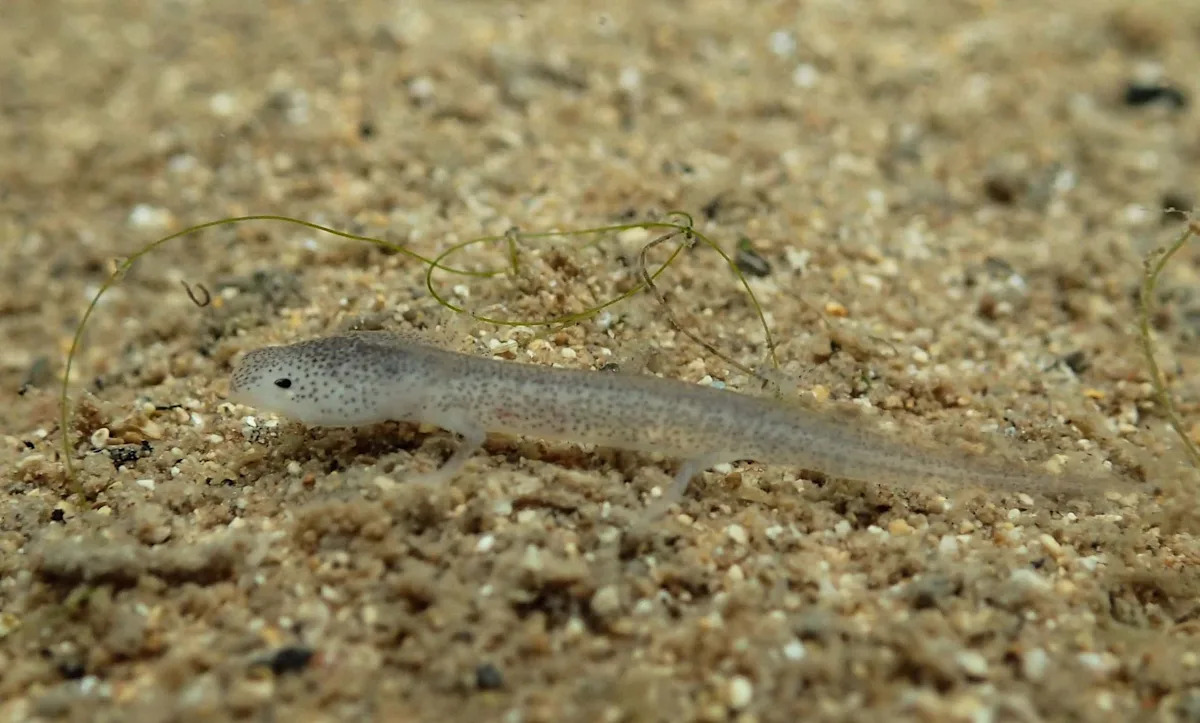
A rare species of salamander found only in downtown Austin, Texas, is having some of its habitat restored — and these efforts are already benefiting the population in a noticeable way, The Wildlife Society reported.
The Barton Springs salamander was described as a separate species only in 1993. Soon afterward, it was designated as endangered. Most of the population lives in underground aquifers most of the time. Above ground, this salamander can only be found in a few bodies of water in downtown Austin, including springs that flow into Barton Creek, which runs into the Colorado River. Many of these springs and the creek itself have been modified to allow public swimming; they are surfaced in concrete instead of natural stone or silt, and may have pipes to direct the flow of water, whereas once they sprang up naturally through springs.
This is a problem for the Barton Springs salamander, which needs fist-sized rocks and gravel to hide in and lay its eggs under.
Austin Watershed Protection, a city government department, has spent roughly 20 years planning and executing the restoration of Eliza Springs, one of the salamander’s habitats. Work began physically in 2016.
“We had to go rock shopping,” said Nathan Bendik, a biologist from Austin Watershed Protection, per the Wildlife Society. The team wasn’t able to find the appropriate river rock for sale, and even quarried rock was the wrong size. Eventually, debris cleared out from the main Barton Springs pool after a flood proved to be the perfect solution.
It was perfect; surveys of salamander numbers at the site jumped from a peak of 1,200 before the restoration to over 2,000 after it.
“Everything is looking very positive at that site,” Bendik said, per the Wildlife Society.
The department is looking to do the same at other nearby bodies of water to give this little salamander a fighting chance.
In this case, a species found only in an urban area might not seem connected to the broader ecosystem. However, otherhabitatrestorations protect an entire web of interconnected species that rely on each other to survive — and we need them to support our economy and food systems.
Get TCD’s free newsletters for easy tips to save more, waste less, and make smarter choices — and earn up to $5,000 toward clean upgrades in TCD’s exclusive Rewards Club.