
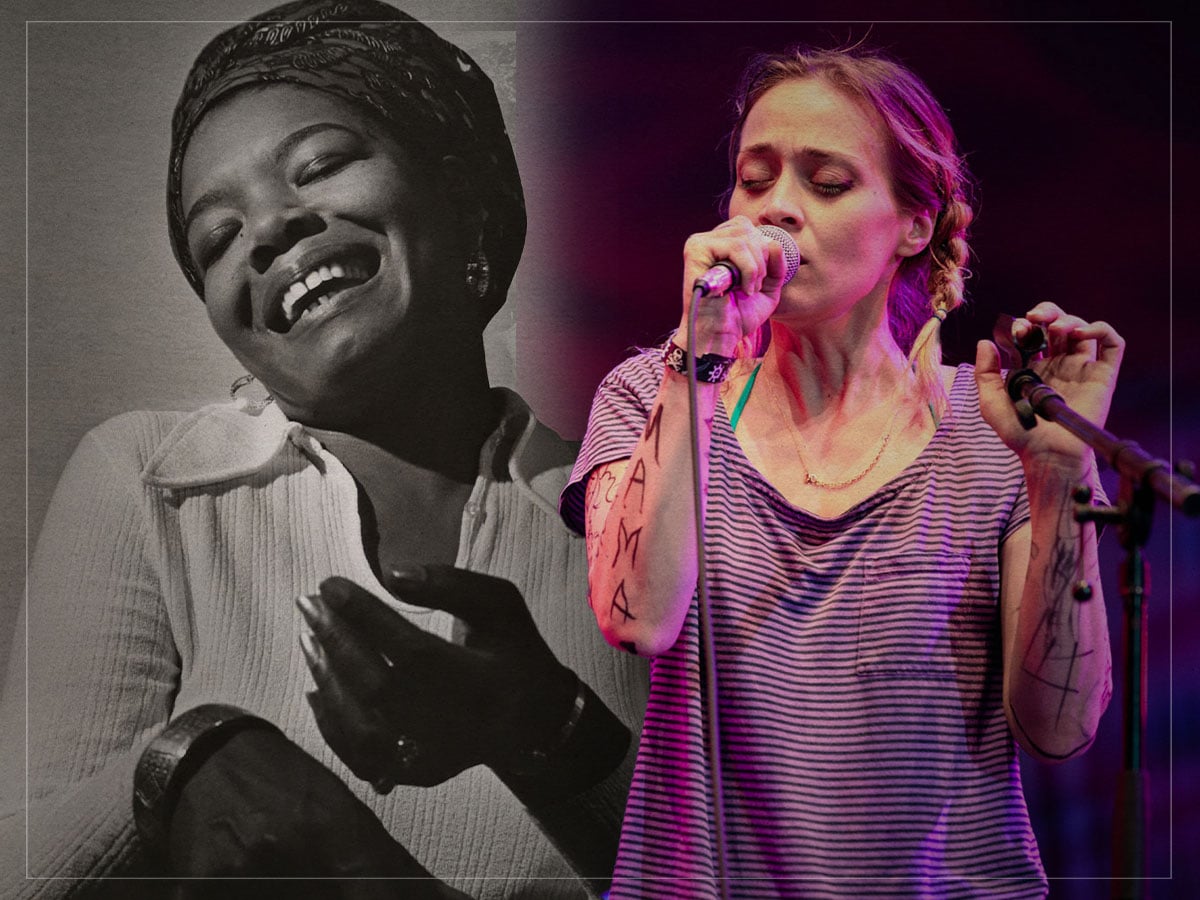
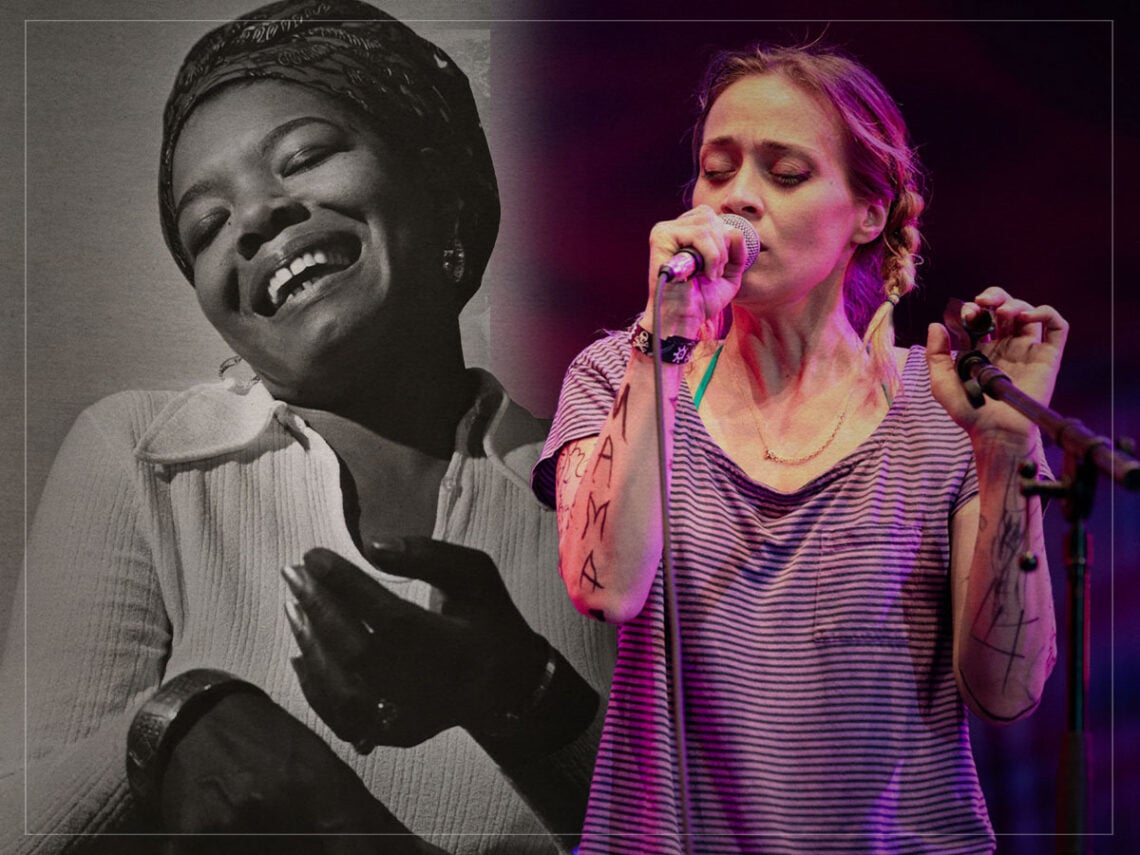
(Credits: Far Out / Maya Angelou / Sachyn Mital)
Mon 29 December 2025 5:00, UK
In 1997, upon accepting her award at the MTV Video Music Awards for her single ‘Sleep To Dream’, earning her the title of ‘Best New Artist’, Fiona Apple approached the stage.
She begins by apologising for not preparing a speech, but acknowledges that she was glad she didn’t because, in her words, “I’m not gonna do this as everybody else does it”.
She then quotes Maya Angelou: “See, Maya Angelou said that we, as human beings, at our best, can only create opportunities. And I’m gonna use this opportunity the way that I want to use it.”
Apple goes on to give a legendary speech, with the immortal declaration of, “This world is bullshit,” followed by the sentiment, “Go with yourself”.
Just before her 20th birthday, Apple saw her platform as a chance to share an honest perspective on the music industry and the downsides of fame, though her speech would later be ridiculed. Still, all was led by Angelou’s guiding words, a call to action for a young Apple who found herself tangled in the web of a media frenzy.
From when her first single, ‘Shadowboxer’, debuted to the world in July 1996, Apple was trapped in a paradox: she was controversial on account of her looks and age, deemed too “waifish” in the eyes of the media, and her candid lyricism, which was interpreted as too “raw” and too eloquent to have possibly been written by her.
But the way that Apple presented herself to the world was done entirely on her own terms, done in a tactful, present way that reflected a young life that had endured enough pain to last a lifetime. She once said that writing, for her, was not a “fun” experience; it was a necessity. To grow from such experiences, Apple turned to writing and singing as a means of reclamation.
“I don’t have a huge relationship to poetry, but when I come across poetry that gets me, it gets me,” Apple explains to Pitchfork, “And I love the idea of a poem of all of the power that can go into a space between two words or a repetition of one word, these tiny things that can mean so much and feel so huge”.
Apple’s songwriting grew from a love of the written word, but one writer in particular inspired her to set her words to music. “My singing self was born out of singing Maya Angelou poems to myself at night going to sleep,” she says.
Angelou’s diverse spectrum of writing, encompassing essays, memoirs, poetry, and more, all resonated with Apple from a young age. She names two of her poems, in particular: ‘Still I Rise’, a personal favourite of Angelou’s, and ‘Pickin’ ‘Em Up and Layin’ ‘Em Down’, which Apple recalls singing a certain part, “Pickin ’em up, and layin’ them down, getting to the next town baby.”
“She writes about her sensitivities and her vulnerabilities, and the weak points in her life and the embarrassing points in her life,” Apple said on MTV’s 120 Minutes. “I remember, I would read about it and… it would give me a lot of hope, just to read about somebody that I admired, that I respected her work, and to know that she had weaknesses, that she wasn’t just a totally strong person, born that way, born perfect, like everyone else seems to be.”
To think that Angelou’s words prompted Apple to find her melodies within is a beautiful continuation of tradition, where womanhood is absolved of any shame or guilt that comes with expressing oneself through their art. Both Angelou and Apple, in turn, write with an inspiring vulnerability, baring their souls to personally reckon with their contents, while also inspiring the courage to do so in others.
Related Topics