
Home » Latest Travel News » Breaking News in Oaxaca: Interoceanic Train Derailment Claims Thirteen Lives Leaving Mexico’s Rail Safety Under Scrutiny! The Nation Demands Answers
Published on
December 29, 2025
By: Paramita Sarkar

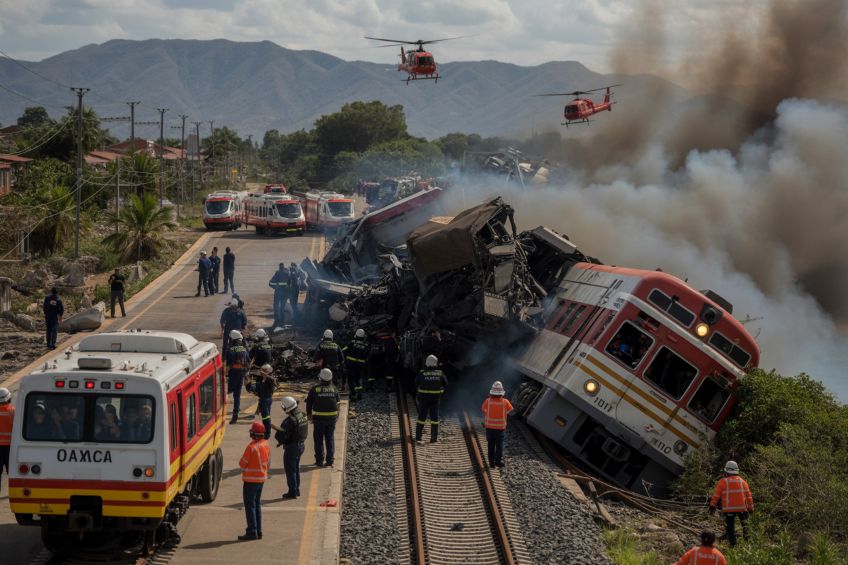
A catastrophic incident has rocked southern Mexico as the Interoceanic Train (Tren Interoceánico), part of the ambitious Interoceanic Corridor project, derailed early Sunday morning, leaving at least thirteen dead and at about hundred injured. The deadly crash occurred in the state of Oaxaca, triggering an urgent response from both federal and state authorities. The tragedy, which is now Mexico’s deadliest train disaster since the inauguration of the railway in 2023, has raised questions about the safety of this crucial transportation route.
 Where and When Did the Accident Happen?
The derailment took place on the morning of Sunday, December 28, 2025, between the towns of Chivela and Nizanda, located around 5 kilometers south of Nizanda, near Asunción Ixtaltepec in Oaxaca. The Interoceanic Train was operating on Line Z, traveling from the Pacific port of Salina Cruz toward Coatzacoalcos on the Gulf coast when the incident occurred. With 250 people on board—241 passengers and 9 crew members—the crash has left a significant toll on both lives and the region’s trust in the safety of the new transportation system.
What Were the Casualties and Injuries?
As of the latest updates, the Mexican government, including the Secretariat of the Navy (SEMAR) and President Claudia Sheinbaum, have confirmed the tragic loss of life. At least 13 people have been killed, while 98 others sustained injuries. The injuries vary in severity, with 36 individuals requiring hospitalization in multiple locations, including Matías Romero, Salina Cruz, Juchitán, and Ixtepec. Five passengers remain in critical condition as medical teams work tirelessly to stabilize their health.
In the midst of this devastation, 139 passengers were reported as uninjured and have been assisted in reaching their destinations. However, the scale of the disaster has sent shockwaves across Mexico and beyond, calling into question the safety protocols for such high-profile infrastructure projects.
How Did the Government Respond?
Following the derailment, Mexican authorities launched an extensive emergency operation aimed at both rescuing the injured and investigating the cause of the incident. The Secretariat of the Navy (SEMAR) deployed 360 naval personnel, supported by 20 vehicles, 4 ground ambulances, and 3 air ambulances, along with the use of a tactical drone to assist in search and rescue efforts. High-level officials, including the Secretary of the Navy and the Undersecretary for Human Rights, were sent to the site to oversee the coordination of emergency relief efforts and to support the families affected by this tragedy.
In addition, Oaxaca’s state government, under Governor Salomón Jara Cruz, has provided substantial backup, coordinating state civil protection units to assist federal teams at the accident site, which is located in a remote part of the state, making access difficult.
What Does the Investigation Say?
The cause of the derailment remains under investigation by Mexico’s Attorney General’s Office (FGR). Preliminary reports from witnesses, including several passengers, suggest that the train was possibly traveling at a high speed or suffered a potential brake failure before entering a sharp curve, where it ultimately went off track. These reports, combined with the timing and location of the crash, have prompted investigators to carefully examine the track maintenance and overall infrastructure of Line Z, which is a key part of the Interoceanic Corridor project that connects the Pacific and Gulf coasts of Mexico.
This incident has become the deadliest railway disaster since the Interoceanic Train service began in 2023, raising serious concerns about the reliability and safety of the new rail line, which was designed to rival the Panama Canal in terms of facilitating trade and boosting regional connectivity.
What is the Interoceanic Corridor?
The Interoceanic Corridor is a major infrastructure project in southern Mexico that aims to create an efficient transportation route between the Pacific and Gulf coasts. The project is seen as a game-changer for Mexico’s economy, offering a new way to move goods and passengers across the country. However, this devastating incident has cast a shadow over the ambitious plans, with many now questioning whether the infrastructure is ready for widespread use. With so many lives impacted by the derailment, the future of the Interoceanic Train and its associated projects is now under intense scrutiny.
What’s Next for the Families and the Industry?
The Mexican government is committed to providing support to the victims’ families and those injured in the crash. A full investigation is underway, and the authorities have vowed to get to the bottom of what caused this tragic accident. As the investigation continues, many are asking: How can Mexico prevent such incidents in the future, especially as it moves forward with projects that are integral to its economic future?
Conclusion: A Sobering Wake-Up Call
The derailment of the Interoceanic Train serves as a stark reminder of the risks associated with high-speed rail and the urgent need for rigorous safety standards in such massive infrastructure projects. As Mexico grapples with the fallout from the deadliest rail disaster in recent history, the country’s ambitious plans to expand its transportation networks must be revisited to ensure that future tragedies are avoided.
The people of Oaxaca and all of Mexico await answers. For now, the focus is on recovery and support for the victims and their families, while the investigation into this catastrophic event unfolds.