
New Yorkers are losing more than just a way to pay for subway and bus rides with the MetroCard’s retirement — they’re also saying goodbye to a versatile tool for some resourceful residents.
Ahead of the official end of MetroCard sales on Jan. 1, Gothamist spoke to small business workers, including nail technicians and phone repairers, who explained how the card has become a key tool of their trades because of its unique design. It’s thinner and more flexible than credit cards, while also sturdy and smooth enough that it doesn’t scratch surfaces.
“It is plastic, so recycling it is a little bit more difficult than a soda bottle, so adaptable reuse, I guess, is something the MetroCard was born for,” said Jodi Shapiro, curator of the New York Transit Museum’s “FAREwell, MetroCard” exhibit. She said she has used her MetroCard to open her hotel room door by sliding the card between the door and frame at the latch — something she couldn’t do with her credit card because it was too thick.
Social media is full of videos of nail salon technicians using MetroCards to remove nail enhancements by shoving the cards between acrylic nail tips and natural nails and then popping them off. Kelly Lam, a technician at Nail Chic Salon in Cobble Hill, said many salons use MetroCards because they provide a quick and easy solution, especially when workers are in a hurry.
Lam said she doesn’t recommend this method because it can be painful and rip off layers of natural nails, adding that damaged nails are harder for technicians to work on. The healthiest way to take off nail enhancements is soaking them in pure acetone, which breaks down the acrylics, she said. Still, Lam noted salons will likely keep using MetroCards until they run out.
Several phone repair technicians said MetroCards have helped them remove screen protectors and take apart batteries.
Metrocards are “soft enough and malleable enough and sturdy enough that they allow us to go through the entire screen … without the risk of the tablets breaking,” said Bryan Campoverde, a technician at MobiCompu Repair in Park Slope.
He said he could reuse a single MetroCard for a few weeks, making them “super practical, cheap and effective for our business.”
Campoverde’s technicians used to collect expired MetroCards discarded on subway station floors and ask customers for their old ones. But the cards have become harder to find since the MTA introduced the OMNY tap-based fare system, he said.
Customers who used to give their old MetroCards to Campoverde now tell him, “If I find one, I’ll give it to you,” he said.
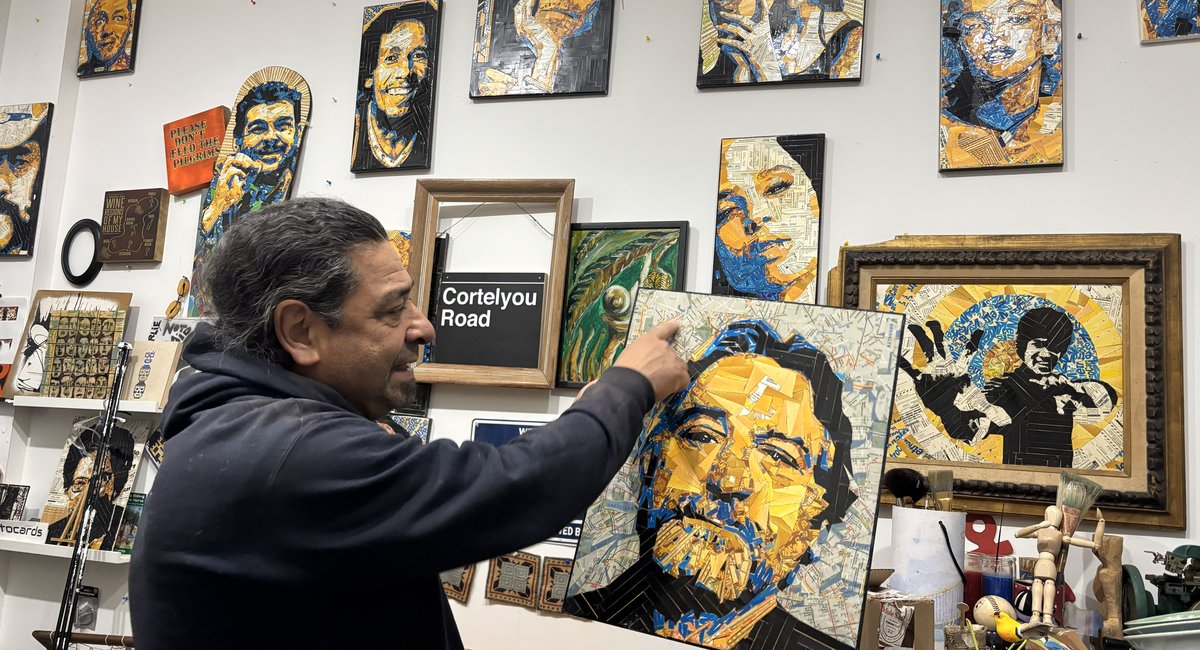
MetroCards’ magnetic strips offer one of Juan Carlos Pinto’s favorite materials for his art.
Elizabeth Shwe / Gothamist
Youssef Eskander, a technician at iFixScreens, also in Park Slope, said the MetroCard is superior to other tools on the market.
He said he’s tried tools made of carbon fiber, harder plastic and even razor blades, but none work as effectively as the MetroCard, which doesn’t scratch screens because of its flexible plastic.
Eskander said he has a stash of around 20 MetroCards left and plans to collect more before the MTA stops selling them for good.
“I mean, you have to adapt,” he said.
Juan Carlos Pinto, a Brooklyn-based artist who makes mosaic portraits of celebrities and animals from cut-up pieces of recycled MetroCards, said the cards have helped him make his living for the last two decades.
“Now I can pay my expenses,” he said. “I started paying my rent, my mortgage, because of the MTA.”
Pinto said the inspiration came to him around 25 years ago when he received a fare-evasion fine after jumping a subway turnstile because he didn’t have enough money to pay. He picked up all the MetroCards on the station’s floor, brought them to his house and chopped them up that night in anger, he said.
After two hours of doing this, Pinto said he calmed down and had a powerful realization.
“Wait a minute, there are five colors in the card,” he recalled. “You got black, blue, yellow, red and white. I have a palette now.”
“People didn’t see the value of the card,” he added. “It was all over. New Yorkers are dirty. All I do with mosaics in my studio with the card is reuse and repurpose.”
Youssef Eskander uses MetroCards to help repair phones. He says the cards are more effective than other tools on the market.
Elizabeth Shwe / Gothamist
Pinto said his first portrait was of John Lennon, which he plastered copies of across the city to protest MTA fare hikes in the early 2000s. The magnetic black strip is his favorite part of the MetroCard because, he said, each strip contains a stranger’s transportation history. He used around 75 of those strips in his collage portrait of Albert Einstein.
“That’s the history of 75 New Yorkers I have never met. Maybe they met each other or maybe there’s a marriage there or a crime, you never know,” Pinto said.
The artist has a backpack full of Metrocards he thinks will last him another five or six years. But even when the yellow and blue cards become collector’s items one day, Pinto said he’s not worried because this will be an opportunity to try something new, like returning to painting.
According to Shapiro, New Yorkers have found other creative ways to use the MetroCard, including as a screwdriver to open computers, since the slots in the screwheads are just thick enough for the card to fit.
Jenny Snowden, a dance teacher and director of Brooklyn Swings, said she made an earring out of her special-edition MetroCard, which had green block lettering instead of the typical blue. Lauren Comito said she uses her MetroCard to scrape off extra ink from her metal plate when she does intaglio printmaking.
Campoverde said he’ll always prefer the MetroCard over OMNY because of the nostalgia the card offers.
“I grew up with the MetroCard, so I think for me, I’ll always think that the MetroCard reigns supreme,” he said.