
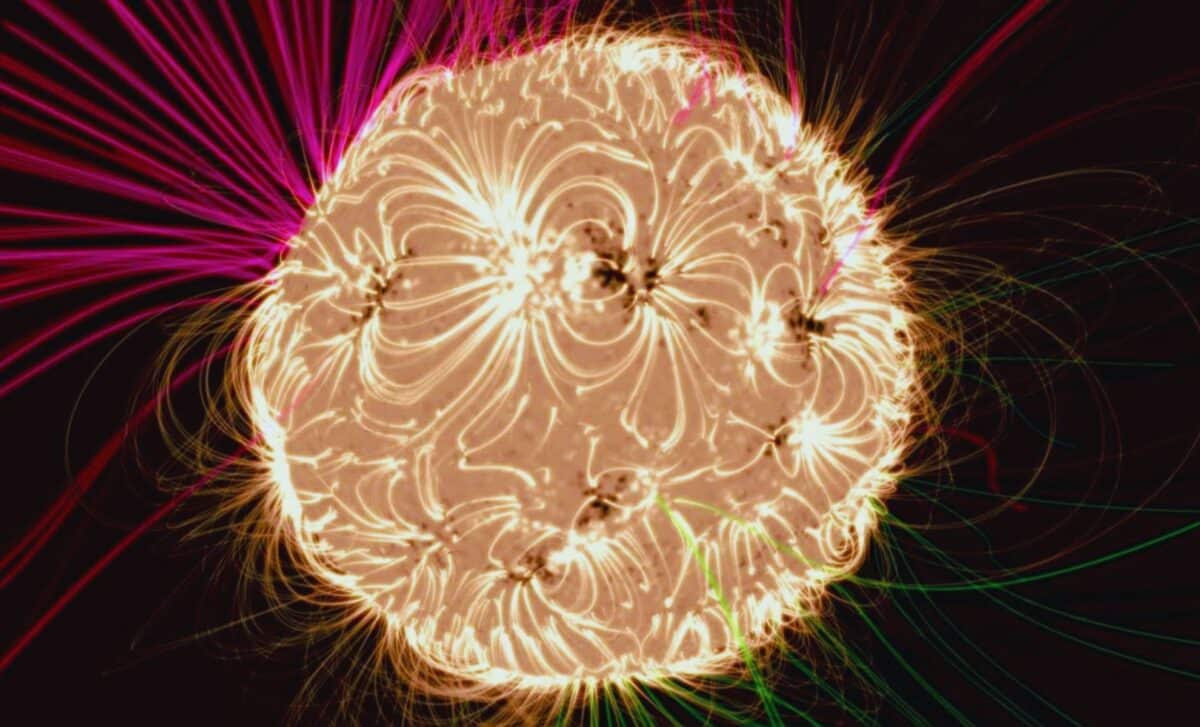
For the first time in the history of solar observation, NASA has made the Sun’s invisible magnetic behavior visible. Using footage recorded during a recent flyby, the Parker Solar Probe has shown the movement of magnetic switchbacks, sudden reversals in the direction of magnetic fields, in the Sun’s outer atmosphere. These structures, long theorized but never seen, are now available for scientists and the public to witness in real time.
The video was released as part of a NASA report, which described it as the first time “the magnetic Sun” could be seen in motion. The footage marks a major step forward in space science, confirming long-held theories and opening new paths for studying the forces that shape solar and interplanetary conditions.
Magnetic Switchbacks Revealed Near The Sun
The Parker Solar Probe, launched in 2018, was designed to fly closer to the Sun than any previous spacecraft. During a key phase of its mission, the probe encountered regions of solar wind influenced by violent, magnetic distortions known as switchbacks. These magnetic spikes were first detected in 2019 through indirect measurements, but no visual record existed until now.
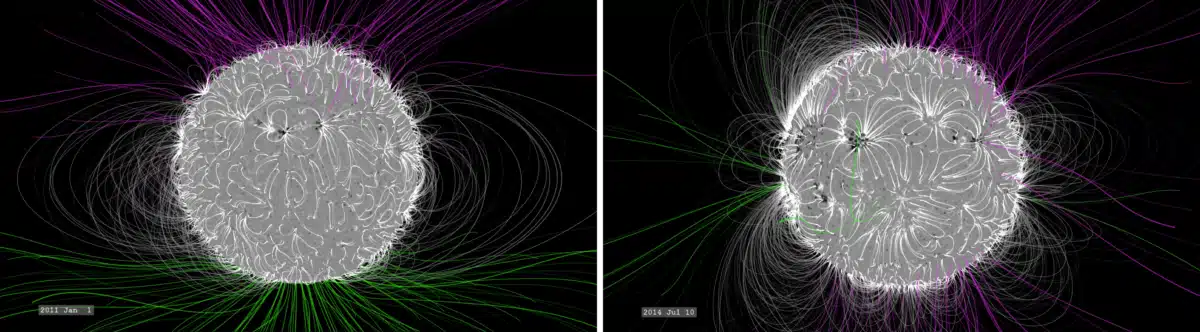 The Sun’s field shifted from ordered in 2011 to tangled in 2014, marking the transition to solar maximum and increased solar activity. Credit: NASA’s Goddard Space Flight Center/Bridgman
As reported by the American Space Agency, researchers used the probe’s WISPR (Wide-Field Imager for Parker Solar Probe) instrument to capture visible traces of the dust and particles being flung around by these magnetic kinks. This movement allowed researchers to “see” what is otherwise invisible: the Sun’s dynamic magnetic field twisting and shifting in real time.
“We’re not sure exactly where in the sun the magnetic field is created,” explained Dean Pesnell, a space scientist at NASA’s Goddard Space Flight Center in Greenbelt, Maryland. “It could be close to the solar surface or deep inside the sun – or over a wide range of depths.”
Visualizing The Invisible: A Scientific Milestone
For solar physicists, the ability to observe the magnetic field visually is a breakthrough. The Sun’s magnetic activity is known to power solar flares, coronal mass ejections, and the solar wind, all of which affect Earth’s space environment. But until now, these processes have only been inferred through data or simulations.
According to NASA scientists, the new footage shows a direct relationship between magnetic movement and solar material, offering unprecedented clarity on how the Sun’s atmosphere behaves. The observed switchbacks suggest that magnetic energy is being released in bursts, reshaping the flow of particles outward into the solar system. Pesnell emphasized how the magnetic field shifts over time: “
“At solar maximum, the magnetic field has a very complicated shape with lots of small structures throughout – these are the active regions we see. At solar minimum, the field is weaker and concentrated at the poles. It’s a very smooth structure that doesn’t form sunspots.” His description frames the footage in the broader context of the Sun’s magnetic cycle.
Parker Probe Opens Door To Real-time Solar Dynamics
The Parker Solar Probe’s data may help improve models that predict solar storms, which can disrupt communication systems, satellites, and power grids. While the full scientific analysis of the footage is ongoing, the moment has already made its mark.
The ability to see the Sun’s magnetic activity as it happens marks a “first in history”, a moment when a once-theoretical aspect of solar physics becomes visible and measurable. The Parker Solar Probe continues its mission, promising more insights in the years to come. But with this footage, the Sun has already given up one of its most guarded secrets.