
By Al Doyle
Even in the current high-strikeout, low batting average environment, the idea of coming in below .200 — the dreaded “Mendoza Line” named after weak-hitting shortstop Mario Mendoza — is something to be avoided. Defense-first catchers and sure-handed utility infielders might hang around a while, hitting in the .180s or .190s, but other position players will need to find a new career. USUALLY.
Catcher/outfielder Frank Fernandez‘s numbers look right in line with modern baseball, but they were truly odd during a big-league career that spanned from 1967 to 1972. The Staten Island native debuted with his hometown Yankees in 1967 by hitting .214 (6 for 28) with his first major league home run.
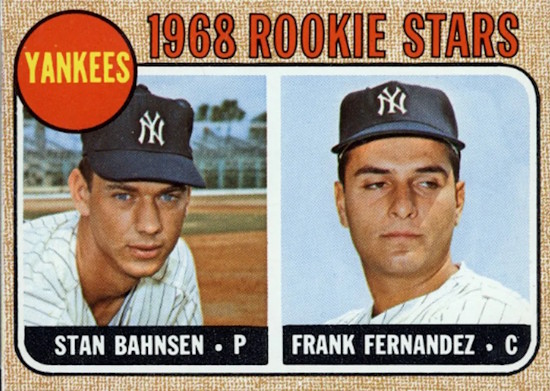 Frank Fernandez was a 2-time Topps Rookie Star, appearing on a 1966 card with Fritz Peterson and a 1968 card with Stan Bahnsen.
Fernandez’s 1968 numbers were beyond freakish. He hit .170 with 50 strikeouts and 35 walks in 135 at-bats (171 plate appearances). The right-handed swinger showed power with 7 HRs, and 30 RBI with just 23 hits is unprecedented. Since he had 14 extra-base knocks, 60.9 percent of Fernandez’s hits were doubles or better. He had just nine singles. Frank’s .341 on-base percentage was 44 points higher than the AL average of .297.
1968 is known as “The Year of the Pitcher” in the American League, as 10 teams combined for a .230 average, so Fernandez was 60 points under a historically low number. Despite that, the slugging and walks gave him a fine OPS+ of 125. The Yankees set a live ball era record low by hitting .214. A 2.79 team ERA was a major reason why the Yankees finished with an 83-79 record.
This was Mickey Mantle’s final season. Chronically bad knees and a stacked deck against hitters led to a .237 average (103 for 435) with 18 HR and 54 RBI. That dropped the Mick’s career average from .30155 to .29807. Even an over-the-hill No. 7 was among the league leaders with 106 walks (2nd), .385 OBP (3rd) and a .782 on-base plus slugging (9th).
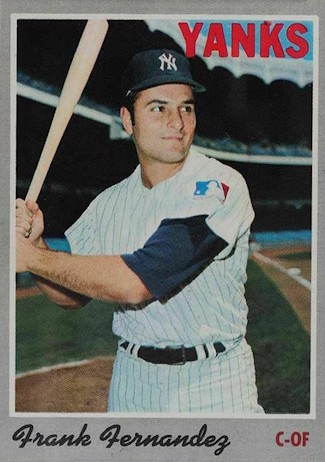
Fernandez saw his average soar 53 points to .223 in 1969. He had 12 HR and 29 RBI in 229 AB with 68 Ks and 65 walks. A .399 OBP would have been good for 8th in the AL if Fernandez had 502 or more ABs. He had a .994 fielding percentage in 65 games behind the plate as compared to the American League average of .987. Frank threw out 20 of 48 opposing base stealers for a solid 41.7 percent success ratio.
Traded to the A’s prior to the 1970 season, Fernandez hit .214 with 15 HR and 44 RBI in 252 at-bats for Oakland. Seventy-six strikeouts were in line with his norm, but a drop to 40 walks meant Frank declined from being an ultra-selective hitter to merely above average. Despite that, his .327 OBP was better than the AL’s cumulative .322 mark.
Fernandez became a baseball nomad in 1971. He was traded to the Washington Senators on May 8 and returned to Oakland just 46 days later on June 23. Being managed by Senators skipper Ted Williams should have been a natural match, but Frank hit just .100 (3 for 30) in the nation’s capital. He spent 17 games with the AAA Iowa Oaks, and that included five appearances at shortstop.
Swapped to the Chicago Cubs on August 31, Fernandez put up one of the weirdest stat lines ever in his first month as a National Leaguer. Small sample sizes can be extreme, but 7 for 41 (.171) with four solo homers, 15 strikeouts and 17 walks stands out like a floodlight in the darkness. Frank’s .414 OBP was 243 points higher than his batting average. He finished the season hitting .138 (11 for 80) with 4 HR plus 9 RBI along with 28 Ks and 22 walks.
How did three at-bats make a significant difference in Fernandez’s final numbers? A trio of unsuccessful pinch-hitting appearances for the 1972 Cubs dropped Frank’s career average from .20027 (145 for 724) to .19944 (145 for 727). Despite dipping under the Mendoza Line, Fernandez’s career 39 HR, 116 RBI, 164 walks, 114 OPS+ and .350 OBP are impressive. (Editor’s Note: Joey Gallo, with his .194 career batting average, trails with a 106 OPS+.) That kind of performance would be worth $2 million or more as a platoon player in today’s market. Instead, Fernandez became baseball’s first three true outcomes (K, BB, HR) player.
A second 1960s player takes the silver medal for under-.200 productivity. Pitcher Earl Wilson hit 35 homers in just 740 at-bats, which means he cleared the fences every 21.1 AB. The righty hitter and thrower had three triples and a homer while hitting .208 (15 for 72) with 7 RBI for the Boston Red Sox in 1964. Wilson found the Green Monster in 1965, as he slammed six long balls with 12 RBI in just 79 AB in 1965.
Traded to the Detroit Tigers on June 14, 1966, Wilson came through with 7 HR that year. He had 22 RBI, averaging nearly an RBI per hit (23 for 96, .240). The 6’3″ Wilson kept slugging in Motown. Earl hit .185 (20 for 108) with 4 HR and 15 RBI in 1967 in a season where he made 13 of his career 28 pinch-hitting appearances. Wilson came through with 7 HR and 17 RBI while batting .227 (20 for 88) for the World Champion 1968 Tigers.
At this point, Wilson had a .206 career average (127 for 616). His bat declined in 1969 and 1970, as Earl hit just .137 (17 for 124) with 2 HR for the Tigers and Padres. Wilson was no slouch on the mound, finishing with a 121-109 record and a 3.69 ERA. His best seasons included an 18-11, 3.07 campaign in 1966 along with a 22-11 record and 3.27 ERA for the Tigers in 1967. Wilson took a loss in Game 3 of the 1968 World Series against the Cardinals.
What could Wilson have done if he had focused entirely on hitting instead of getting sporadic batting practice swings? The result might have a big-time slugging right fielder with a cannon arm.
The best sub-Mendoza performance of all time is a no-brainer. Kyle Schwarber hit .197 for the Phillies in 2023. He did nothing small that season. “Schwarbs” led the majors with 215 strikeouts, exactly 100 more than his 115 hits. Both his 47 HR (40.9 percent of his hits) and 126 walks were second in the NL and majors. The lefty-swinging slugger’s 104 RBI was good for ninth in the NL. His .343 OBP was 20 points better than the league average of .323. Schwarber made .197 productive with a 121 OPS+.
With 340 career homers, 32.4 percent of Schwarber’s 1050 hits have cleared the fences. He has a decent chance of reaching 500 HR, especially since he just signed a five-year contract with the Phillies. Hitting under .200 is still a large negative indicator, but there have been a few exceptions to the rule.
Follow me on Instagram: @rip_mlb
Follow me on Facebook: ripbaseball
Follow me on Bluesky: @ripmlb
Follow me on Threads: @rip_mlb
Discover more from RIP Baseball
Subscribe to get the latest posts sent to your email.

Published by Sam Gazdziak