
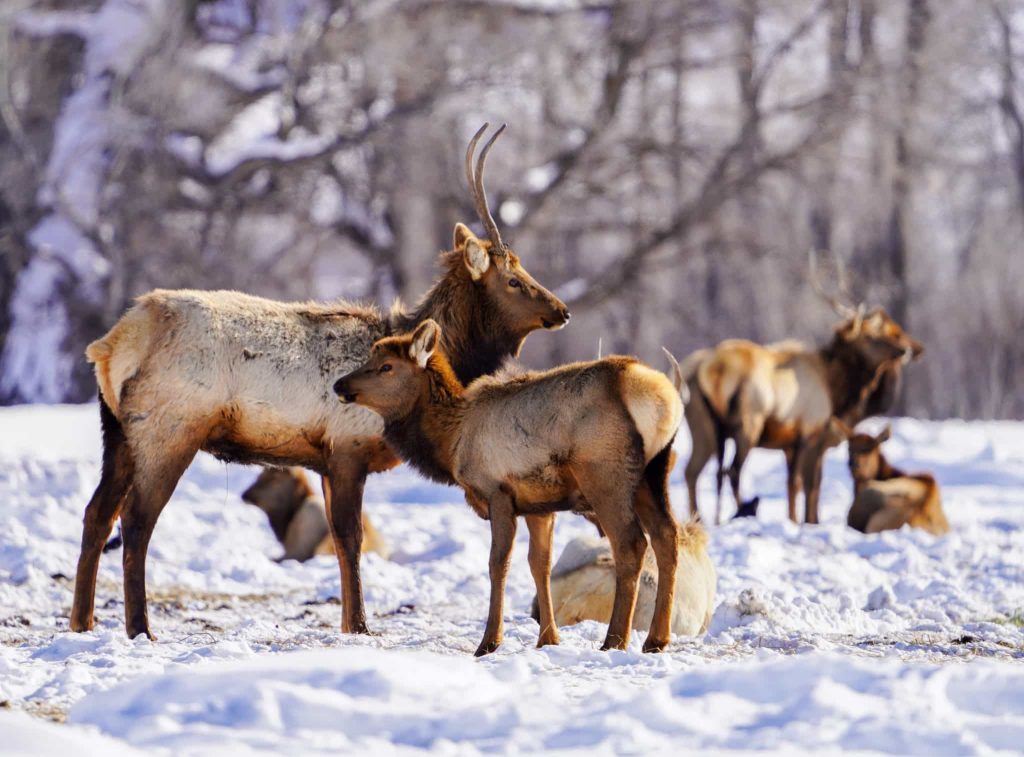
Big game herds in Northwest Colorado are rebounding from the punishing winter of 2022-23, a season that forced wildlife managers to shift from managing abundant populations to supporting their recovery.
Every winter since that year, when significant winterkill staggered big game populations, has been much different to the benefit of elk, deer and pronghorn.
With light snow and prolonged mild conditions throughout Northwest Colorado thus far this winter, Colorado Parks and Wildlife big game biologist Becca de Vergie said deer, elk and pronghorn are once again positioned to make it through winter with less stress and lower mortality than usual.
The benefits of a mild winter, however, can come with tradeoffs. If snowpack remains low through late winter and spring, de Vergie said the region could face a dry summer with limited water availability and reduced forage quality during the months when animals rebuild their body condition.
“What I get concerned about is next summer,” de Vergie said. “If we don’t get as much snow as we normally do, then we’re going to be set up to have another pretty dry summer, which coming after this past summer which was unusually dry, could be an issue.”
From abundance to emergency
Prior to the winter of 2022–23, de Vergie said the Craig area sat at the center of some of the most productive ungulate herds in the state and in the country.
“These are the largest ungulate herds up here,” she said, referring to the populations she manages near Craig and south toward Meeker. “We’ve got a lot higher calf ratios for elk than anywhere else in the state. And deer and pronghorn are very productive as well.”
That productivity created a longstanding management challenge.
“We historically had too many elk,” de Vergie said. “The plan of attack up here has been to harvest a lot of elk, with more cow licenses than other parts of the state, to keep the herd within our objective range.”
The winter of 2022–23 led to an abrupt reversal of that strategy.
“It went from how do we kill enough elk to how do we save everyone we can,” she said. “It was a complete game changer.”
Severe snow accumulation combined with crusted snow conditions caused widespread winterkill, particularly among calves and fawns, older animals, and mature bulls and bucks that already had their body condition depleted after the fall rut.
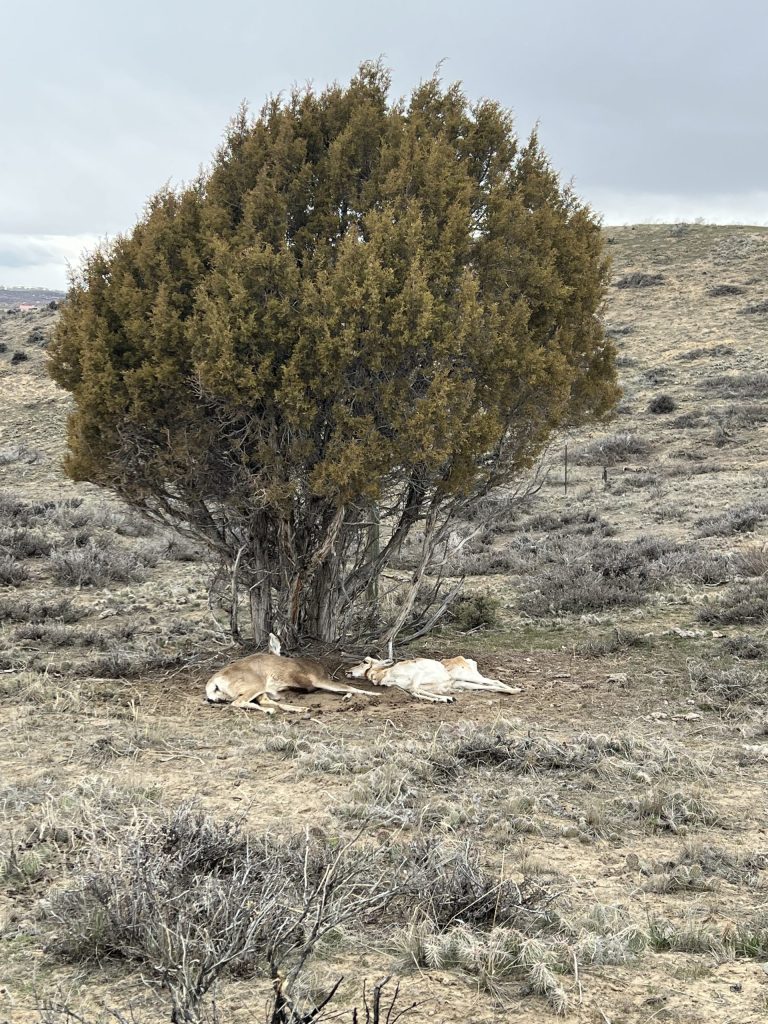 Winterkill among mule deer, pronghorn and elk reached record levels during the winter of 2022-23. Courtesy Photo/Colorado Parks & Wildlife
In response, CPW sharply reduced license numbers to slow additional losses.
Why mild winters help
Mild winters can help reduce one of the biggest threats to big game survival: energy loss. Deep, wind-drifted or crusted snow can force animals to burn calories when they move and access forage. When the amount of energy they are using to access food exceeds its nutritional value, their body condition decreases and mortality can increase.
“The severe winter wasn’t just about snow depth,” de Vergie said. “It was the crust layer that formed. Animals were burning a ton of energy trying to get to food and then not finding enough food to replace that. In some cases animals were literally stuck, unable to move through the crusted snow.”
In a mild winter, snow is easier to move or dig through. As a result, animals burn fewer calories, retain more body weight and enter spring in better condition.
During harsh winters, the most vulnerable animals are the first to die.
“The first ones to go are young of the year and older animals,” de Vergie said. “Mature bulls and bucks are also susceptible because they’re coming off the rut in their worst body condition.”
Mild conditions benefit nearly all age classes. They also improve the health of cows heading into calving season.
“If cows haven’t lost as much body weight over winter, they’re stronger and better able to support their calves,” de Vergie said. “That can translate into healthier calves through better nutrition and care.”
If conditions remain mild through January, animals may gain an early-season advantage even if winter turns more typical later.
“They’re just able to feed and move easily and pack on calories,” she said.
Recovery since 2022–23
The rebound of big game populations has been driven by more than license reductions alone. Weather following the severe winter played a major role.
Heavy snowfall led into an unusually wet spring in 2023, which in turn led to a strong summer for vegetation and water availability.
“There was water absolutely everywhere for longer into the summer than usual,” de Vergie said, noting that ponds that were typically dry by July held water into August.
That abundant moisture supported forage growth and boosted calf and fawn survival. De Vergie said productivity ratios were higher than normal, meaning more young survived to six months of age.
Since then, winters have been relatively mild.
“There hasn’t been another hard-hitting winter since,” she said. “All of that together has allowed herds to rebound.”
A mild winter risk: delayed migration
While mild winters reduce mortality, they can also disrupt seasonal migration. When snow remains light, animals may stay in higher elevations longer than usual. If a major storm arrives suddenly, those animals can become trapped in poor winter habitats.
“That could happen,” de Vergie said when asked about the sudden onset of severe winter conditions. “We could have animals stuck in not ideal places.”
CPW has already observed elk lingering farther east than normal this winter, with fewer animals crossing west over Highway 13 compared to a typical year.
If conditions suddenly change, management options are limited.
“Feeding is the first thing people think of,” de Vergie said. “But it’s not feasible to sustain entire populations.”
She explained that while feeding is sometimes used to move animals away from highways, livestock operations or dangerous bottlenecks, it cannot prevent widespread winterkill.
“There’s really nothing we can do at that point,” she said.
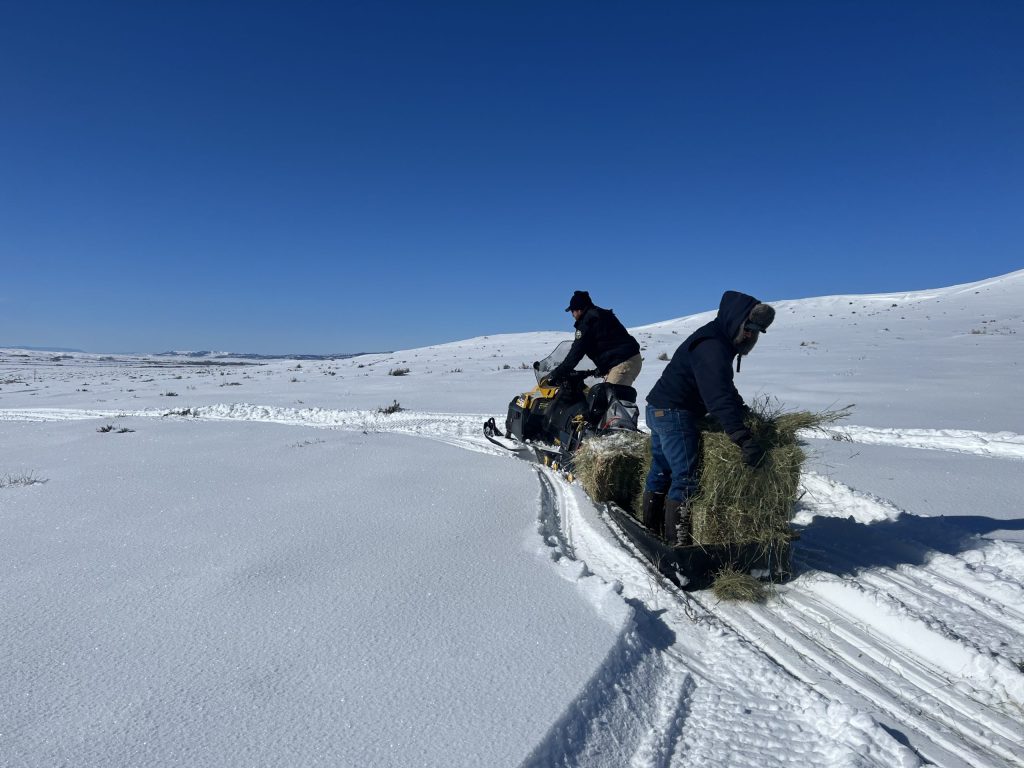 Colorado Parks and Wildlife implemented feeding operations during the winter of 2022-23 to support big game. Though the effort was extensive, it couldn’t offset the impacts of consistent snowfall and prolonged cold temperatures.Courtesy Photo/Colorado Parks & Wildlife
Summer concerns
De Vergie’s biggest concern lies beyond winter survival, as low snowpack can reduce spring runoff, which can lead to earlier drying of ponds and vegetation during summer.
“We saw that this past summer,” she said. “Ponds dried earlier than they should have and animals had to travel farther to find water.”
As forage dries, its nutritional quality declines. That can affect the body condition of big game animals heading into fall and winter, even if animals survived the previous winter easily.
“You get green grass in the spring, which is really nutritious,” de Vergie said. “But if it turns brown in early July instead of late July, that’s a few weeks of nutrition they’re missing.”
During summer pronghorn classification flights, de Vergie noticed animals distributed differently than usual, which she said might have been due to less moisture than normal, causing animals to move to higher elevations where more moisture still remained..
“They weren’t where I typically find them,” she said. “More of them were moving up, which is not normal behavior.”
Dry summers do not appear to significantly affect trophy antler size, she said, but they can influence overall body condition.
Current herd status
Elk have rebounded quickly since the winter of 2022-23, and de Vergie said that the Bears Ears elk herd is back within its objective range of 15,000 to 18,000 animals, with a more specific estimated population of about 15,800 post 2024 hunting season..
“That happened faster than people expected,” de Vergie said.
As a result, CPW hopes to possibly increase license numbers, though they will not immediately be brought back to allocations that existed prior to the 2022-23 winter.
Mule deer, however, are proving to be a bit more complicated. The Bears Ears deer herd is currently estimated to be around 21,000, while the objective is 30,000 to 40,000 animals.
“Based on what I’m seeing from the air, there’s a good number of deer and fawns,” she said. “They look good, despite what the numbers say.”
Pronghorn were hit especially hard in 2022–23, and population estimates dropped from roughly 23,000 animals pre-winter to around 6,000–7,000 after. The objective for pronghorn in this herd is 15,800 animals.
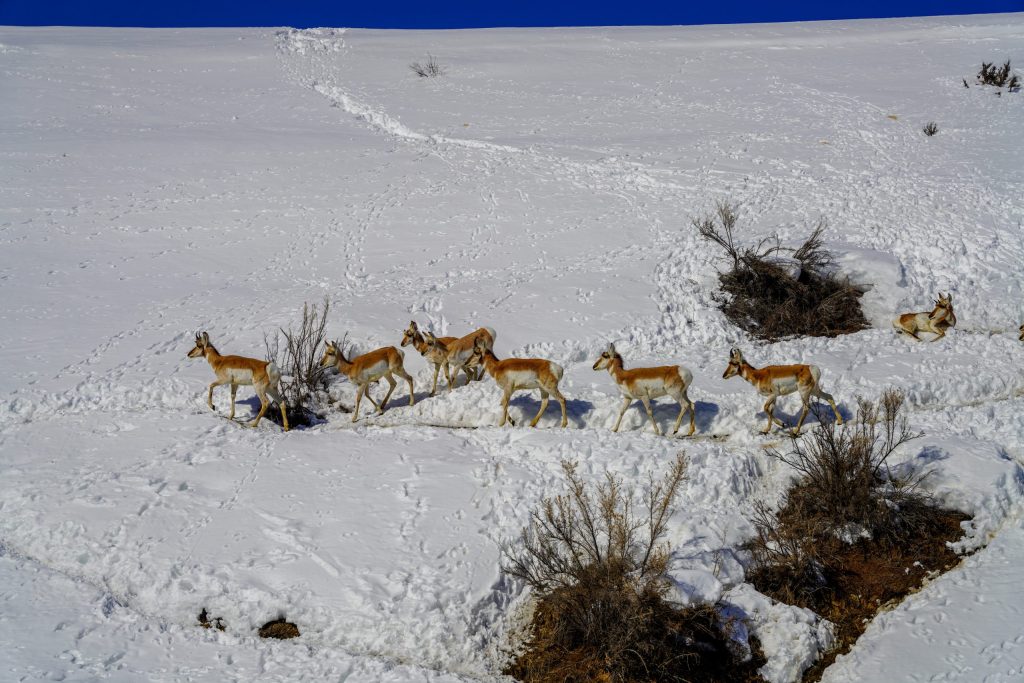 Pronghorn were especially hard hit during the relentless winter of 2022-23, prompting Colorado Parks and Wildlife to take drastic action to support the population in the following years. With thinner coats and greater risk of fence entanglement, pronghorn have taken longer to recover compared to elk and mule deer.Image #4
The most recent estimate is about 9,700.
Strong fawn production has driven that rebound and in 2024 observed pronghorn fawn ratios reached 97 fawns per 100 does, which de Vergie said was the highest observed ratio since at least 2002.
Impacts on predators
Predators largely follow prey distribution, de Vergie said, and while mild winters may make hunting more difficult for predators due to lack of snow, there is also a reduction in energy demands on them.
For bears, she has heard unconfirmed reports of a few individuals denning late this winter, though she has not observed it herself.
Decisions and hindsight
de Vergie noted that the license reductions that were implemented after the severe winter were well-thought out, even as populations rebound faster than expected.
“At the time, nobody knew we were going to get two mild winters,” she said. “It’s easier to increase licenses later than to keep cutting them.”
For now, big game near Craig are benefiting from a winter that demands less energy. Whether that advantage holds will depend on what the rest of winter delivers and how spring and summer unfold.
“Mild winters help animals now,” de Vergie said. “But a low snowpack can still come back to bite us later.”
For more details on how big game populations have recovered, visit CoHunter.com/uncategorized/big-game-herds-rebound-following-historic-2022-2023-winter-in-moffat-county.