
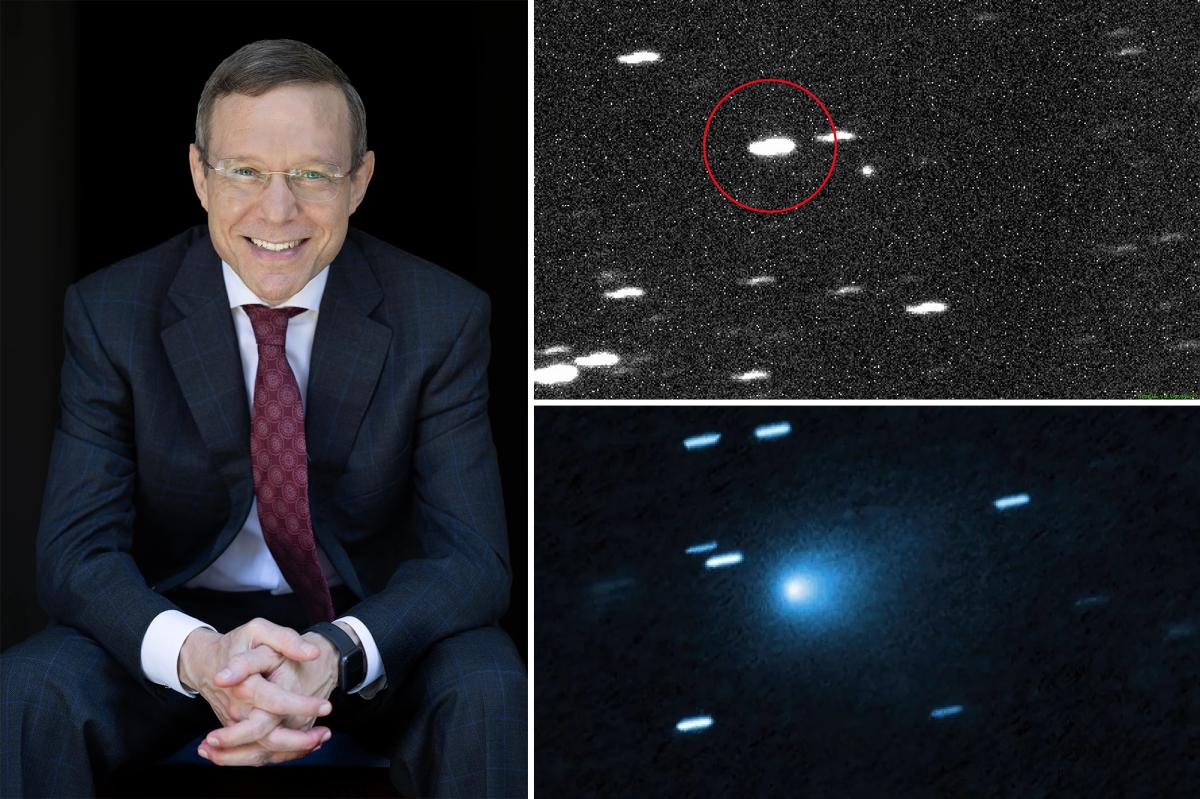
Could these be signs of artificial 3I-ntelligence?
With 3I/ATLAS streaking away from our planet, speculation remains as to whether the interstellar comet is alien or not.
NASA has staunchly maintained that the cosmic interloper is of cometary provenance, while Harvard scientist Avi Loeb has doubled down on claims that it could be technological.
3I/ATLAS has faced much speculation about its origin. NASA / SWNS
This was after initially appearing to concede it was “natural” in an interview with NewsNation following the comet’s closest approach on Dec. 19.
“You can’t just say, ‘I know the answer and ignore the anomalies. That’s not viable,” Loeb told The Post. “Because it could be a Black swan event (an unlikely-seeming phenomenon that seems inevitable in retrospect), we must consider the possibility that it’s technological.”
“Originally in July, I ranked it [3I/ATLAS] four on the Loeb scale between zero and 10, where zero is a natural comment, and 10 is an alien technology of potential threat to humanity…and [I] haven’t changed that rank,” added Loeb.
Avi Loeb (shown above) has been following 3I/ATLAS for quite some time now. Chris Michel/National Academy of Sciences
Loeb hopes that humanity’s 3I-insight will become clearer after the results of the International Asteroid Warning Network’s Planetary Defense campaign are learned — an effort to glean as much ATLAS intel as possible between Nov. 27, 2025, and Jan. 27, 2026.
“My general hope is that the best is yet to come in terms of the new data and what we will learn about 3I/ATLAS,” Loeb concluded. “But also, there might be new objects in the future because the Rubin Observatory will find new interstellar objects every few months in the coming decade.”
He added, “And suppose five years from now, there will be one that is definitely technological. People will go back to what I said in 2025 and it will give them good ideas for what to do about another object.”
As a service to space-watchers, Loeb listed the 15 burning theories that remain unanswered following its tour of Earth, which could potentially prove that ATLAS is technological — and The Post condensed them into eight of the most intriguing.
1. The comets align
A diagram showing 3I/ATLAS’s trajectory through our solar system. NASA/JPL
Loeb noted that the trajectory of 3I/ATLAS was “aligned to within 5 degrees with the ecliptic plane of the planets around the Sun,” which he noted had a probability of 0.2%. The rationale for this was unclear but the scientist had previously speculated that ATLAS was using this path to conduct recon on our galaxy — possibly with hostile intent.
2. Jupiter descending
Loeb believes that Jupiter might be a more enticing target due to its size. Artsiom P – stock.adobe.com
Loeb said that for the comet to do recon on Jupiter, it would have to move close to Jupiter’s Hill Radius —a region where Jupiter’s gravity dominates over the sun’s, allowing it to hold position with minimal fuel.
So he found it extremely coincidental that during the interstellar entity’s closest approach to Jupiter in March, it will be at a minimum distance of 53,445 million kilometers (over 33.209 million miles) from Jupiter, based on calculations by NASA’s Jet Propulsion Laboratory.
Loeb told The Post that if technological objects were to release mini probes to monitor our solar system, our gas planet would be the best bet because it’s “massive” and “not fragile.” He analogized them to the monoliths in Stanley Kubrick’s 1968 opus “2001: A Space Odyssey.”
In accordance, the scientist urged the space defense sector to conduct countersurveillance during ATLAS’s closest approach to Jupiter in March.
“The thing to do there would be to use the Juno spacecraft or any other mission that will arrive at Jupiter in the near future,” Loeb said, adding that they should check if there are “new objects in orbit.”
3. A tall tail
This photo provided by Gianluca Masi shows the interstellar comet 3I/ATLAS as it streaks through space. AP
Loeb noted that analysis of the Hubble Space Telescope image from July 21, 2025, indicated that ATLAS’ anti-tail — a jet that faces toward the sun rather than away as is typical — before its solar approach was in a “collimated jet” that extended over 600,000 miles.
He didn’t understand how the natural cometary sublimation of ice could create such a structure.
“No known comet exhibited a physical sunward jet of this length,” explained Loeb, who speculated it could be evidence of a jet-shield that deflected solar particles.
4. Soaking up the sun
Loeb speculated that the collimated anti-tail could be a sun deflector shield. lukszczepanski – stock.adobe.com
This sun-screen theory was further supported by the fact that the Sunward “anti-tail” is angled within eight degrees of the poles associated with the object’s axis of rotation — a phenomenon with a probability of 0.5%, per Loeb.
5. A real ‘Wow!’ moment
The MeerKAT telescope in South Africa. South African Radio Astronomy Observatory
Loeb declared that the 3I/ATLAS arrived from a direction that coincided within nine degrees of the famous “Wow! Signal,” a baffling radio transmission captured by Ohio State University’s Search for Extraterrestrial Intelligence (SETI) project. It has been viewed as one of the most bizarre radio signals from beyond and is frequently cited as compelling evidence for the existence of extraterrestrial intelligence.
6. A nickel for your thoughts
The Deep Random Survey telescope managed to capture images of interstellar object 3I/Atlas (previously known as A11pl3Z) in July 2025. K Ly/Deep Random Survey / SWNS
Loeb noted 3I/ATLAS’ bizarre metal makeup. “The gas plume surrounding 3I/ATLAS contains much more nickel than iron, as found in industrially-produced nickel alloys, and a nickel to cyanide ratio that is orders of magnitude larger than for thousands of known comets,” he wrote. “This might indicate a technological origin for these abundances.”
7. Bigger, faster, stronger
Comet 3I/ATLAS as captured by the Gemini North telescope in July 2025. NSF NOIRLab/Int.Gemini Ob et al. / SWNS
Loeb observed that 3I/ATLAS’ nucleus is much larger and faster than its predecessors — 1I/`Oumuamua and 2I/Borisov — and that this could be evidence of its artificial origins.
“There might not be enough rocky material in interstellar space to deliver a natural iceberg of this mass once per decade to the inner solar system,” he wrote. “This suggests that 3I/ATLAS may have targeted the inner solar system rather than being drawn at random from the reservoir of interstellar icebergs.”
8. Feeling blue
3I/ATLAS glows blue while streaking through space. NASA
During perihelion, “3I/ATLAS brightened faster than any known comet and was bluer than the sun,” Loeb declared.
Loeb had previously speculated that the blue hue “could be a signature of ionized carbon monoxide or a hot engine,” although he observed that it could also be an indication that 3I/ATLAS is burning off a large amount of ice during its approach.
He concluded, “Whether we encounter a ‘Trojan Horse’ can be decided only through a careful study of the anomalies that distinguish 3I/ATLAS from familiar comets.”